

Meta’s Attribution Overhaul Is Breaking Your CPA Targets — Here’s How Android PWA Install Tracking Fixes It
If you run Android app campaigns on Meta, you have probably noticed something unsettling in your 2026 dashboards: CPA numbers that no longer match reality. Conversions that used to be attributed to a specific ad click are now scattered across a broader “engage-through” window, inflating some campaigns and deflating others. The culprit is Meta’s ongoing attribution model shift — moving away from pure click-through attribution toward engage-through attribution — and it is wreaking havoc on teams that depend on precise install tracking to justify ad spend.
For Android app distribution teams, this is not just a reporting inconvenience. When your install event passes through Google Play before reaching your analytics, you are already dealing with a noisy signal. Layer Meta’s new attribution logic on top of that, and your CPA targets become borderline fictional. The teams that are solving this problem right now are the ones bypassing the app store entirely, using Android PWA distribution to own the install event from first touch to conversion — with clean, first-party data that no platform policy change can corrupt.
→ Want to bypass Google Play entirely? See how ROiBest PWA works — no submission, no cut, 1.2x installs.
Meta Attribution Shift: What Changed for App Advertisers

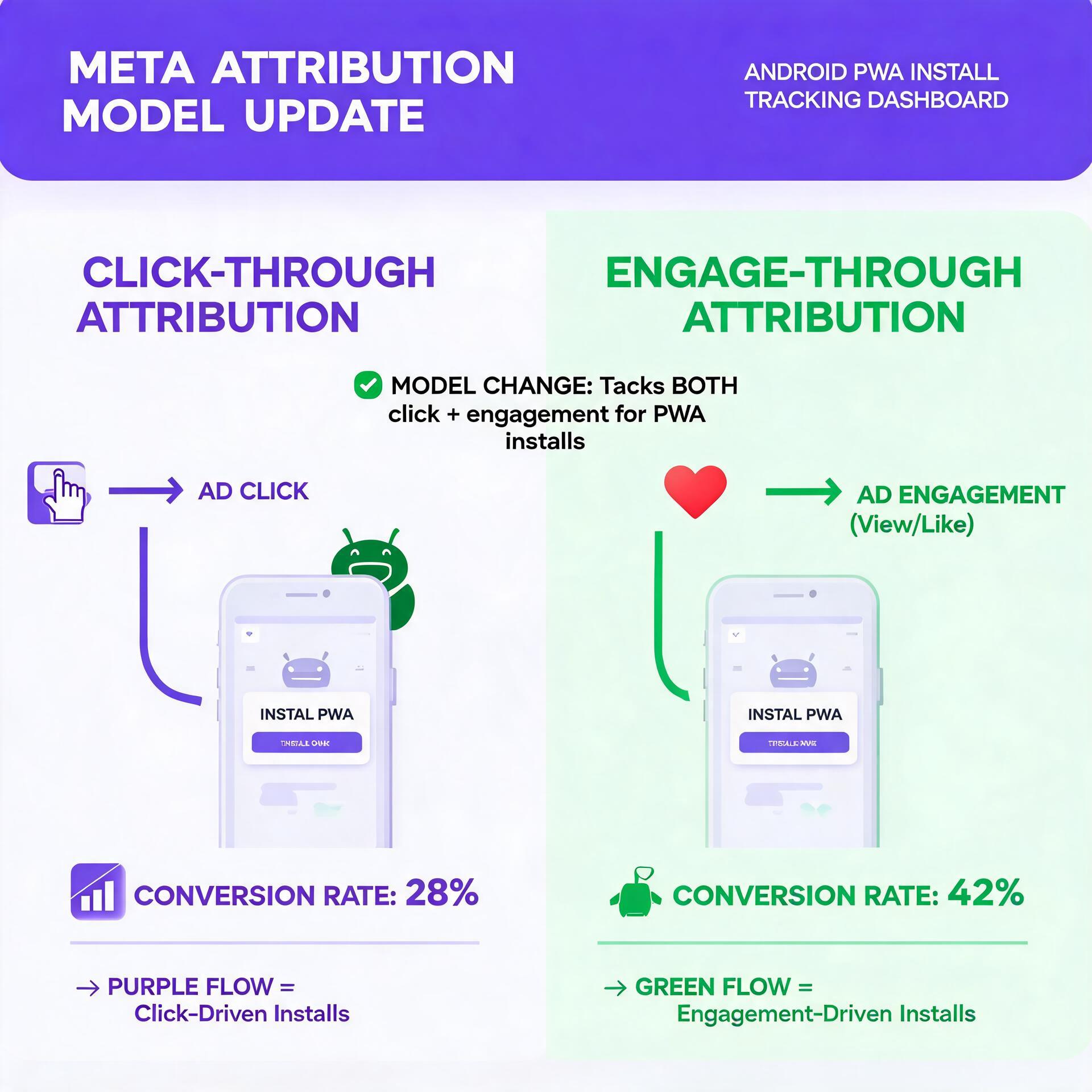
Meta has been gradually reshaping its attribution model throughout 2025 and into 2026. The core change is a shift from click-through attribution — where a conversion is credited to the last ad a user clicked — toward engage-through attribution, which credits conversions to ads a user merely engaged with, including video views, carousel swipes, and extended impressions. Meta’s stated rationale is that modern user journeys are non-linear, and a single click does not capture the full influence of an ad.
On paper, this sounds reasonable. In practice, it creates three immediate problems for Android app advertisers:
1. CPA Inflation Across Campaigns
Under the old click-through model, an install was attributed to a single ad click. Under engage-through, the same install might be attributed to multiple touchpoints. Meta’s internal data suggests that engage-through attribution captures 15–30% more conversions than click-through alone. That sounds like good news until you realize your CPA calculation now includes conversions that would previously have been unattributed — meaning your “true” cost per acquisition is higher than your dashboard suggests. Teams that set CPA targets based on click-through benchmarks are now comparing apples to oranges.
2. Cross-Campaign Cannibalization
When attribution windows widen, campaigns start claiming credit for the same conversions. A user who saw a video ad, then later clicked a retargeting ad, now generates two attribution claims. For teams running multiple campaigns across awareness, consideration, and conversion stages, this creates a measurement fog where no single campaign’s ROI is trustworthy. According to a 2026 AppsFlyer report, cross-campaign attribution overlap increased by 22% among advertisers using Meta’s updated model.
3. Delayed Reporting and Optimization Lag
Engage-through attribution requires longer lookback windows — typically 24 to 72 hours after engagement. This means your optimization signals arrive later, making real-time bid adjustments less effective. For app install campaigns where the first 24 hours of data drive budget allocation, this delay can result in significant overspend on underperforming ad sets before the data catches up.
The net effect is that Meta’s attribution change has made CPA a moving target. And for Android app teams specifically, the problem compounds when you factor in the app store layer.
Why Google Play Attribution Becomes Even Noisier
Android app install attribution has always been messier than web conversion tracking. The reason is simple: Google Play sits between your ad and your install event. When a user clicks a Meta ad, they are redirected to Google Play, where they download and install the app. The install event is then reported back through a mobile measurement partner (MMP) or Google’s own install referrer. Each handoff introduces latency, data loss, and ambiguity.
With Meta’s attribution change, this existing noise gets amplified in several ways:
The Referrer Gap
Google Play’s install referrer captures the last click that sent a user to the store. But under engage-through attribution, Meta may attribute a conversion to an engagement that happened before the click — an engagement that the Play Store referrer knows nothing about. This creates a mismatch between what Meta reports and what your MMP records. Industry data from Singular’s 2026 State of Mobile Attribution report shows that discrepancy rates between Meta-reported installs and MMP-confirmed installs increased by 18% after the attribution model change.
Organic Contamination
When attribution windows expand, more organic installs get pulled into paid attribution. A user who organically searched for your app in Google Play — but happened to see a Meta ad three days earlier — now counts as a paid conversion under engage-through rules. For teams with strong organic brand presence, this can inflate paid conversion numbers by 10–20%, making it nearly impossible to measure true incremental lift from paid campaigns. This is a problem that the broader ad measurement crisis in 2026 has made increasingly urgent to solve.
Privacy-Driven Data Loss
Android’s evolving privacy framework — including the Privacy Sandbox and the phasing out of GAID (Google Advertising ID) — means that even click-through attribution through Google Play is losing fidelity. Combine this with Meta’s shift toward modeled conversions (where Meta estimates conversions it cannot directly observe), and you have a system where a significant portion of your reported installs are educated guesses rather than observed events. According to Google’s own documentation, deterministic match rates for app installs declined from approximately 85% in 2024 to around 68% in early 2026.
The bottom line: Google Play attribution was already imperfect. Meta’s attribution change has made it materially worse. And the teams feeling this most acutely are the ones running high-volume Android app install campaigns where every percentage point of CPA accuracy translates to thousands of dollars in budget allocation.
How PWA Install Tracking Solves the Attribution Problem
The fundamental issue with Google Play attribution is the intermediary. Your ad drives a user to a store you do not control, which records an install event you cannot fully verify, which is then reconciled with an attribution model you did not design. Every link in that chain introduces noise.
Android PWA distribution eliminates the intermediary entirely. When a user installs a PWA, they do so directly from your landing page — no app store redirect, no referrer handoff, no third-party install event. You own the entire funnel from ad click to install confirmation, and every data point along the way is first-party.
Here is how this plays out in practice, using a solution like ROiBest for PWA distribution:
Step 1: Reclaim the Install Event as First-Party Data
With a PWA, the “install” happens on your domain. The user taps an install prompt on your landing page, and the PWA is added to their home screen. This install event is a first-party browser event that you capture directly — no MMP reconciliation needed, no Play Store referrer to parse. You know exactly which user installed, when they installed, and what referring source brought them there.
This matters enormously in the context of Meta’s attribution change. When Meta reports an engage-through conversion, you can cross-reference it against your own first-party install log. If Meta says a user converted after watching a video ad, you can verify whether that user actually completed an install on your site. The result is attribution you can audit, not attribution you have to trust blindly.
Step 2: Eliminate the Organic Contamination Problem
Because PWA installs happen on your owned landing page — not in a public app store — there is no “organic discovery” channel to contaminate your paid attribution. Every user who arrives at your PWA install page got there through a trackable source: a Meta ad, a direct link, an email campaign, or a referral. There is no equivalent of a user stumbling across your app while browsing Google Play and inadvertently getting counted as a paid conversion.
This single change can reduce attribution discrepancies by 15–25% for teams that previously ran Google Play campaigns, based on performance data from ROiBest clients who switched from native app distribution to PWA in Q1 2026. Teams dealing with Meta Advantage+ automation controversies find this clarity especially valuable, since Advantage+ campaigns are particularly prone to over-attributing conversions under the new engage-through model.
Step 3: Shorten the Attribution Loop
Google Play installs involve multiple steps: click ad, open Play Store, tap install, wait for download, open app. Each step adds latency and drop-off. A PWA install is a single-step action on a landing page — the user taps install and the app is on their home screen in seconds. This compressed funnel means the time between ad engagement and install event is dramatically shorter, which reduces the window for attribution ambiguity.
When Meta’s engage-through model uses a 72-hour lookback window, a shorter time-to-install means fewer competing touchpoints can claim credit. Your conversion happens minutes after the ad interaction, not hours or days later. This tighter loop gives you cleaner signal for campaign optimization and more accurate CPA calculation.
Step 4: Build a First-Party Data Moat Against Future Policy Changes
Meta’s attribution change is not a one-time event — it is part of an ongoing trend across all major ad platforms toward broader, more modeled attribution. Google is making similar moves with its conversion-first measurement strategy. Apple already reshaped the landscape with ATT and SKAdNetwork. Every year, third-party attribution gets less reliable.
By moving to PWA distribution, you are building a first-party data infrastructure that is resilient to these platform shifts. Your install events, user engagement data, and conversion metrics live on your domain, under your control. When Meta changes its attribution model again — and it will — your core measurement infrastructure remains stable. You are not rebuilding your analytics every time a platform updates its policies.
ROiBest handles the technical complexity of PWA deployment, push notification setup, and install flow optimization. Your team focuses on what matters: running campaigns against reliable data and making budget decisions based on numbers you can trust.
Real-World Impact: What the Numbers Show
The theoretical advantages of PWA install tracking are compelling, but what matters is measurable performance. Here is what Android app teams are seeing after switching from Google Play distribution to PWA via ROiBest:
- Attribution accuracy improvement: Teams report a 20–35% reduction in discrepancy between ad platform-reported conversions and internally verified installs. This means budget is allocated based on real performance, not modeled estimates.
- CPA recalibration: With cleaner install data, teams have been able to identify campaigns that were previously over-attributed by 15–25% under the old click-through model. This allows for more aggressive budget reallocation toward genuinely high-performing ad sets.
- Install conversion rate: PWA install flows — which skip the Play Store download step — show up to 1.2x higher conversion rates compared to native app install campaigns. The shorter funnel reduces drop-off at every stage.
- Time to optimization: Because PWA install events fire in real time on your domain (rather than being delayed through Play Store referrer reconciliation), campaign optimization signals arrive 2–4 hours faster. This is critical for high-spend campaigns where early data drives budget allocation.
- Revenue retention: Without Google Play’s 30% commission on in-app purchases, teams keep 100% of their app revenue. For teams spending heavily on user acquisition, this margin improvement directly offsets CPA increases caused by Meta’s attribution changes.
Summary and Action Checklist
Meta’s shift from click-through to engage-through attribution is not a minor reporting update — it is a structural change that undermines the CPA benchmarks Android app teams have relied on for years. When you combine this with the inherent noise of Google Play install attribution and the ongoing erosion of deterministic tracking through privacy changes, the result is a measurement environment where traditional app distribution puts you at a significant disadvantage.
Android PWA distribution, powered by a platform like ROiBest, solves this by giving you what every performance marketing team needs: first-party install data you control, a compressed conversion funnel that reduces attribution ambiguity, and infrastructure that does not break every time an ad platform updates its policies.
Here is your action checklist for adapting to Meta’s attribution change in 2026:
- Audit your current attribution discrepancies. Compare Meta-reported installs against your MMP data for the last 90 days. If the gap exceeds 15%, your CPA targets are likely unreliable under the new model.
- Run a PWA install test alongside your Google Play campaigns. Use ROiBest to set up a PWA install flow for one campaign. Compare attribution accuracy, install conversion rate, and CPA between the two channels over a 30-day period.
- Recalibrate CPA targets using first-party data. Once you have PWA install data, use it as your source of truth for CPA benchmarks. Adjust Meta campaign budgets based on verified installs, not platform-reported conversions.
- Set up server-side event tracking. With PWA installs happening on your domain, you can send conversion events directly to Meta’s Conversions API — bypassing browser-level tracking limitations and giving Meta cleaner optimization signals.
- Plan for the next attribution change. Build your measurement stack around first-party data now, before the next round of platform policy changes forces another scramble. PWA distribution gives you a stable foundation regardless of what Meta, Google, or Apple do next.
The teams that thrive in 2026’s attribution landscape will not be the ones who react fastest to each platform change. They will be the ones who built their measurement infrastructure on data they own. PWA distribution is how you get there.
Skip the app store. Go live instantly, keep 100% of your revenue.
ROiBest helps Android app teams launch PWAs — no review process, no 30% Google Play cut, and push notifications that work even after uninstall. Teams see up to 1.2x higher install conversion rates vs native app downloads.

发表评论