

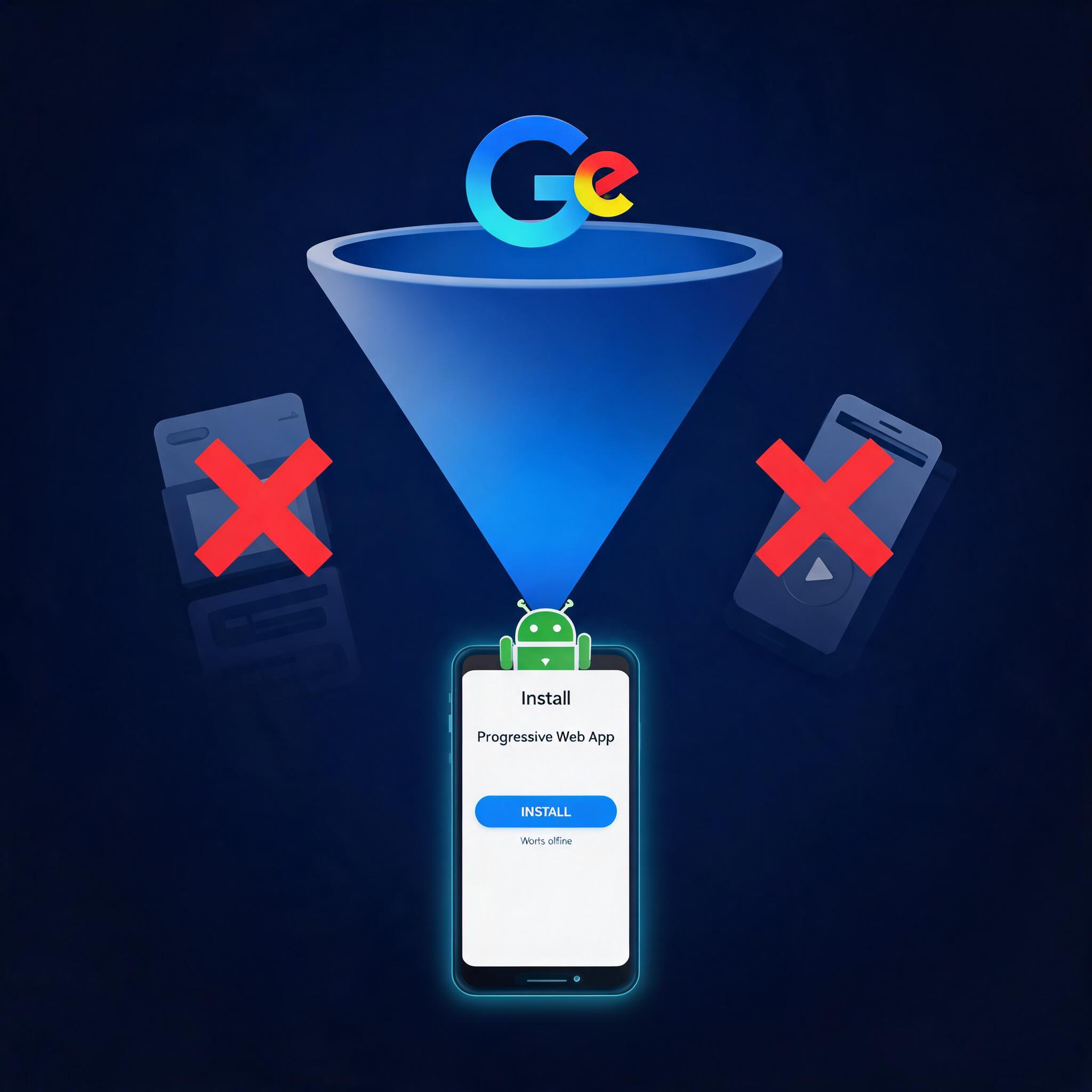
Google’s Conversion-First Pivot in 2026: The End of “Planning” and the Rise of Performance Distribution
Earlier this year, Google quietly removed the Display & Video 360 campaign-planning tools — a set of reach-and-frequency forecasting utilities that media buyers had used for years to plan brand-awareness campaigns. No fanfare, no replacement announcement. Just gone.
On its own, this looks like product housekeeping. But when you stack it against other moves Google has made over the past 18 months — the continued expansion of Performance Max, the deprecation of broad keyword match controls, the push toward Smart Bidding by default — a clearer picture emerges: Google is systematically dismantling the infrastructure built for reach and doubling down on infrastructure built for conversions.
For Android app teams distributing overseas, this is not an abstract platform debate. It is a direct signal about where Google’s system will reward you going forward — and where it won’t. If your distribution strategy still leans on impression volume, brand awareness spend, or app store rank as a proxy for success, you are working against the grain of where Google’s ecosystem is heading.
Android PWA distribution, by contrast, is structurally aligned with the conversion-first model. Here’s how to read the signal and act on it.
→ Want to bypass Google Play entirely? See how ROiBest PWA works — no submission, no cut, 1.2x installs.
What Google Just Did: Display/Video Tools Sunset

The Display & Video 360 planning tools — specifically reach planning, frequency forecasting, and brand-lift simulation — were designed for a media-buying model that prioritizes awareness over action. You define a target audience, estimate how many impressions it takes to reach them, and model the expected brand recall lift. Conversions are a secondary signal at best.
Google’s decision to sunset these tools in 2026 is a product decision that reflects a deeper strategic bet. The company has been clear about the direction: AI-driven Performance Max campaigns now handle channel selection, creative rotation, and bid optimization automatically. The premise is that manual reach-and-frequency planning becomes redundant when the system can optimize directly toward a conversion event in real time.
What’s being retired is not just a set of features — it’s a philosophy. The “plan your reach, then buy media” workflow assumes that distribution success comes from broad visibility followed by gradual conversion. Google is replacing it with a model that says: define what a conversion looks like, set your value inputs, and let the system find users who will take that action.
This shift affects every advertiser who runs Android app campaigns. But it is especially significant for teams choosing between Google Play store distribution and alternative channels like Android PWA.
The Signal: Conversion-First Means Distribution-First
When Google’s ad system optimizes for conversions above all else, the definition of “distribution success” changes. It’s no longer enough to get an app listed in the Play Store and drive traffic to it. The conversion event — the install, the first session, the first purchase — has to happen efficiently, without friction, and in a measurable way that Google’s signals can optimize around.
This creates a structural problem for traditional app store distribution. The Play Store introduces several friction points that work against conversion-first optimization:
- Multi-step install flow: Users click an ad, land on a Play Store listing, read the description, check reviews, then decide to install. Each step is a drop-off point Google’s bidding system cannot control.
- Review and approval latency: New app versions or new apps face submission queues. This slows iteration on conversion-critical elements like install flow UX or onboarding screens.
- Attribution gaps: Store-mediated installs add complexity to the conversion signal chain, especially in markets where Google Play Services coverage is inconsistent.
- 30% revenue cut: Beyond the platform tax on revenue, this affects how teams model LTV and bid ceilings — compressing the range within which Performance Max can optimize.
Android PWA distribution removes most of these friction points. When a user clicks an ad, the PWA loads directly in the browser, the install prompt appears on the first meaningful engagement, and the install event fires as a clean, first-party conversion signal. No store listing page. No review queue. No attribution gap from a third-party marketplace.
This is not a coincidence — it’s a structural match between what Google’s conversion-first system rewards and what PWA distribution delivers. For a deeper technical and strategic comparison, see our Android PWA vs Google Play complete guide.
Why Android PWA Aligns With This Shift: 3 Concrete Reasons
1. Instant Install = Cleaner Conversion Signal
Performance Max and Smart Bidding optimize on conversion signal quality as much as volume. A conversion signal that fires quickly, consistently, and without intermediary steps (like a third-party app store) is more useful to Google’s bidding algorithm than one that passes through multiple systems.
With Android PWA, the “Add to Home Screen” install event is a first-party browser event. It fires directly, passes cleanly through GA4 or your preferred MMP, and gives Google’s bidding system a clear, low-latency signal to optimize around. Teams running PWA installs through PMax campaigns consistently report that bid efficiency improves after 2–3 weeks of signal accumulation — the system “learns” the install event faster because the signal is unambiguous.
Data point: ROiBest clients running Android PWA distribution see 1.2x higher install conversion rates compared to equivalent Play Store install campaigns, largely because the PWA removes the listing-page drop-off and reduces install steps from 4–5 to 1–2.
2. Faster Iteration = Better Conversion Optimization
The conversion-first model only works if you can iterate on the conversion path quickly. If improving your app’s install flow requires submitting a new APK, waiting for review, and hoping the update clears within a week, you lose the ability to run tight optimization cycles.
Android PWA updates deploy instantly — no submission, no review queue, no version approval. If you identify that a particular landing screen or install prompt phrasing is underperforming, you can update it and see results within the same day. This is a fundamental advantage when Google’s system expects you to test and improve conversion signals continuously.
Teams using ROiBest’s PWA platform report shipping conversion-focused UI updates on a weekly cycle, compared to bi-weekly or monthly release cycles constrained by Play Store review timelines. Over a quarter, that’s the difference between 12 optimization cycles and 6 — doubling the surface area for performance improvement.
This connects directly to how advanced PMax setups work in practice. See how PMax channel type PWA install optimization can be tuned when your install surface is under your direct control.
3. No Revenue Cut = Higher Bid Ceiling = Better Auction Performance
This is the one that most teams underestimate. Google Play takes a 15–30% cut of in-app revenue. This is not just a business-model issue — it directly affects how you can bid in Google’s auction.
Your LTV-to-CAC ratio determines your maximum sustainable bid. If 30% of your LTV is going to Google Play before it reaches your P&L, your effective bid ceiling is lower. Lower bid ceilings mean you lose more auctions to competitors who have higher LTV models or better cost structures.
Android PWA distribution eliminates this cut entirely. 100% of in-app revenue stays with you. For a team with an average LTV of $30 per user, the 30% cut represents $9 in recoverable margin — which translates directly into a higher sustainable CPI bid. In competitive categories (finance apps, utilities, gaming), that $9 difference can be the gap between winning and losing the PMax auction for high-intent users.
This mechanics is explored in detail in our analysis of PMax Android PWA install conversion dynamics — including how teams model LTV recovery when switching from Play Store to PWA distribution.
Common Concerns: Is PWA Ready for This?
“Is Android PWA mature enough for production-scale distribution?”
Yes — with the right infrastructure. PWA on Android has supported push notifications, offline access, home screen installation, and app-like full-screen experience since Android 8+, which covers over 90% of active Android devices globally as of 2025. Chrome’s PWA install prompt triggers reliably on engagement signals, and Google’s own guidelines for TWA (Trusted Web Activity) packaging mean PWAs can be listed on Play Store as a fallback if needed.
The maturity question is really an infrastructure question. Teams that try to manage PWA distribution with in-house engineering often hit issues with install prompt timing, push notification opt-in flows, and analytics integration. ROiBest handles all of this as a managed service — you bring the app experience, they manage the PWA packaging, distribution infrastructure, and conversion tracking setup.
“Will users accept a web app instead of a native app?”
In most emerging markets — Southeast Asia, Latin America, South Asia, MENA — users are highly pragmatic. If an app loads fast, works offline, and doesn’t require them to navigate a store listing, they install it. The “native vs. web” distinction that matters to Western tech audiences simply doesn’t register as a concern for a user in Jakarta or Bogotá who wants a functional app on their home screen.
Retention data supports this. ROiBest clients see D7 retention rates within 5–8 percentage points of native app benchmarks when the PWA onboarding flow is well-designed. Push notification re-engagement rates are often higher for PWA users than native app users because the opt-in is earlier in the user journey and permission fatigue is lower.
“What happens after a user uninstalls?”
One of PWA’s most underappreciated advantages: push notifications continue to work even after a user removes the PWA from their home screen, as long as push permission was granted and the underlying browser remains installed (which it almost always is on Android). This gives you a re-engagement channel that native app uninstall eliminates entirely. For teams running win-back campaigns, this is a material difference in reachable audience size.
Summary: PWA Distribution Action Plan for the Conversion-First Era
Google’s removal of Display/Video planning tools is a directional signal, not an isolated product decision. The direction is: conversion-first, signal-quality-first, iteration-speed-first. Here’s how to align your Android distribution strategy accordingly:
- Audit your current conversion signal chain. Map every step between an ad click and a counted install. Identify where drop-off happens and which steps involve a third-party system (Play Store, MMP intermediaries, etc.). Score each friction point by its impact on signal latency and drop-off rate.
- Model your LTV headroom. Calculate your current LTV assuming 30% Play Store cut. Recalculate with 0% cut under PWA distribution. Determine how much additional CPI budget the recovered margin unlocks, and project the impact on auction win rate in your key markets.
- Run a PWA parallel test in one market. Pick a single market — ideally one with strong Android penetration and price-sensitive users — and run a 30-day PWA install campaign alongside your existing Play Store campaign. Use matched audience segments and identical creative. Measure install conversion rate, CPI, D7 retention, and LTV at D30. The data will be directional within the first two weeks.
- Connect push notifications to your CRM from day one. The uninstall-proof push channel is only valuable if it’s integrated with your lifecycle marketing flows. Set up the push opt-in and CRM sync during the PWA build phase, not as an afterthought. ROiBest’s platform includes this integration as a standard component.
- Plan weekly conversion iteration cycles. PWA’s deployment speed is only an advantage if you use it. Build a weekly review process for install flow performance, use A/B testing on install prompt timing and wording, and feed conversion signal improvements back into your PMax campaigns continuously.
Google has made its strategic priorities clear. The teams that win in the next 12–18 months will be those that match their distribution infrastructure to those priorities — not those that wait for the ecosystem to stabilize before adapting.
Android PWA distribution is not a workaround or a fallback. In the conversion-first era Google is building toward, it is the structurally correct choice.
Skip the app store. Go live instantly, keep 100% of your revenue.
ROiBest helps Android app teams launch PWAs — no review process, no 30% Google Play cut, and push notifications that work even after uninstall. Teams see up to 1.2x higher install conversion rates vs native app downloads.


发表评论