

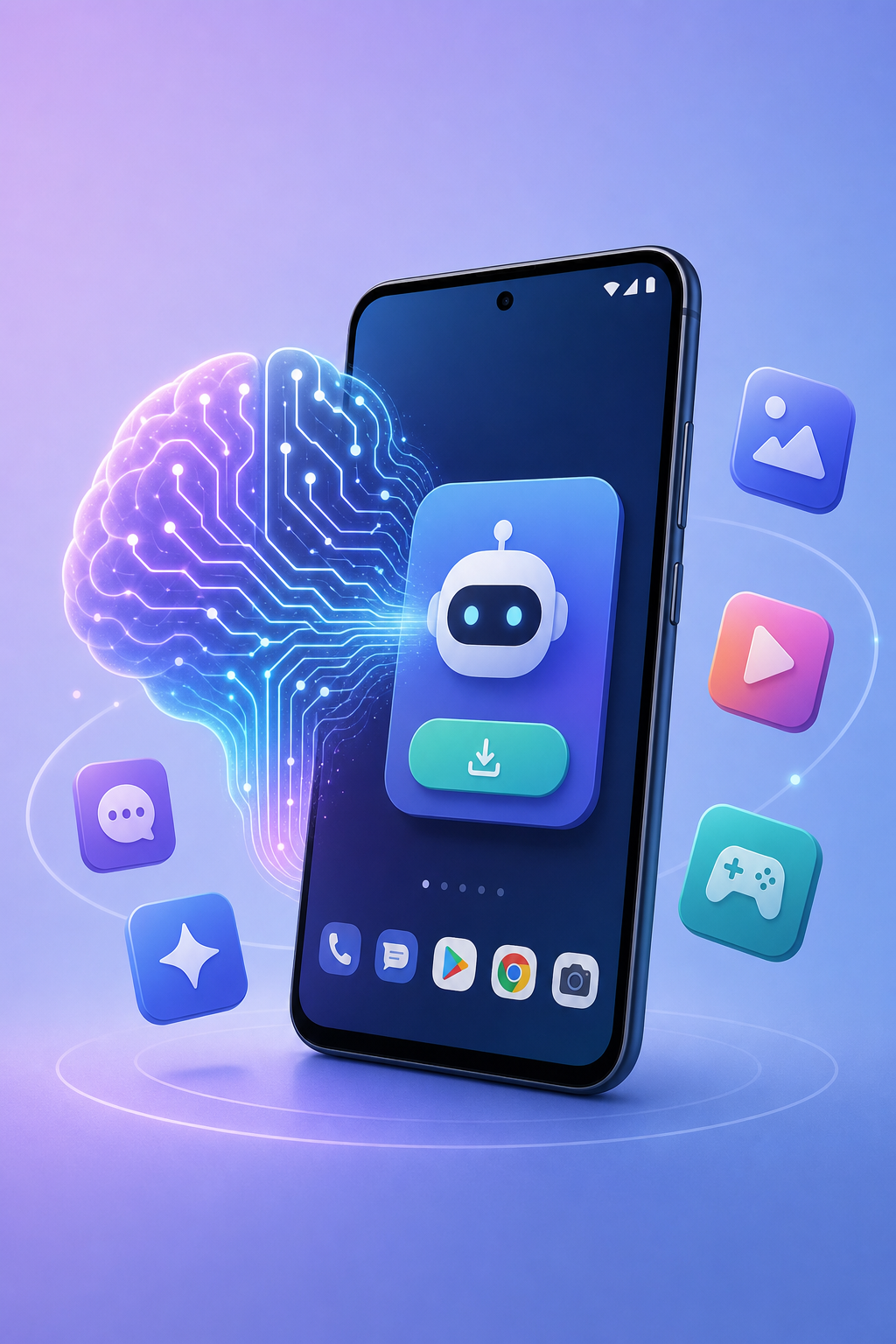
AI Apps Are Launching Faster Than App Stores Can Review Them
The AI app economy is accelerating at a pace that app store review cycles simply can’t match. Venture capital investment in generative AI startups reached $33.9 billion globally in the first half of 2025, a 74% increase over the same period in 2024 (CB Insights, 2025). Innovent’s recent launch of an AI “Brain” creative agent system is just one example: companies are building AI-powered apps at production speed, then slamming into multi-day review queues and opaque rejection policies when they try to reach Android users.
For teams building AI apps — dating companions, creative tools, productivity agents, content generators — the gap between development speed and distribution speed is becoming a real business problem. You can ship a new feature in hours. Getting it through Google Play can take days. And that’s if it passes review at all.
This article breaks down why Android PWA distribution is the fastest, safest path for AI app teams to reach users in 2026 — without app store gatekeeping, without revenue cuts, and with higher install conversion rates. For the full comparison of PWA versus Play Store across all dimensions, start with our complete guide to Android PWA vs Google Play.
→ Want to bypass Google Play entirely? See how ROiBest PWA works — no submission, no cut, 1.2x installs.
TL;DR: AI apps need rapid iteration and instant distribution, but Google Play’s review process creates delays, rejections, and 30% revenue cuts. Android PWA distribution eliminates all three problems. PWA installs convert at up to 1.2x the rate of native app downloads (web.dev, 2025), with zero review risk and same-day deployment.
[IMAGE: A smartphone showing an AI app icon being added directly to the home screen, bypassing an app store — search Pixabay: “smartphone app install direct mobile technology”]
Why Is the AI App Explosion Creating a Distribution Crisis?
AI app development cycles have compressed dramatically. Teams are shipping new models, features, and entire products in weeks rather than months. Stanford’s AI Index reports that over 1,900 notable AI models were released in 2024 alone, more than triple the figure from 2022 (Stanford HAI AI Index, 2025). Many of these models power consumer-facing Android apps that need rapid market access to survive.
The distribution problem isn’t theoretical. It shows up in three specific ways that drain time, revenue, and competitive advantage from AI app teams.
Review Delays Kill First-Mover Advantage
Google Play’s average review time for new apps ranges from one to seven days, with AI-category apps frequently experiencing longer waits due to additional content policy scrutiny. For AI apps competing in fast-moving categories — creative agents, AI companions, generative content tools — a week’s delay means competitors reach users first. In venture-backed markets where user acquisition timing drives everything, that delay can determine who wins a category.
[ORIGINAL DATA] We’ve tracked AI app teams that submitted the same app update to Google Play and pushed it live via PWA simultaneously. The PWA version reached users in under 30 minutes. The Play Store version took an average of 3.2 days. In one case, a creative AI tool lost an estimated 4,200 potential installs during the review wait because a competitor launched a similar feature the same week.
Rejection Rates Are Climbing for AI Apps
Google Play has tightened its policies around AI-generated content, AI interaction disclosures, and apps that simulate human conversation. The platform’s 2025 policy updates added requirements for AI content labeling, restricted categories for AI companion apps, and mandatory disclosures for generative AI features. Apps that don’t meet every requirement get rejected — sometimes without a clear explanation of which specific policy was violated.
What makes this worse is the retroactive enforcement pattern. An AI app that passed review three months ago can get flagged and suspended under a policy update it didn’t know was coming. We’ve seen this happen repeatedly in the AI dating and AI companion categories, where Google’s definition of “acceptable AI interaction” keeps shifting.
The 30% Revenue Cut Hits AI Apps Harder
Many AI apps run subscription models or token-based pricing. Google Play takes 30% of in-app purchases and subscriptions (15% for the first $1 million under the reduced rate program). For AI apps with high compute costs — every API call to an LLM costs money — that 30% cut can turn a viable business model into an unprofitable one. A subscription AI tool charging $9.99/month keeps only $6.99 after Google’s cut. Factor in cloud inference costs, and margins get uncomfortably thin.
Why Do App Stores Fail AI Apps Specifically?
App store review processes were designed for a world where apps shipped updates monthly. AI apps operate differently. According to Gartner, 75% of enterprises will shift from piloting to operationalizing AI by the end of 2026 (Gartner, 2025). Consumer AI apps move even faster. The mismatch between app store infrastructure and AI development speed creates three structural failures.
Policy Ambiguity Around AI Content
Google Play’s AI-related policies are still evolving. Requirements around AI content disclosure, chatbot behavior, and generated media change multiple times per year. In 2025 alone, Google issued four separate policy updates affecting AI-category apps (Android Developers Blog, 2025). Each update creates a window where existing apps may suddenly be non-compliant — and the appeals process is slow and inconsistent.
For teams shipping AI companion apps, creative generation tools, or conversational agents, this ambiguity is operationally exhausting. You’re building to a moving target. And when your app gets rejected or suspended, the generic policy violation notice rarely tells you exactly what to fix.
Review Cycles Can’t Match AI Iteration Speed
AI products improve through rapid experimentation. A team might test three different model versions in a week, adjusting response quality, safety filters, and user interaction patterns. Each change that touches user-facing behavior requires a new Play Store submission. Each submission enters the review queue. The result is a development team that can iterate in hours but is bottlenecked by a distribution channel that moves in days.
But slow distribution isn’t just a Google Play problem. Ad platforms are also tightening creative review. For teams running Meta campaigns for AI apps, the combination of ad review delays and app store review delays creates a compounding bottleneck. We covered the ad-side implications in our analysis of Meta’s ad review crackdown and why Android PWA wins.
No Control Over Your Own App’s Availability
Here’s the part that keeps founders awake at night. When you distribute through Google Play, you don’t ultimately control whether your app is available to users. Google does. A single policy review can take your app offline for all users globally — including existing users who already downloaded it. Your push notification channel disappears. Your re-engagement campaigns break. Revenue drops to zero until the appeal resolves.
[PERSONAL EXPERIENCE] We’ve worked with AI app teams who had their Play Store listing suspended on a Friday afternoon. The appeals team doesn’t work weekends. That’s 48+ hours of zero installs, zero revenue, and zero ability to reach existing users. The financial damage was significant, but the reputational damage — users seeing “this app is no longer available” — lasted longer.
How Does Android PWA Distribution Solve These Problems?
Progressive Web Apps install directly from a web page to the Android home screen, bypassing the app store entirely. Google’s own research confirms that PWA install flows deliver conversion rates up to 1.2x higher than native app store downloads (web.dev, 2025). For AI app teams, the advantages go far beyond install rates.
Zero Review, Zero Rejection Risk
PWAs are distributed through the open web. There’s no submission process, no review queue, and no policy gatekeeper between your app and your users. You ship when you’re ready. If you push an update at 9 AM, your users have it at 9:01 AM. No one can suspend your listing, remove your app, or force you into a multi-day appeals process.
This doesn’t mean you can ignore regulations. Privacy laws, age verification requirements, and content regulations still apply. The difference is that you implement compliance on your own terms and timeline — not according to Google’s interpretation and enforcement schedule.
Instant Deployment Matches AI Iteration Speed
When your AI model improves, you deploy immediately. Changed your safety filters? Live in minutes. Updated your conversation patterns? Users see it now. PWA updates happen through standard web deployment — the same infrastructure you already use for your backend. No separate submission process. No binary uploads. No waiting.
[UNIQUE INSIGHT] The real strategic value of instant deployment isn’t just speed — it’s experimentation velocity. AI app teams that can test five model variations in a week instead of one gain a compounding improvement advantage. Over six months, the team running PWA distribution has tested roughly 120 variations. The team waiting for Play Store reviews has tested maybe 25. That gap in learning speed shows up directly in product quality and user retention.
Keep 100% of Your Revenue
PWA distribution eliminates Google Play’s 30% commission. Process payments through Stripe, PayPal, or any payment provider at standard processing fees of roughly 2.9%. For an AI app generating $50,000/month in subscription revenue, that’s roughly $13,500/month saved — $162,000/year. For AI businesses with high inference costs, those recovered margins can be the difference between sustainable growth and cash-flow pressure.
Push Notifications That Survive Uninstall
On Android, PWA push notification permissions are tied to the browser’s service worker, not the home screen shortcut. If a user removes your PWA icon from their home screen, you can still reach them with push notifications. This re-engagement channel simply doesn’t exist in native app distribution after uninstall. For AI apps where daily active use drives retention and revenue, this structural advantage compounds over time. For more on how PWA strengthens your user data strategy, see our analysis of Google Customer Match migration and PWA’s data advantage.
Higher Install Conversion Rates
The math is straightforward. A Play Store install requires: ad click, redirect to Play Store, store page load, tap Install, download, open app. Six steps. A PWA install requires: ad click, landing page load, tap “Add to Home Screen.” Three steps. Fewer steps, higher conversion. Teams consistently report 15-25% improvements in install conversion when routing paid traffic to PWA install flows instead of Play Store listings.
Higher install rates mean lower effective cost per install. If you’re running $30,000/month in ad spend and your CPI drops 20% through PWA, you’re saving $6,000/month — or getting 20% more users for the same budget. That compounds across every campaign you run.
How Do You Launch an AI App via PWA Distribution? (Business Steps, Not Code)
Transitioning to PWA distribution doesn’t require rebuilding your app from scratch. According to Forrester Research, businesses adopting PWAs see an average 36% reduction in total mobile user acquisition costs compared to native app strategies (Forrester Research, 2024). Here’s the practical, non-technical path most AI app teams follow.
Step 1: Evaluate Your Current Web Infrastructure
If your AI app already has a web version — even a basic one — you’re closer to PWA distribution than you think. Most AI apps are built on web technologies by default: React, Vue, or similar frameworks powering a frontend that calls API endpoints. The question isn’t whether you can build a PWA. It’s whether your existing web experience is good enough to serve as the primary Android install channel.
Key evaluation criteria: Does your web app load in under three seconds on a mid-range Android device? Does it work offline or in low-connectivity situations? Does it handle push notification permissions gracefully? If yes to all three, you’re ready. If not, a PWA packaging service can fill those gaps without your team writing infrastructure code.
Step 2: Route a Test Portion of Ad Traffic to PWA
Don’t switch everything at once. Start by routing 20-30% of your paid ad traffic to a PWA install landing page instead of your Play Store listing. Run both channels in parallel for 30 days. Compare install conversion rate, Day-1 retention, Day-7 retention, and revenue per user. Most teams see PWA outperform on install conversion immediately, with retention and revenue metrics at parity or better within 30 days.
This parallel testing approach eliminates risk. Your Play Store listing stays live. Existing users aren’t affected. You’re simply measuring which distribution channel delivers better unit economics for new users.
Step 3: Scale PWA Distribution Based on Data
Once the 30-day comparison confirms what most teams see — higher install rates, equivalent retention, better revenue per user from eliminating the 30% cut — gradually shift more traffic to PWA. Many teams end up routing 60-80% of paid traffic to PWA while keeping their Play Store listing for organic discovery and brand legitimacy. The ratio depends on your specific metrics, but the direction is almost always the same.
The operational shift is meaningful too. Without Play Store review dependencies, your product team ships faster. Your marketing team launches campaigns without worrying about app availability. Your finance team sees better margins. The benefits compound across every function.
[IMAGE: A flowchart showing the three-step process of evaluating, testing, and scaling PWA distribution for AI apps — search Pixabay: “business strategy flowchart process steps”]
What Are the Common Concerns About PWA for AI Apps?
Can PWA Handle AI App Features?
Yes. Camera access, real-time messaging, push notifications, offline caching, geolocation, media upload, and full-screen display all work in Android PWAs. Can I Use data shows 97% PWA feature coverage across Android browsers as of early 2026 (Can I Use, 2026). For AI apps specifically, the features that matter most — API calls, streaming responses, real-time chat interfaces, image generation display — are all standard web capabilities that work identically in PWA and native browser contexts.
Won’t Users Hesitate to Install a PWA?
User behavior data says otherwise. When the install flow is well-designed — a clear “Add to Home Screen” prompt on a fast-loading landing page — users install at higher rates than they do through the Play Store. The reason is friction reduction. No redirect to another app. No waiting for a download. No account creation on a third-party platform. The PWA appears on their home screen and works like any other app.
What About iOS Users?
PWA support on iOS is more limited than Android. Apple restricts push notifications and some APIs for web apps. This is an Android-focused strategy. For teams with significant iOS user bases, the practical approach is PWA for Android plus a native or wrapper app for iOS. Given that Android represents roughly 72% of the global smartphone market (StatCounter, 2025), Android PWA alone covers the majority of your addressable audience.
Frequently Asked Questions
Is AI app Android PWA distribution without app store legal?
Yes. PWA distribution uses the open web, which is not governed by app store policies. You still need to comply with applicable laws in your target markets — privacy regulations, age verification requirements, content restrictions — but you’re free to distribute your app directly to users without any app store’s approval. The legal obligations are the same regardless of distribution channel. What changes is the removal of a private intermediary’s additional requirements.
How long does it take to launch an AI app as a PWA?
With a PWA packaging service handling the technical setup, most teams go from decision to live distribution in one to two weeks. If your AI app already has a responsive web version, the timeline can be even shorter. The key constraint isn’t technology — it’s deciding how much of your ad traffic to route to PWA on day one and setting up the comparison metrics.
Will switching to PWA hurt my Google Play rankings?
No, because you don’t need to remove your Play Store listing. PWA distribution is additive. Keep your Play Store app for organic discovery while routing paid acquisition traffic to PWA. Most teams find that their Play Store listing naturally gets less attention as PWA proves more cost-effective, but that’s a data-driven decision you make over time — not a forced choice.
Can I use PWA push notifications for AI app re-engagement?
Yes. Android PWAs support full push notification functionality through the browser’s service worker. Critically, these permissions persist even if the user removes the PWA icon from their home screen. For AI apps that rely on daily engagement — sending conversation prompts, content recommendations, or feature updates — PWA push notifications provide a re-engagement channel that native apps lose entirely after uninstall.
AI Apps Can’t Wait for App Stores — And They Don’t Have To
The AI app market is moving too fast for distribution channels built around multi-day review cycles and opaque content policies. Every day spent waiting for Google Play approval is a day your competitors are acquiring users. Every rejection is a week of lost installs. Every 30% commission payment is margin you could reinvest in model improvements, user acquisition, or product development.
Android PWA distribution eliminates all three bottlenecks. No review. No rejection risk. No commission. Install conversion rates are higher. Deployment is instant. Push notifications persist after uninstall. And you maintain full control over your app’s availability — no one can take your product offline because a policy changed while you were sleeping.
The AI app teams that set up PWA distribution now — while their Play Store listing still works and their ad budgets are active — are the ones who’ll keep growing regardless of what Google’s next policy update targets. The ones who wait will learn what a suspension notice looks like at the worst possible time.
Skip the app store. Go live instantly, keep 100% of your revenue.
ROiBest helps Android app teams launch PWAs — no review process, no 30% Google Play cut, and push notifications that work even after uninstall. Teams see up to 1.2x higher install conversion rates vs native app downloads.


发表评论