

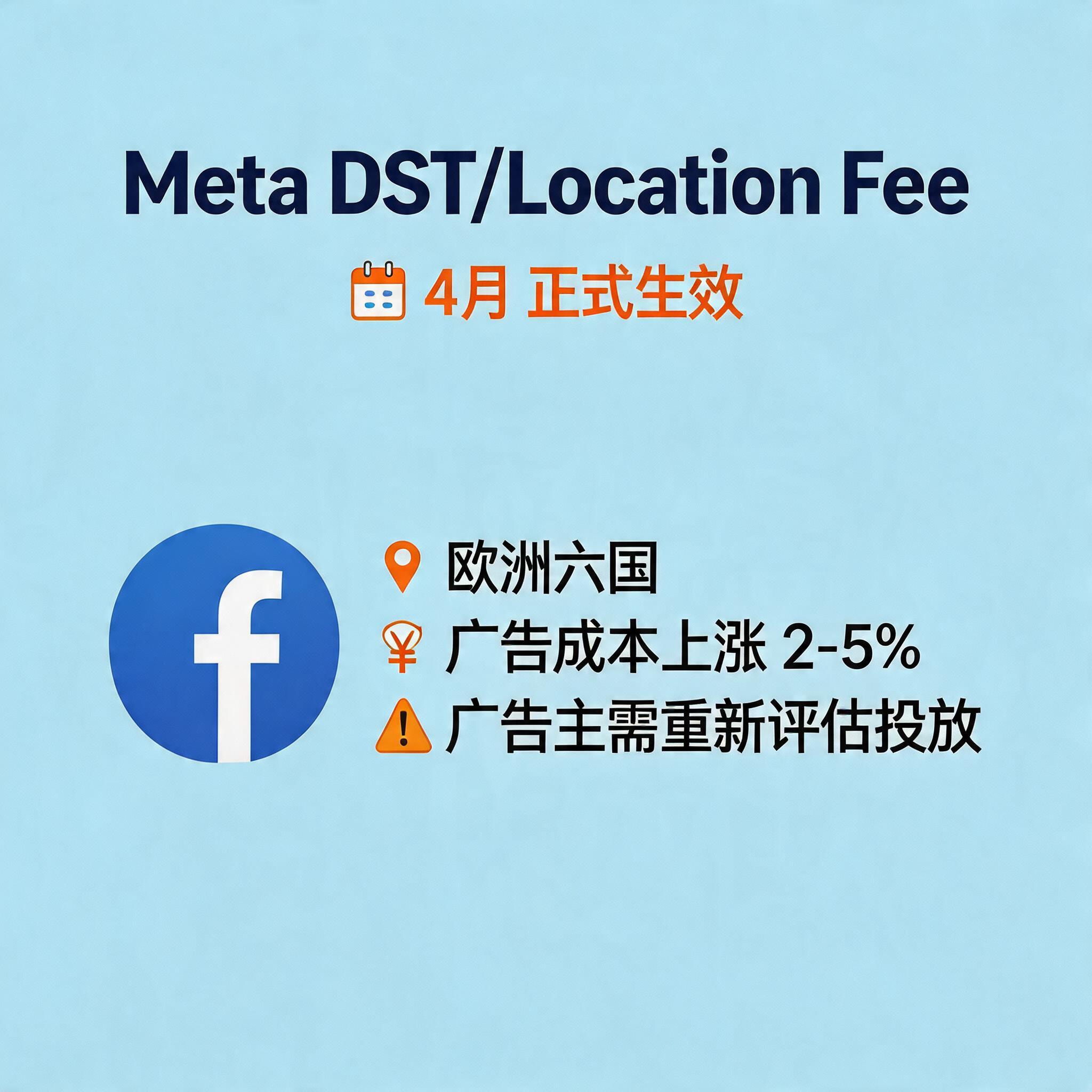
Starting April 2026, Meta’s Digital Services Tax (DST) and Location-Based Fee surcharges are now fully enforced across six European markets — France, Spain, Italy, Austria, Turkey, and the UK. Advertisers targeting these countries will see an automatic 2–5% surcharge added to every ad dollar spent on Facebook and Instagram. For performance marketers running app install campaigns, this fee directly erodes already-tight margins. The question is no longer whether costs are rising, but how you recalculate ROI and where you redirect budget to stay profitable.
→ See how ROiBest PWA works — no submission, no cut, 1.2x installs.
What Is Meta’s DST/Location Fee and Why It Matters Now
Meta introduced DST surcharges to offset Digital Services Taxes imposed by individual European governments. These taxes target large tech platforms’ advertising revenue. Rather than absorbing the cost, Meta passes it directly to advertisers as a line-item fee on invoices.
Here is the current surcharge breakdown by country:
- France: 3% surcharge
- Spain: 3% surcharge
- Italy: 3% surcharge
- Austria: 5% surcharge
- Turkey: 5% surcharge
- United Kingdom: 2% surcharge
For an advertiser spending $100,000/month on Meta campaigns across these markets, the added cost ranges from $2,000 to $5,000 monthly — or $24,000 to $60,000 annually. This is pure cost inflation with zero additional reach or impressions in return.
How the Fee Impacts App Install Campaign ROI

App install advertisers are hit hardest because their funnel economics are already under pressure. Consider a typical scenario: if your cost per install (CPI) was $2.50 before the surcharge, a 3% DST fee pushes it to $2.58. At scale — say 50,000 installs per month — that is an extra $3,750 in monthly spend for identical results.
The compounding problem is that these fees stack on top of other rising costs. Meta’s average CPM in Western Europe increased 12% year-over-year in Q1 2026 according to industry benchmarks. Combined with DST surcharges, some advertisers report effective CPI increases of 15–18% compared to the same period last year.
This makes ROI recalculation not optional but urgent. Campaigns that were marginally profitable six months ago may now be underwater.
5 Actionable Steps to Protect Your Ad Budget
Step 1: Audit your geo-targeting and reallocate spend. Pull your Meta Ads Manager reports filtered by country. Identify which of the six surcharge markets deliver the lowest ROAS. Shift 10–20% of that budget to non-surcharge EU markets like Germany, Netherlands, or Poland where DST fees do not apply. Data from Q1 2026 shows that German CPIs remain 8–14% lower than French equivalents for comparable app verticals.
Step 2: Diversify beyond Meta with multi-channel distribution. Relying solely on Meta for European installs is increasingly expensive. Platforms like Google Ads, TikTok, and direct PWA distribution channels offer alternative paths. A multi-channel distribution strategy reduces dependency on any single platform and its fee structure. Advertisers using three or more channels report 22% lower blended CPI compared to Meta-only strategies.
Step 3: Recalculate break-even CPI with surcharges included. Update your financial models to include DST fees as a fixed cost layer. Your new break-even formula should be: Target CPI = (LTV × Target ROAS) / (1 + DST surcharge rate). For a product with $8 LTV and 150% target ROAS in France, your maximum CPI drops from $5.33 to $5.17 after accounting for the 3% fee.
Step 4: Leverage AI-powered campaign optimization. Google’s AI Max campaigns and Meta’s Advantage+ use machine learning to find lower-cost conversion paths automatically. Early adopters of AI Max report 10–15% CPI reductions by letting algorithms optimize creative and placement combinations across inventory sources.
Step 5: Shift to PWA-based install funnels. Progressive Web Apps eliminate app store commissions (up to 30%) and reduce install friction — users tap once instead of navigating a store listing. When combined with Performance Max channel optimization, PWA funnels convert at 1.2x the rate of traditional store-linked campaigns, effectively offsetting the DST cost increase.
Compliance Considerations for European Campaigns
As you restructure campaigns for these markets, ensure your ad creatives and landing pages comply with evolving European regulations. AI-generated content now requires explicit labeling in several jurisdictions. Review the latest AI content labeling compliance guidelines to avoid ad disapprovals or account restrictions that would compound your cost problems.
Additionally, track Meta’s policy updates closely. The company has indicated that surcharge rates may adjust quarterly based on changes in national tax legislation. Building flexible budget models now will save significant rework later.
The Bottom Line: Adapt or Overpay
Meta’s DST/Location Fee is not a temporary inconvenience — it is a structural cost increase that will persist and likely expand to additional markets. Advertisers who treat it as a rounding error will slowly bleed margin. Those who recalculate ROI thresholds, diversify channels, and adopt lower-friction install methods like PWAs will maintain or even improve profitability despite the fee.
The math is straightforward: a 3–5% surcharge on a $500,000 annual Meta budget costs $15,000–$25,000. Redirecting even a fraction of that to higher-converting, fee-free channels pays for itself within the first quarter.
Skip the app store. Keep 100% revenue.


发表评论