


In 2026, AI-generated content is everywhere in mobile apps and games — and regulators plus ad platforms are watching closely. If you’re shipping a PWA app or game to Android users, understanding AI content labeling compliance isn’t optional. It’s a business risk management decision.
Whether you’re running a casual game, an AI companion app, or a social platform, chances are your promotional assets, in-app text, or generated visuals involve some level of AI automation. Meta, Google, and TikTok have all rolled out explicit AI disclosure requirements for ads and app content. The EU and US are building legal frameworks that will make non-disclosure not just a policy violation — but a legal liability.
This guide breaks down what each platform requires, which PWA apps are in scope, what the real risks are, and what practical steps you should take right now.
→ Want to bypass Google Play entirely and launch your PWA without app store AI content policies?
Platform-by-Platform AI Content Disclosure Requirements

Meta (Facebook + Instagram)
Meta updated their AI-generated content policies in 2024 and began enforcement in 2025. Their current requirements:
- Advertisers must disclose when AI or digitally generated content is used in ads — including AI-edited images, synthetic videos, and AI-written ad copy
- Applies to all Meta ad formats across Facebook, Instagram, and Audience Network
- Non-disclosure can result in ad disapproval, account restrictions, or repeat-offender bans
- Meta uses a combination of automated detection and human review
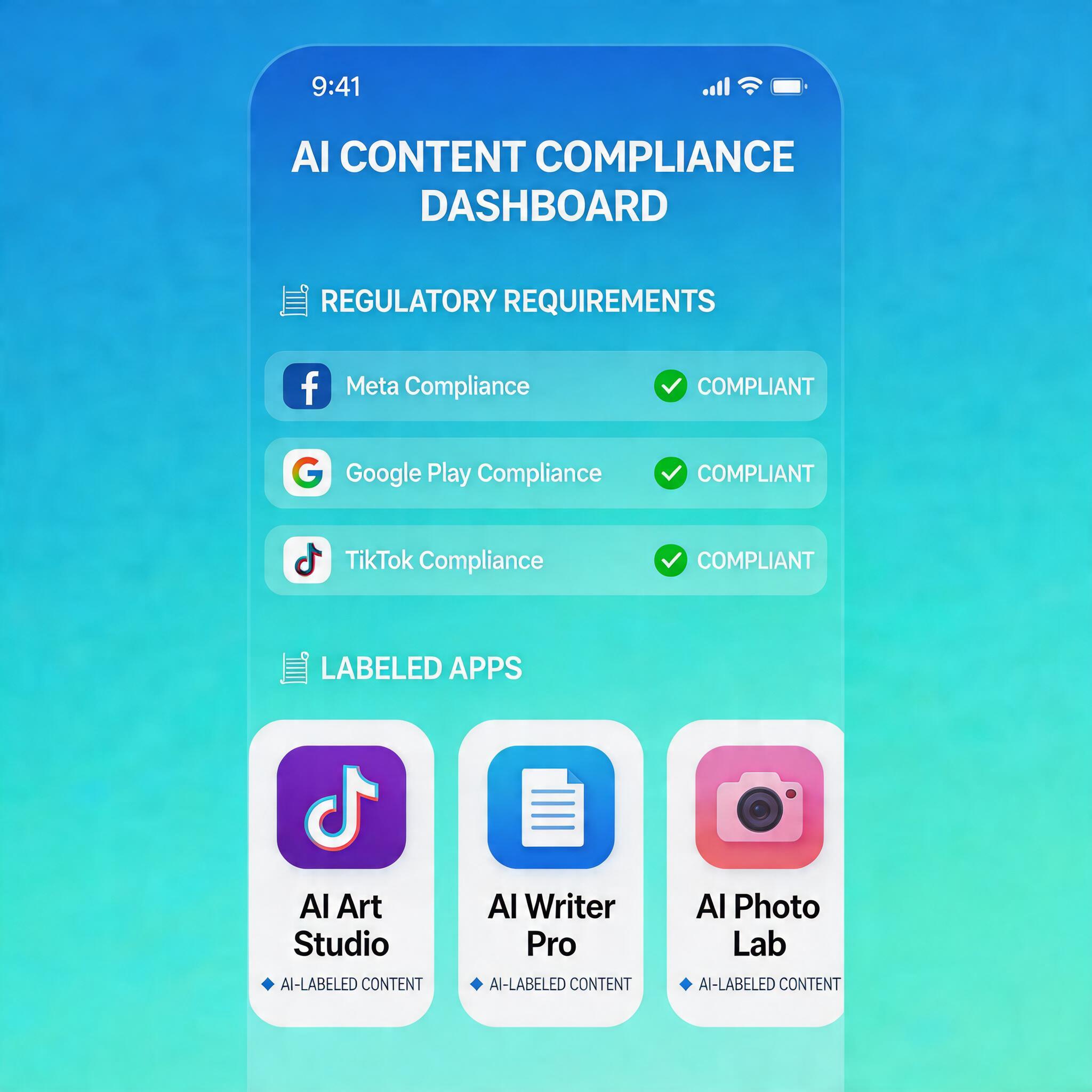
PWA relevance: If you’re running Meta ads to drive installs of your PWA game or app, your ad creatives — images, videos, copy — need AI disclosure labels if any AI generation was involved. This is separate from Google Play’s policies and applies regardless of where your app is distributed.
Google’s AI content disclosure requirements split into two areas:
- Google Ads: AI-generated or AI-enhanced content in ads must be disclosed. Google flags non-compliant ads and requires corrective action before reinstating spend.
- Google Play (for native apps): Google Play’s AI-generated content policy requires developers to disclose AI-generated content in app listings and in-app experiences. Apps that fail to comply can be removed from the Play Store.
PWA relevance: For PWA apps distributed outside Google Play, Google’s Play Store AI policies technically don’t apply directly. However, if you’re running Google Ads (UAC/PMAX) to promote your PWA, Google’s ad content policies apply to your creatives. This creates a two-track compliance situation: your PWA landing pages and ad campaigns need to meet Google’s ad standards, but your PWA itself isn’t subject to Play Store review.
This is actually one of the underappreciated advantages of PWA distribution — you’re not bound by Google Play’s AI content policies for the app itself. But it also means the compliance responsibility lands squarely on you, with no store-level enforcement guardrails.
TikTok
TikTok’s AI disclosure rules:
- TikTok requires creators and advertisers to label content that is fully AI-generated or significantly AI-modified
- Applies to organic content, branded content, and paid ads
- TikTok’s policy explicitly covers AI-generated video, AI dubbing, and AI-voiced content
- FTC has also signaled heightened scrutiny of AI-generated content in influencer and creator ads on the platform
PWA relevance: If your PWA game or app is being promoted via TikTok ads or through creator partnerships, AI-generated trailers, gameplay clips with AI voiceovers, or AI-created promotional images all need disclosure. TikTok has been actively removing unlabeled AI content and penalizing accounts that repeatedly fail to comply.
Emerging Platforms and Channels
Don’t sleep on the long tail. Other channels where AI disclosure may already be required or incoming:
- Unity Ads / ironSource: Acquired by Google — now adopting similar AI content disclosure norms
- AppLovin: AI-generated ad content disclosure increasingly enforced
- Reddit Ads: Automated detection of AI-generated images in ad creatives
- YouTube: AI-generated or synthetic content in monetized videos must be disclosed via the enhanced content certification process
Regulatory Landscape: EU AI Act, US FTC, and What Teams Need to Know
United States: FTC Guidance and the AI Labeling Standard
As of early 2026, the US does not have a comprehensive federal AI law. However:
- The FTC has issued guidance on AI-generated content disclosure in advertising, treating undisclosed AI content that misleads consumers as a deceptive practice under Section 5
- The FTC has settled cases against companies using undisclosed AI-generated testimonials or reviews
- The TINA Act (informally) has increased scrutiny of AI-generated claims in commercial contexts
- State-level activity: California, Colorado, and Illinois have introduced AI-specific legislation with disclosure requirements
For PWA app teams, this means: if your AI-generated content in ads or app descriptions could be seen as misleading — for example, AI-generated reviews, AI-composed testimonials, or AI-fabricated performance claims — the FTC’s deceptive practices framework could apply.
European Union: AI Act and Digital Services Act
The EU has moved faster than the US on AI regulation:
- The EU AI Act (in force 2024, phased implementation through 2027) establishes a risk-based framework. While it doesn’t mandate universal AI content labeling, it does require transparency for AI systems that interact with users
- The Digital Services Act (DSA) requires platforms to label AI-generated content and fight disinformation — this affects how platforms like Google and Meta handle AI disclosure on their services
- The AI Act’s transparency requirement for general-purpose AI models (including generative AI) may indirectly affect how AI-generated content in apps is treated
PWA relevance: If your PWA app or game is targeting EU users, you may face dual disclosure obligations: one from the platforms you advertise on (Meta, Google, TikTok — all of which comply with DSA), and one from the EU AI Act if your app uses AI systems in ways that fall within scope. The good news: PWA distribution through web channels gives you more control over your disclosure architecture than a typical app store submission.
China and APAC
China’s Generative AI Regulations (effective 2023) require:
- Disclosure of AI-generated content to users
- Content that simulates real persons (deepfakes) requires special labeling
- Applies to apps and services operating in China
If your PWA targets China-based users or Chinese diaspora markets, you need a China-specific AI disclosure approach. Other APAC markets are in various stages of AI regulation — Japan, South Korea, and Singapore all have active consultation processes underway.
Brand Risk Analysis: What Actually Happens When You Don’t Disclose
Let’s be direct about the business risks, because “compliance” language undersells the actual exposure.
Ad Account Suspension — The Immediate Kill Switch
This is the most immediate financial risk. Platforms don’t wait for a legal ruling. If your AI-generated ad content is detected and not disclosed:
- Meta: Ad disapproval, appeal, second review, account restriction for repeat violations. Three material violations in 90 days can trigger a permanent advertising account ban.
- Google: Ads paused pending corrective disclosure. UAC campaigns with unresolved policy violations get spending limits applied.
- TikTok: Content removed, creator account strikes (three strikes = ban).
For a game studio or app team running live campaigns, an ad account ban mid-campaign is catastrophic. You’ve lost the channel, your campaign data, and you’re facing a recovery process that takes weeks.
Regulatory Fines — Real and Growing
The FTC has issued fines in the tens of millions for AI disclosure failures in broader contexts. EU regulators under the AI Act can issue fines of up to 30 million euros or 6% of global annual turnover — whichever is higher. For mid-size game studios and app teams, these numbers are existential.
Brand Reputation — The Invisible Damage
Getting flagged for undisclosed AI content is a story that surfaces on industry forums, Reddit, and Twitter/X. For AI social apps especially — where authenticity and trust are core product values — being exposed for undisclosed AI-generated content in your marketing is a brand crisis that no PR team can fully contain.
The PWA Specific Risk Factor
Here’s something many teams overlook: your PWA is distributed through your own web domain. That means there’s no app store intermediary doing a policy review before your app reaches users. You own the entire compliance chain — from the app itself to every promotional channel. This is empowering, but it also means there’s no “the store approved it” safety net when regulators or platforms come asking questions.
Understanding how PWA distribution changes your risk profile is critical. Our full guide to PWA as a Google Play alternative covers the compliance and control implications in detail.
Practical Compliance Checklist for PWA Apps and Games
Here’s what you should actually do. Not theory — action items.
Step 1: Run an AI Content Audit on Your Entire Stack
Before you can comply, you need to know what you’re dealing with. Map every piece of content in your app and marketing that involves AI generation:
- Game assets: character designs, textures, environments, music
- In-app text: descriptions, dialogue, chatbot content
- Marketing: ad images, video trailers, social posts, app store listing copy
- Landing pages: headline copy, feature descriptions, testimonials
- User-generated content (if applicable): how is AI moderation or generation involved?
Document each asset with: content type, AI tool used, degree of AI involvement (fully generated vs. AI-assisted editing), and where it’s displayed or distributed.
Step 2: Map Requirements by Platform and Region
AI disclosure isn’t uniform. Create a requirements matrix:
- Meta ads: AI disclosure in ad creative required if any AI involvement
- Google Ads (UAC/PMAX): AI disclosure in ad content required
- TikTok ads: AI-generated or AI-modified video/audio/image content must be labeled
- EU users: DSA plus AI Act transparency considerations
- China users: Generative AI Regulations compliance
- Your PWA landing pages: FTC guidance on deceptive practices (US), DSA-adjacent transparency expectations (EU)
Step 3: Build Disclosure Into Your Creative Workflow
Compliance can’t be an afterthought. Insert disclosure review into your creative production pipeline:
- At brief stage: does this creative involve AI-generated content?
- At production stage: document AI tool and degree of involvement
- At submission stage: platform-specific disclosure label applied
- At post-launch: monitor for platform policy changes
Step 4: Add AI Labels to Your PWA Content
For content in your PWA itself:
- In-app AI-generated content should have a visible disclosure (e.g., “This image was AI-generated” in the UI, or a settings toggle)
- AI chatbot or AI companion features should have clear “AI-generated response” disclosure
- AI-composed music should be labeled as such in the app
Step 5: Monitor Platform Policy Updates
AI disclosure policies are evolving fast. Set up a quarterly review of:
- Meta’s Advertising Policies updates
- Google Ads AI-generated content policy changes
- TikTok’s Brand Partnership and Content policies
- EU AI Act implementation milestones
- FTC guidance updates
How ROiBest Helps You Manage PWA Compliance
ROiBest is not a technical implementation studio. We are a PWA packaging and distribution service — we handle the web wrapping, the install flow, the push notification infrastructure, and the ongoing distribution so your team can focus on content, compliance, and growth.
When it comes to AI labeling compliance, here’s where ROiBest fits into your workflow:
- Fast iteration without app store constraints: If your AI disclosure approach needs to change because a platform updated its policy, you can update your PWA landing page and app content without going through a Google Play review cycle. Speed matters when platform enforcement is active.
- Multi-channel distribution: Our PWA distribution framework is built for teams running across multiple ad networks and promotional channels, each with their own AI disclosure requirements.
- Compliance-aware architecture: We help you design your PWA’s content disclosure architecture so it’s structured for compliance across jurisdictions, not just for one platform or one region.
- Expert guidance: Our team has worked with hundreds of game studios and AI app teams on exactly these questions. When a platform updates its AI content policy, we help our clients understand what it means for their specific setup.
The PWA distribution model gives you something app stores cannot: the ability to update your disclosure practices and your app simultaneously, without review delays. In a regulatory environment that is moving this fast, that agility is itself a compliance advantage.
Conclusion: AI Disclosure Is Now a Cost of Doing Business
Ignore AI content labeling compliance at your peril. The platforms have made their requirements clear. Regulators are building legal frameworks that will make today’s policy violations tomorrow’s legal liability.
The good news for PWA teams: you have more control over your distribution and content than teams locked into app store submission cycles. Use that control proactively. Run the audit, build the disclosure workflow, monitor the platforms, and work with a PWA distribution partner who understands the compliance landscape.


发表评论