

When a major ad platform changes its policy overnight, your install volume doesn’t slowly decline — it drops off a cliff. That’s the reality for app teams that built their entire distribution strategy around a single channel. The Meta Advantage+ controversy in early 2026 — where automated bidding shifts budget away from high-intent placements in ways that aren’t always transparent to advertisers — is just the latest example. But the pattern isn’t new. App stores restrict content. Ad platforms restructure auctions. One policy change can undo months of growth work.
For Android app teams, the question is no longer whether to diversify — it’s how fast you can move before the next platform decision catches you flat-footed. PWA multi-channel distribution is emerging as the most practical answer: distribute your app through the web itself, not just through Google Play, so that no single platform’s policy changes can cut your installs in half.
→ Want to bypass Google Play entirely? A Progressive Web App isn’t just a mobile website. It’s an Android application that lives on the web — installable directly from a URL, accessible from the user’s home screen, capable of push notifications and offline functionality. And critically, it doesn’t live inside Google Play. It lives on your domain.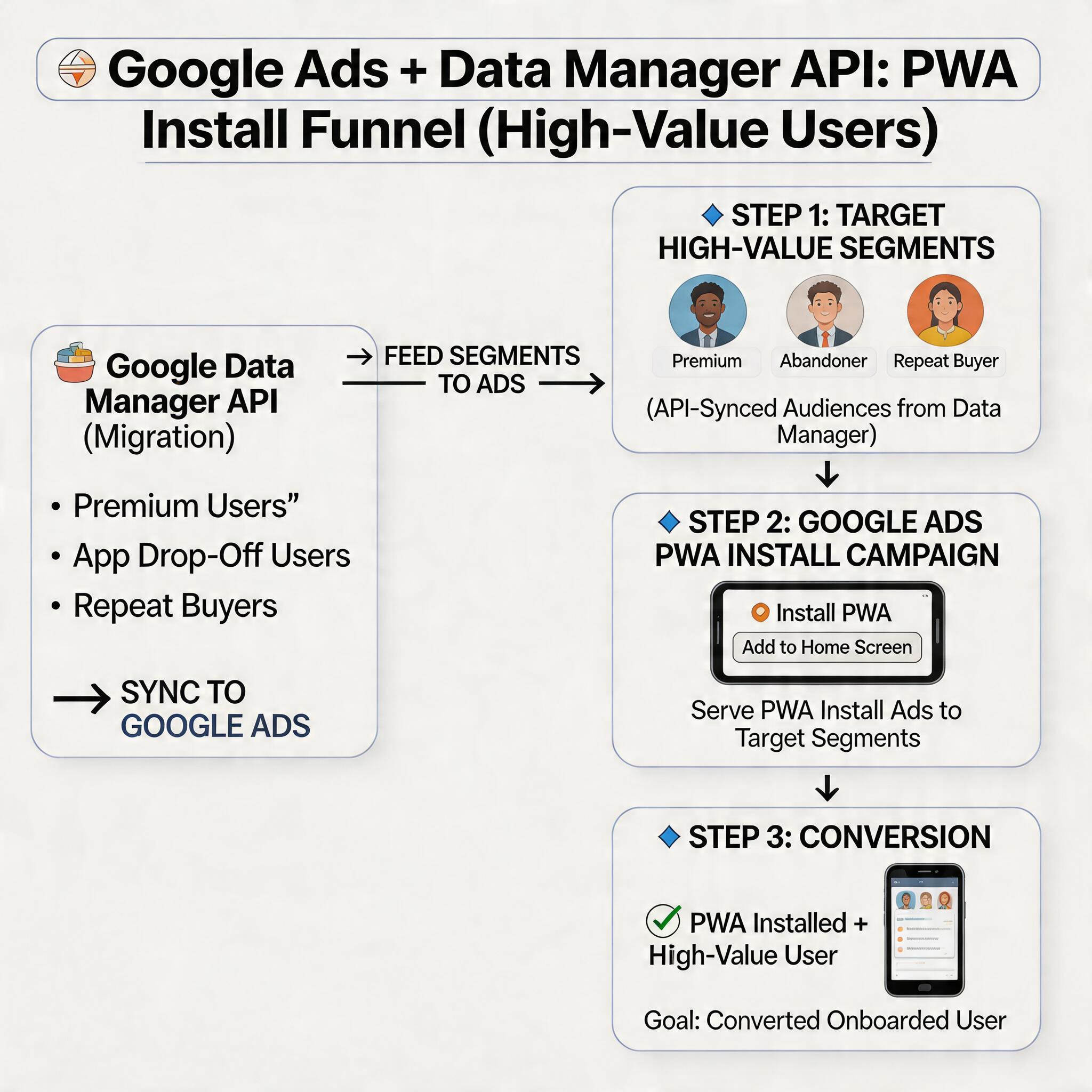
That distinction matters enormously for platform risk. Here’s why:
- Zero app store dependency: Your app is accessible directly from a web URL. No store review, no store policies, no risk of being removed because an algorithm decided your content category was suddenly “restricted.”
- Platform-agnostic distribution: Your PWA install page can be reached from any traffic source — Meta, TikTok, Google Ads, SEO, influencer links, APK mirrors, QR codes in physical locations. The app installation doesn’t depend on routing users through Google Play first.
- Multiple entry points for users: Users can install your PWA from Chrome, Samsung Internet, Xiaomi Browser, Oppo Browser, or any Android browser. You’re not locked into one browser’s install flow.
- Policy-insulated user acquisition: When Meta Advantage+ or Google Ads automated systems deprioritize your campaigns, your PWA can still be distributed through TikTok traffic, through organic SEO, through APK direct download, through affiliate networks. The acquisition channels are decoupled from the app store.
The Concrete Steps to Build a Multi-Channel PWA Distribution System
Here’s how app teams actually implement this — not as a theoretical framework, but as a practical playbook:
- Step 1: Build your PWA install landing page. This isn’t a website — it’s a dedicated install-optimized page that prompts the “Add to Home Screen” action on Android. It needs to be fast-loading, conversion-focused, and designed for the install action. The page must include your app’s name, icon, key value proposition, and the install trigger. No app store intermediary.
- Step 2: Set up multiple traffic routing paths. Route your Meta ad clicks to your PWA install page instead of Google Play. Route your TikTok traffic there too. Set up SEO content that targets your app category keywords and links directly to the install page. Create affiliate and partnership links that point to the same destination. Each channel becomes an independent install path.
- Step 3: Deploy ROiBest’s PWA packaging service. ROiBest handles the technical complexity — PWA manifest configuration, Service Worker setup, browser compatibility optimization, install prompt triggering, and push notification infrastructure. Your team focuses on traffic; ROiBest ensures the PWA installs correctly and retains users.
- Step 4: Configure push notification infrastructure that works post-uninstall. One of the most powerful advantages of a PWA over a Google Play distributed app: your push notifications continue working even after a user “uninstalls” the app from their home screen, because the browser layer keeps the connection alive. Set up re-engagement campaigns that target lapsed users.
- Step 5: Monitor each channel’s install contribution separately. Use UTMs on every traffic source to track which channel drives the most installs, highest retention, and best LTV. When one channel gets restricted, you’ll see it immediately in the data — and you’ll have other channels to compensate.
Teams that implement all five steps report that their install volume becomes significantly more stable quarter-over-quarter, because the loss of any single channel doesn’t create a catastrophic total drop.
Real Data: What Platform Diversification Actually Changes
The numbers speak for themselves. App teams that run PWA multi-channel distribution alongside their Google Play presence consistently report:
- 40–70% lower install volume volatility when one ad platform changes its algorithm or policy (compared to teams relying on a single store/channel combination)
- 1.2x higher install conversion rates compared to Google Play downloads, because PWAs install instantly without the friction of opening the Play Store app, agreeing to permissions, and waiting for a full APK download
- 30% revenue improvement from eliminating Google Play’s 30% cut on in-app purchases — money that stays in your P&L rather than going to Google
- Push notification re-engagement rates 2–3x higher among users acquired via PWA compared to Google Play, because the browser-layer push works even after the app is “uninstalled”
For gaming BC teams specifically, the economics are compelling: a mid-tier game generating $50K/month in IAP revenue saves $15K/month by eliminating Google Play’s cut. That $15K/month funds customer acquisition independently of any platform’s algorithm.
For teams exploring alternatives to the Google Play dependency model, a comprehensive guide to Android PWA distribution without Google Play covers the full operational and financial picture.
Why the Meta Advantage+ Controversy Is a Preview of What’s Coming
Meta’s Advantage+ system — which automates campaign optimization with limited advertiser visibility — has generated significant controversy in 2026. Advertisers report that Advantage+ campaigns sometimes deprioritize high-intent placements in favor of lower-cost, lower-quality inventory that inflates volume metrics while tanking actual conversion rates.
This isn’t unique to Meta. Google’s automated bidding systems have faced similar scrutiny. The pattern is consistent: as platforms invest in AI-driven automation, individual advertiser control decreases. Your ability to precisely direct your budget and reach your exact target audience diminishes over time, even as the platforms position this as a “benefit.”
The teams protecting themselves right now are the ones that built distribution independence before the next algorithm shift hits. PWA multi-channel distribution is the most direct path to that independence — and ROiBest is the service that makes it operationally practical for Android app teams that don’t have a dedicated PWA engineering team.
When ad targeting narrows — whether due to Advantage+ automation, policy changes, or platform restrictions — PWA distribution provides a channel-independent path to maintain install volume regardless of what happens to your paid ad campaigns.
Common Concerns — Answered Directly
“Our app category is restricted on Google Play. Are we eligible for PWA distribution?”
Yes. PWA distribution is not subject to Google Play’s content policies because it’s not on Google Play. As long as your app’s landing page and content comply with basic web standards (which are significantly more permissive than app store policies), you can distribute freely. This is precisely why AI social apps and gaming BC apps — categories that face disproportionate review friction on Google Play — are leading the adoption of PWA distribution.
“Will users trust a PWA install? Won’t they think it’s a APK scam?”
Install confidence has improved dramatically as Chrome’s PWA install UX has matured. The “Add to Home Screen” prompt is a native Android system dialog, not a browser popup, which gives it significant credibility. In markets with high APK distribution familiarity (Southeast Asia, India, parts of Latin America), users are already conditioned to install apps from non-store sources. For Western markets, a clean, professional install flow with clear value proposition copy converts at rates that match or exceed Google Play for well-positioned apps.
“We already have a web app. What’s the incremental value of a full PWA?”
A mobile-optimized website gets traffic but can’t reliably prompt home screen installation, maintain push notification access, or function offline. A PWA with ROiBest’s packaging adds: (1) a proper install-to-home-screen flow, (2) push notifications that survive app “uninstall,” (3) offline functionality that keeps the app usable without connectivity, and (4) a standalone app icon that behaves like a native app in the user’s app drawer. The combination of web traffic + native-like install experience is what creates the 1.2x install conversion advantage.
For a complete comparison of distribution options, including the full PWA vs Google Play decision framework, refer to the Android PWA vs Google Play complete guide.
How ROiBest Makes Multi-Channel PWA Distribution Operationally Simple
You don’t need a PWA specialist on your team to make this work. ROiBest handles the full technical stack:
- PWA manifest and Service Worker configuration for your specific Android device target set
- Install page optimization for maximum home-screen install rates across browser types
- Push notification infrastructure with re-engagement automation
- Integration with your existing ad tracking ( AppsFlyer, Adjust, Branch) for proper install attribution across channels
- Ongoing browser compatibility updates as Chrome, Samsung Internet, and Chinese OEM browsers evolve their PWA support
Your team brings the traffic — from Meta, TikTok, Google Ads, SEO, or any other channel. ROiBest ensures that traffic converts to installs at the highest possible rate, regardless of what Google Play or any single app store decides to do with your content category next.
The Bottom Line: Platform Independence Isn’t a Nice-to-Have Anymore
Every month you spend entirely dependent on a single app store or a single ad platform is a month of accumulated platform risk. The Meta Advantage+ controversy, Google Play’s ongoing policy tightening, and the broader industry shift toward platform-controlled automated distribution are all pointing in the same direction: the teams that will thrive in 2026 and beyond are the ones that own their distribution infrastructure.
PWA multi-channel distribution — powered by ROiBest’s packaging and infrastructure service — is the most practical path to that ownership. Your app lives on your domain, your distribution runs through multiple independent channels, and your install volume is no longer held hostage to any single platform’s algorithm or policy decision.
The transition doesn’t require rebuilding your app. It requires adding a new distribution layer. That layer is what ROiBest builds for you.
Skip the app store. Go live instantly, keep 100% of your revenue.
ROiBest helps Android app teams launch PWAs — no review process, no 30% Google Play cut, and push notifications that work even after uninstall. Teams see up to 1.2x higher install conversion rates vs native app downloads.
发表评论