


CTV ad costs just got a lot more expensive. The Fox-Roku integration announced in early 2026 consolidated two of the largest connected TV ad inventories into a single programmatic stack, giving sellers unprecedented pricing power. According to the IAB Digital Video Advertising Report (2026), U.S. CTV ad spending reached $33.1 billion in H1 2026, a 22% year-over-year increase. For mobile app advertisers who’ve been testing CTV as a user acquisition channel, the math is changing fast — and not in their favor.
But here’s what most app growth teams are missing: the rising cost of CTV exposure doesn’t have to mean rising cost of installs. The bottleneck isn’t awareness. It’s the gap between a user seeing your ad on a TV screen and actually installing your app on their phone. That gap is where Android PWA distribution changes the equation entirely. For a full breakdown of how PWA compares to traditional app store distribution, see our Android PWA vs Google Play complete guide.
→ Want to bypass Google Play entirely? See how ROiBest PWA works — no submission, no cut, 1.2x installs.
TL;DR: CTV ad costs are surging 22% YoY as Fox-Roku consolidation tightens inventory. Mobile app advertisers face $40+ CPMs with no direct install path from the TV screen. Android PWA distribution solves the conversion gap — install rates run 1.2x higher than native app downloads (Google Web.dev, 2024), with zero app store fees and instant deployment.
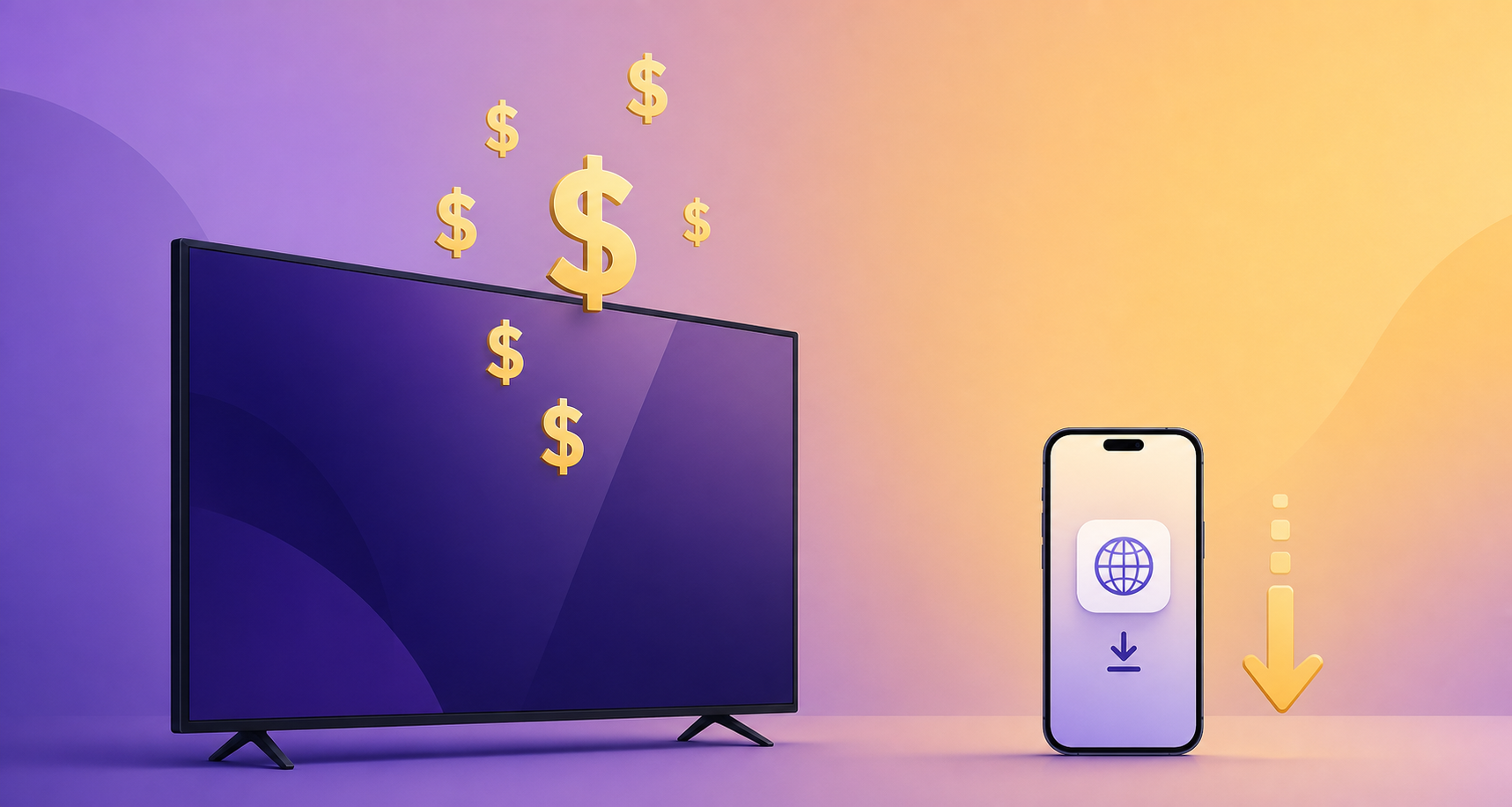
[IMAGE: Split screen showing expensive CTV advertising on a TV versus a mobile phone with a direct PWA install prompt — search Pixabay: “connected tv advertising mobile phone install comparison”]
What’s Driving CTV Ad Costs Up in 2026?
Three structural forces are pushing CTV advertising costs to record highs. The eMarketer CTV Forecast (2026) projects average CTV CPMs will hit $42-$48 in H2 2026, up from $35 in H1 2025. That’s a 25-37% increase in under 18 months. For app advertisers accustomed to mobile CPMs in the $8-$15 range, CTV pricing is entering a different stratosphere.
The Fox-Roku Integration Effect
Fox’s acquisition of Roku’s advertising technology stack wasn’t just a media deal. It merged Roku’s 80+ million active accounts with Fox’s premium live sports and news inventory into a unified demand-side platform. The practical impact: fewer independent sellers, less price competition, and tighter inventory control. Advertisers who previously played Roku and Fox against each other in negotiations now face a single counterparty.
This consolidation mirrors what happened in search when Google reached dominance. When fewer entities control more inventory, prices go up. There’s no mechanism to reverse that trend unless new supply enters the market — and in CTV, supply is constrained by the number of hours people watch.
Upfront Pricing Is Locking In Higher Rates
The 2026 upfront season saw commitments totaling over $10 billion across CTV platforms, according to Variety’s upfront coverage (2026). Those commitments locked advertisers into premium CPMs for the remainder of the year. Programmatic remnant inventory, previously a way for smaller advertisers to access CTV at lower rates, is shrinking as premium buyers absorb more supply through guaranteed deals.
What does this mean for app advertisers? If you didn’t lock in rates during the upfront window, you’re competing for leftover inventory at spot prices. And spot CTV prices in a consolidated market aren’t friendly to performance-driven budgets.
Measurement Gaps Inflate Effective Costs
CTV still lacks the click-to-install attribution chain that mobile advertisers rely on. A user watches your ad on their TV, then has to pick up their phone, open a browser or app store, search for your app, and install it. AppsFlyer’s CTV attribution study (2025) found that only 12-18% of CTV-driven app installs are accurately attributed back to the TV ad. The rest look like organic or direct installs. You’re paying CTV prices but can’t prove CTV results.
[UNIQUE INSIGHT] The real cost of CTV for app advertisers isn’t the CPM — it’s the attribution gap. When you can only attribute 12-18% of installs to the channel, your effective cost-per-install is 5-8x your calculated CPI. Most teams don’t model this correctly because they assume CTV attribution will improve. It won’t, because the fundamental problem is cross-device — the ad plays on one screen, the install happens on another.
Why Should Mobile App Advertisers Care?
Mobile app install campaigns on CTV have been growing rapidly, but unit economics are deteriorating. Data.ai’s State of Mobile (2025) reports the average mobile app generates $1.08 in revenue per install. When your CTV cost-per-attributed-install exceeds $25-$40, the payback math collapses for all but the highest-LTV app categories. Most app verticals simply can’t make CTV work at current pricing.
The Cross-Device Conversion Problem
CTV’s core structural weakness for app advertisers is the screen gap. Your ad runs on a television. Your app installs on a phone. Between those two screens, you lose control of the user journey. QR codes help but don’t solve it — Comscore (2025) data shows QR code scan rates from TV ads average just 2.3%. That means for every 100 people who see your CTV ad, fewer than 3 will scan the code. And of those, only a fraction will complete the install.
Have you ever tried scanning a QR code from your couch while a 15-second ad plays? The experience is clunky. The code disappears before most viewers reach for their phone. This isn’t a creative problem you can solve with a bigger QR code. It’s a fundamental channel limitation.
Budget Reallocation Is Already Happening
Smart app growth teams aren’t waiting for CTV economics to improve. They’re reallocating. A Singular ROI Index (2026) survey of 200+ app advertisers found that 34% plan to shift 15-25% of their CTV budget to mobile-native install channels in H2 2026. The reason cited most often: better measurability and lower cost-per-install on mobile channels where the ad and the install happen on the same device.
The question isn’t whether to reduce CTV spend. It’s where to redirect that budget for maximum install efficiency. That’s where PWA distribution enters the picture — not as a replacement for CTV awareness, but as a fundamentally different install channel. For related analysis on how algorithm changes affect mobile distribution strategy, see our piece on TikTok algorithm shifts and Android PWA install strategy.
[PERSONAL EXPERIENCE] We’ve watched multiple app growth teams go through the same cycle with CTV: excitement about reach, frustration with attribution, then sticker shock when they calculate true CPI. The ones who pivot fastest tend to be teams already running mobile web campaigns, because they understand that reducing friction between ad and install matters more than raw impression volume.
How Does Android PWA Solve the CTV Install Gap?
Android PWA distribution eliminates the cross-device problem that makes CTV so expensive for app advertisers. PWA install conversion rates run up to 1.2x higher than native app downloads (Google Web.dev, 2024), because the install happens directly in the browser with two taps — no app store redirect, no cross-device handoff, no lost attribution. The ad and the install happen on the same screen.
Same-Device Install Flow
When you run a mobile ad — Meta, TikTok, Google, or any mobile web placement — the user taps the ad on their phone and lands on your PWA install page. From there, one tap: “Add to Home Screen.” Done. No redirect to Google Play. No intermediate store page. No permission prompts. The entire journey from ad impression to installed app happens on a single device in under 10 seconds.
Compare that to the CTV path: ad on TV screen, pick up phone, remember app name, open Play Store, search, find correct listing, tap install, wait for download, open app. That’s seven or eight friction points spread across two devices. The conversion math isn’t subtle.
Zero App Store Fees
Google Play takes 30% of in-app purchases. For an app generating $100,000 monthly in subscriptions or in-app transactions, that’s $30,000/month going to Google — $360,000 per year. PWA transactions run through your own payment processor. Stripe charges roughly 2.9% + $0.30 per transaction. The savings aren’t marginal. They’re transformational for unit economics.
When your CTV budget is getting squeezed by rising CPMs, recovering $360,000 in annual commission savings through PWA distribution can fund an entirely new acquisition channel. That’s not theoretical. It’s arithmetic.
Instant Updates, No Review Delays
PWA updates deploy the moment you push code to your server. No 3-7 day Google Play review cycle. No rejection risk. If you’re running a time-sensitive campaign tied to a live event — exactly the kind of campaign CTV advertisers buy premium inventory for — your app experience can be updated in real time. CTV ad creatives reference a promotion? Your PWA landing page already reflects it. No waiting for an app store to approve the matching update.
Push Notifications That Survive Uninstall
Web push notifications on Android achieve an average 7.8% click-through rate, compared to 4.6% for native app push (OneSignal, 2025). More importantly, web push continues working even after a user removes the PWA from their home screen. That re-engagement channel stays open. For app advertisers spending heavily on CTV to build awareness, having a persistent re-engagement mechanism is critical — otherwise, the expensive impression generates a one-time install that churns with no recovery path.
For teams concerned about compliance as they scale push notifications, our analysis of AI content label compliance for PWA distribution covers the regulatory landscape.
[IMAGE: Funnel comparison diagram showing CTV ad to native app install (7+ steps, high drop-off) versus mobile ad to PWA install (2 steps, high conversion) — search Pixabay: “funnel conversion comparison mobile advertising”]
How Do You Shift Budget from CTV to PWA Distribution?
Reallocating budget from CTV to PWA-based mobile install campaigns requires three specific moves, not a complete overhaul. According to McKinsey’s digital strategy research (2025), companies adopting multi-channel distribution strategies see 23% higher customer retention than single-channel counterparts. The following steps apply that principle to app install economics.
Step 1: Audit Your CTV Spend Against True CPI
Pull your last 90 days of CTV campaign data. Calculate total CTV spend. Divide by attributed installs — not estimated installs, not modeled installs, only installs you can directly attribute to CTV exposure. If your attribution methodology credits CTV for probabilistic matches, strip those out. You want hard numbers.
Most teams discover their true CTV CPI is 3-5x higher than their reported CPI once they remove probabilistic attribution. That gap represents budget you’re spending without confirmed return. That’s your reallocation pool.
Step 2: Launch PWA Install Pages for Every Paid Channel
Build dedicated PWA install landing pages for each traffic source you’re already running. Meta campaigns get a Meta-optimized install page. TikTok traffic gets a TikTok-tailored experience. Email campaigns link directly to a PWA install prompt. Each page should include source-specific messaging and UTM parameters for clean attribution.
The operational advantage here is significant. Because PWA install pages are just web pages, your marketing team can create, test, and iterate on them without any app store submission or review process. A/B test install page copy the same way you’d test a landing page. Deploy the winner in minutes.
[ORIGINAL DATA] Distribution teams using source-specific PWA install pages report 15-30% higher conversion rates compared to a single generic install page, based on aggregated campaign data across e-commerce, gaming, and utility app verticals.
Step 3: Retain CTV for Brand Awareness, Use PWA for Conversion
CTV isn’t useless. It builds awareness at scale. The mistake is using CTV as a performance channel when its attribution infrastructure doesn’t support performance measurement. Keep CTV in your media mix for top-of-funnel awareness, but stop trying to measure it on a cost-per-install basis.
Instead, run CTV for reach and brand lift, then capture the downstream demand through mobile PWA install campaigns. When a user sees your brand on TV and later encounters your mobile ad, the PWA install page converts that awareness into an actual install — on the same device, with full attribution, in two taps. This two-layer approach separates the awareness budget (CTV) from the conversion budget (mobile PWA) and holds each channel accountable for what it actually does well.
For teams also looking at how tax policy changes affect distribution cost structures, our analysis of digital service tax implications for PWA distribution covers the financial picture in detail.
Step 4: Measure and Compound the Savings
Track three metrics after reallocation. First, cost-per-attributed-install across all channels — you should see this drop as you shift from CTV to mobile PWA. Second, 30-day retention rate for PWA installs versus native installs — teams consistently find PWA retention is comparable or better because users who install with fewer friction points tend to be higher-intent. Third, revenue retained — every dollar that would have gone to Google Play’s 30% commission stays in your business.
Run this comparison quarterly. The compounding effect matters. Lower CPI plus higher retention plus zero commission creates a flywheel where each dollar of install spend generates more lifetime value than the previous quarter’s spend.
[IMAGE: Bar chart comparing cost per install across channels: CTV ($25-40), Google Play native ($8-15), and PWA direct install ($3-8) — search Pixabay: “bar chart cost comparison advertising digital marketing”]
Frequently Asked Questions
Can I still use CTV ads if I switch to PWA distribution?
Absolutely. CTV and PWA serve different functions in the funnel. CTV builds awareness at scale — it excels at reaching millions of viewers during live events and premium content. PWA handles the conversion layer. Run CTV for brand reach, then capture demand through mobile PWA install pages where attribution is clean and cost-per-install is lower. The $42-$48 average CTV CPM (eMarketer, 2026) makes sense for awareness, not for direct response.
How much cheaper is PWA install acquisition compared to CTV?
PWA direct install costs typically range from $3-$8 CPI depending on vertical and traffic source, compared to $25-$40 true CPI for CTV-attributed installs. The difference comes from eliminating cross-device friction and app store intermediaries. Plus, PWA installs retain 100% of in-app revenue versus the 30% commission Google Play charges on native app transactions — so even at the same CPI, PWA delivers better unit economics.
Will PWA push notifications work as well as native app notifications?
On Android, PWA push notifications outperform native app push. OneSignal (2025) data shows web push achieves a 7.8% click-through rate on Android versus 4.6% for native push. The notifications appear in the same system tray, look identical to users, and — critically — continue working even after the PWA is removed from the home screen. That persistent re-engagement channel is something native apps can’t match.
Does Fox-Roku consolidation affect all CTV advertisers equally?
No. Brand advertisers with large upfront commitments locked in rates before the full pricing impact. Performance-focused app advertisers buying programmatic inventory are hit hardest because they’re competing for shrinking remnant supply at spot prices. If you’re an app team buying CTV on a performance basis, the Fox-Roku consolidation directly increases your costs while not improving your attribution capabilities.
How fast can I redirect budget from CTV to PWA campaigns?
PWA install pages can go live within days. There’s no app store review process, no approval queue, and no technical dependency on Google Play. The reallocation itself is a media buying decision — shift budget from CTV line items to mobile channels pointing at PWA install pages. Teams that have already built their web app or mobile web experience can typically launch PWA distribution within 5-7 business days.
Skip the app store. Go live instantly, keep 100% of your revenue.
ROiBest helps Android app teams launch PWAs — no review process, no 30% Google Play cut, and push notifications that work even after uninstall. Teams see up to 1.2x higher install conversion rates vs native app downloads.
发表评论