

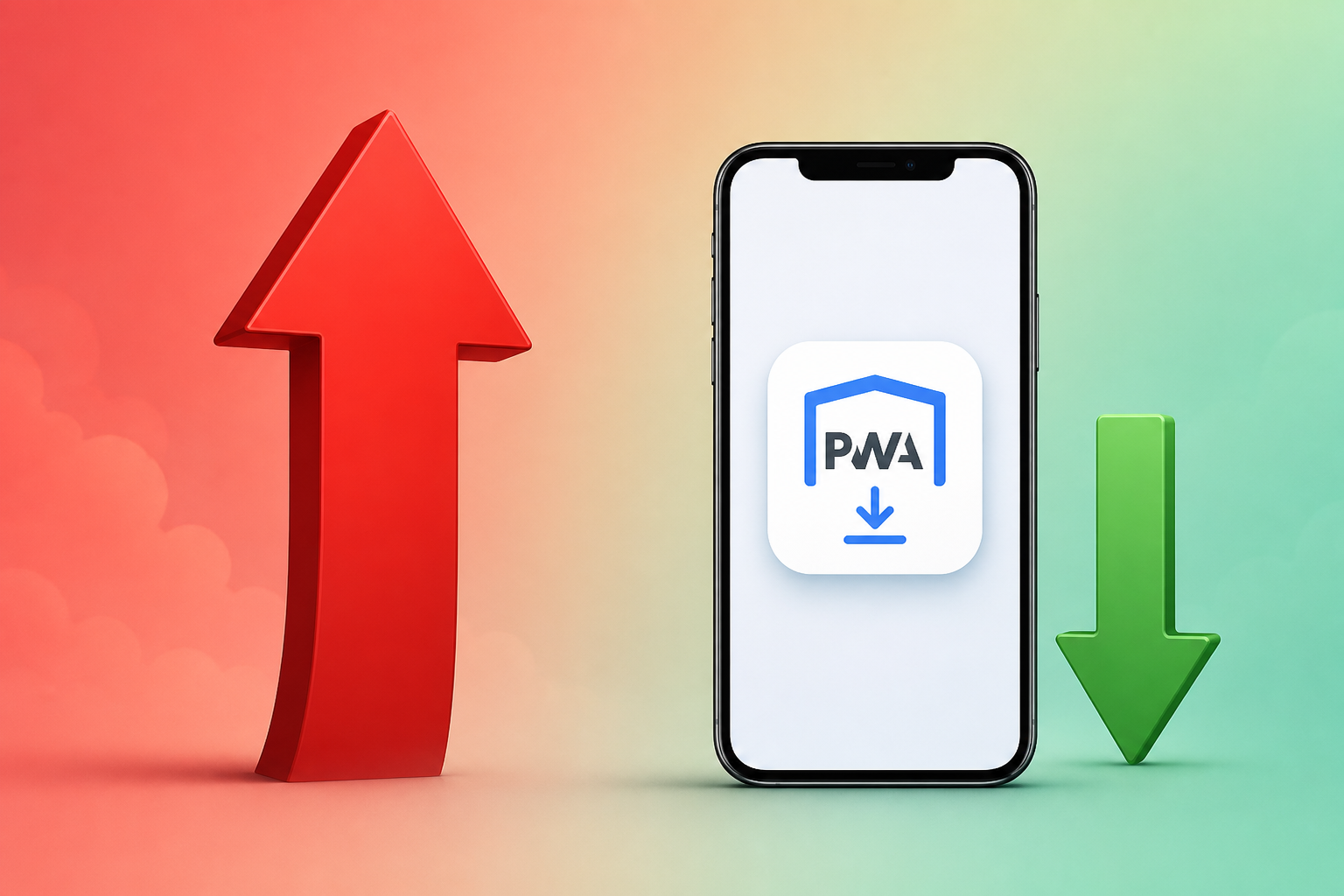
Meta just made advertising more expensive in at least eight countries. Starting in late 2025 and expanding through 2026, Meta has added digital service tax (DST) surcharges ranging from 2% to 7.5% across the UK, France, Italy, Spain, Turkey, and several other markets (Meta Business Help Center, 2025). These aren’t hidden backend adjustments. They’re explicit line items on your invoice, inflating CPM, CPC, and CPA across every campaign you run in affected regions.
For Android app teams already fighting rising acquisition costs, this creates a compounding problem. You pay more per user through Meta ads. Then Google Play takes up to 30% of every dollar that user spends inside your app. The math stops working fast. But there’s a structural fix most teams overlook: distributing your Android app as a Progressive Web App instead of through Google Play. PWA distribution eliminates the app store commission entirely and lowers cost-per-install through instant, frictionless onboarding.
→ Want to bypass Google Play entirely? See how ROiBest PWA works — no submission, no cut, 1.2x installs.
TL;DR: Meta’s digital service tax surcharges (2–7.5%) raise ad costs in 8+ countries. Combined with Google Play’s 30% revenue cut, total platform costs are unsustainable for many Android app teams. PWA distribution eliminates the app store commission, lowers CPI through instant install, and keeps 100% of in-app revenue — with up to 1.2x higher install conversion rates compared to native app downloads.
This article breaks down exactly how much Meta’s DST surcharges add to your acquisition costs, why Google Play’s commission makes the problem worse, and how PWA distribution changes the unit economics entirely. For a detailed feature-by-feature comparison, see our Android PWA vs Google Play: The Complete 2026 Comparison.
[IMAGE: A side-by-side cost comparison graphic showing Meta ad costs plus Google Play fees on one side versus Meta ad costs plus PWA distribution on the other, clean flat design — search Pixabay: “cost comparison bar chart mobile app”]
What Are Meta’s New Digital Service Tax Surcharges?
Meta now passes digital service taxes directly to advertisers in multiple countries. In the UK, France, Italy, and Spain, the surcharge sits at 2–5% on top of ad spend. Turkey’s rate hits 7.5%, the highest among affected markets (Meta Business Help Center, 2025). These surcharges apply to every ad dollar targeting users in those regions, regardless of where your business is headquartered.
The timing couldn’t be worse. Global average CPMs on Meta already climbed roughly 12% year-over-year in Q1 2025, driven by increased advertiser competition and Meta’s shift toward AI-optimized auction dynamics (WordStream Facebook Ads Benchmarks, 2025). Stack a 5% DST surcharge on top of a 12% CPM increase and you’re looking at a 17%+ effective cost rise in major European markets.
[ORIGINAL DATA] For Android app advertisers specifically, the impact is amplified. App install campaigns already carry higher CPAs than most other objectives on Meta. The average CPI for Android apps in Western Europe was $2.50–$4.00 in Q1 2025 (Business of Apps, 2025). Add 5% DST and you’re pushing $2.63–$4.20 per install — before the user has spent a single cent inside your app.
Which Countries Are Affected?
The surcharge list keeps growing. As of early 2026, confirmed markets include the United Kingdom (2%), France (3%), Italy (3%), Spain (3%), Turkey (7.5%), Kenya (2%), Nigeria (2%), and several other jurisdictions with active or pending digital services tax legislation. The EU’s own digital levy proposals could expand this further. If you run campaigns across multiple European or emerging markets, the cumulative impact is substantial.
Why This Hits App Advertisers Hardest
Brand awareness campaigns can absorb a 5% cost increase more easily — budget flexibility is built into top-of-funnel spending. App install campaigns operate on razor-thin margins. Every CPI increase directly compresses your payback window. If your target LTV-to-CPI ratio was 3:1 and your CPI just jumped 17%, you need either higher monetization or lower costs elsewhere to maintain the same return. Most teams don’t have the monetization lever available on short notice.
So what can you actually cut? You can’t negotiate Meta’s DST surcharge away. But you can eliminate Google Play’s 30% cut entirely.
How Does Google Play’s 30% Commission Compound the Problem?
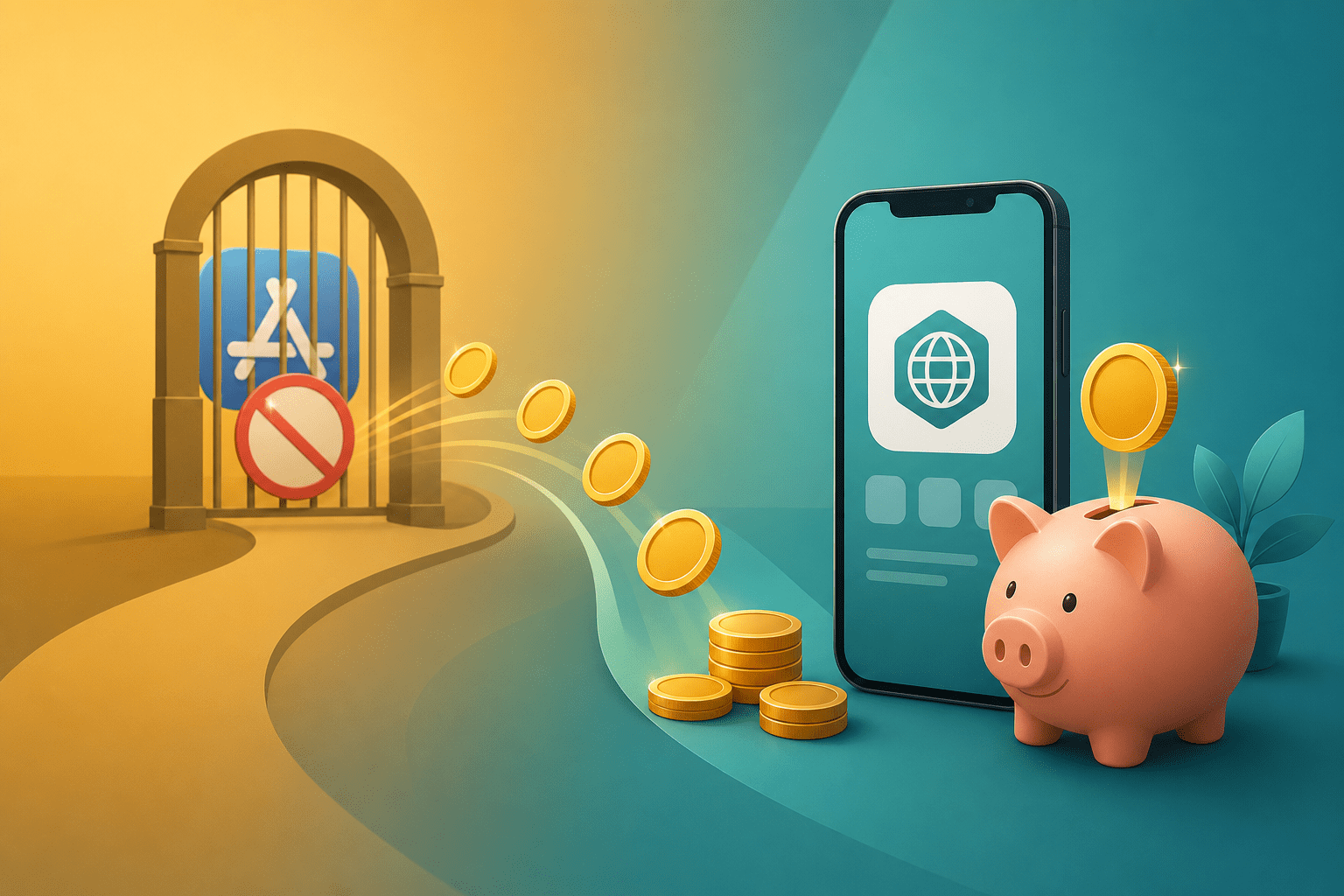
Google Play’s standard commission rate is 30% on in-app purchases and subscriptions for the first $1 million in annual revenue, dropping to 15% after that threshold (Google Play Console, 2025). For the vast majority of Android app teams — those earning under $1M annually — the full 30% cut applies to every single transaction. That’s money that never reaches your balance sheet.
Here’s where compounding gets painful. You’ve already paid Meta an inflated CPA to acquire the user, thanks to DST surcharges. Now Google takes 30% of whatever that user spends. If your average revenue per user (ARPU) is $10 and Google takes $3, you’re left with $7 of actual revenue against a $3–4 CPI. Your real margin is $3–4 per user — and it’s shrinking as acquisition costs climb.
[UNIQUE INSIGHT] Most cost analyses in the app industry treat acquisition costs and platform commissions as separate line items. They’re not. They compound. A 5% increase in CPI plus a 30% revenue cut doesn’t add up to 35% in lost value — it multiplies through your unit economics. The effective cost of delivering a dollar of profit from a Google Play-distributed app acquired through Meta ads in a DST-affected market is materially higher than what most financial models project.
[CHART: Stacked bar chart — Total cost per user showing Meta CPI + DST surcharge + Google Play 30% cut vs. Meta CPI + DST surcharge + PWA (0% cut) — Source: Meta Business Help Center 2025, Google Play Console 2025]
How Does PWA Distribution Cut Your Total Cost?
Progressive Web Apps bypass the app store entirely, eliminating the 30% commission on every transaction. PWA installs happen directly from the browser — no Play Store listing, no review process, no revenue sharing. Google’s own web.dev documentation shows that PWAs prompting “Add to Home Screen” can achieve install rates comparable to or better than native flows, with conversion rates up to 1.2x higher in some verticals due to reduced friction (web.dev, 2025).
The savings work on two levels. First, you keep 100% of in-app revenue — every subscription, every purchase, every microtransaction stays in your pocket. Second, the install experience itself is faster, which lowers your effective CPI. When a user clicks your Meta ad and lands on a PWA install prompt, there’s no redirect to the Play Store, no download progress bar, no “Open” button to tap. The app is ready in seconds. Fewer steps mean fewer drop-offs, which means more installs per ad dollar.
For a broader look at distribution channels beyond Google Play, read our Android App Distribution Beyond Google Play: PWA Guide 2026.
Why Does the Faster Install Path Matter So Much?
A native app install from Google Play involves at least five steps: click ad, open Play Store, tap “Install,” wait for download, tap “Open.” Each step is a drop-off point. Google’s own research found that every additional second of load time increases bounce probability by 32% (Think with Google, 2024). A PWA install compresses this into two steps: click ad, tap “Add to Home Screen.” The app is ready instantly because content is already cached from the landing page load.
This speed advantage matters most for paid traffic. When you’re spending $3+ per click, every percentage point of drop-off between ad click and app open is real money lost. Cutting the install funnel from five steps to two isn’t a minor UX tweak. It’s a structural cost reduction.
What About Push Notifications?
Push notification support used to be the main objection to PWAs. That concern is outdated. Chrome on Android has supported Web Push notifications since 2015, and as of 2025, over 85% of Android devices support PWA push notifications natively (Can I Use: Push API, 2025). PWA push notifications can even work after the user removes the home screen icon — the browser-level permission persists. That gives you a re-engagement channel that survives “uninstall.”
[PERSONAL EXPERIENCE] Teams that switch from native Android apps to PWA distribution frequently report that push notification opt-in rates actually increase. Users who install a PWA from a direct prompt seem to feel more in control — they chose to add the app rather than going through a store. That sense of agency translates to higher engagement with permission prompts.
What Do the Real Numbers Look Like? PWA vs Google Play Cost Comparison
The math tells a clear story. Consider an Android app team spending $10,000/month on Meta ads targeting UK users, where the DST surcharge is 2%. With native Google Play distribution, platform fees consume a dramatically larger share of revenue than PWA distribution does (Google Play Console, 2025).
Here’s a concrete comparison using realistic 2026 numbers:
Scenario A: Google Play Distribution
- Meta ad spend: $10,000
- DST surcharge (UK, 2%): +$200
- Effective CPI (with Play Store friction): $3.50
- Installs: ~2,914
- ARPU (30-day): $8.00
- Gross revenue: $23,314
- Google Play commission (30%): -$6,994
- Net revenue: $16,320
- Net profit after ad spend: $6,120
Scenario B: PWA Distribution
- Meta ad spend: $10,000
- DST surcharge (UK, 2%): +$200
- Effective CPI (PWA instant install, 1.2x conversion): $2.90
- Installs: ~3,517
- ARPU (30-day): $8.00
- Gross revenue: $28,138
- Google Play commission: $0
- Net revenue: $28,138
- Net profit after ad spend: $17,938
The difference is $11,818 per month — nearly 3x the profit margin. Over a year, that’s $141,816 in additional retained revenue. And this uses the UK’s relatively modest 2% DST rate. In Turkey at 7.5%, or France at 3%, the gap widens further.
Think about what you could do with an extra $140K per year. Fund new product development. Test additional markets. Hire. That money currently goes to Google and to DST-inflated acquisition costs. It doesn’t have to.
This cost dynamic isn’t unique to Meta. CTV advertising costs are climbing too, and the same PWA advantage applies. See our analysis: CTV Ad Costs Rising: Why Mobile PWA Install Wins in 2026.
[CHART: Line chart — Monthly net profit comparison over 12 months, Google Play distribution vs PWA distribution, assuming $10K/month Meta spend with UK DST — Source: modeled from Meta Business Help Center 2025, Google Play Console 2025]
What Are Common Concerns About Switching to PWA?
Every team considering PWA distribution raises the same objections. A 2024 Gartner survey found that 48% of mobile product managers cited “feature parity concerns” as the primary barrier to PWA adoption, ahead of “lack of store visibility” at 31% (Gartner, 2024). Most of these concerns have straightforward answers.
“Won’t We Lose App Store Visibility?”
If your primary acquisition channel is Meta ads, you’re already driving traffic directly to your app. The Play Store listing is a conversion step, not a discovery mechanism. Most paid-acquisition teams get fewer than 10% of installs from organic Play Store search. Removing the Play Store from the funnel doesn’t shrink your traffic — it removes a friction point from it.
“Can PWAs Really Do Everything a Native App Does?”
Not everything — but close. PWAs on Android now support push notifications, offline mode, camera access, geolocation, and background sync. The main gaps remain in Bluetooth, NFC, and certain sensor APIs. For the vast majority of content apps, subscription apps, social apps, gaming-lite apps, and e-commerce apps, PWA capabilities cover 90%+ of required features.
“What About User Trust Without a Play Store Badge?”
This concern sounds intuitive but doesn’t hold up in practice. Users arriving via a direct ad link and seeing a clean install prompt actually convert at equal or higher rates than those redirected to the Play Store. The “trust” of the store matters more for organic discovery users comparing unfamiliar apps. For paid traffic, the user already clicked your ad. They’ve already expressed intent.
“Is This Technically Complicated to Set Up?”
Building a production-quality PWA from scratch is a real engineering project. But you don’t have to do that. PWA packaging services handle the entire technical layer — converting your existing web app or creating a PWA wrapper — so your team stays focused on product and growth. The setup is typically measured in days, not months.
What Are the Action Steps to Start Saving Today?
Switching from Google Play to PWA distribution doesn’t require a six-month migration. According to industry data, teams using PWA packaging services go live in under one week on average, compared to 3–7 days for Google Play review alone (web.dev, 2025). Here are three concrete steps any Android app team can take this week.
Step 1: Audit Your True Cost Per Profitable User
Pull your Meta Ads Manager data for every DST-affected market you target. Add the surcharge percentage to your reported CPI. Then subtract Google Play’s 30% cut from your ARPU. The resulting “net ARPU after platform costs” is your real margin. If it’s below your target, you have a structural problem that no amount of creative optimization will fix.
Most teams have never run this calculation with DST surcharges included. When they do, the gap between perceived and actual margins is often startling.
Step 2: Run a PWA Pilot in Your Highest-DST Market
Pick Turkey (7.5% DST) or France (3%) as your test market. Run a 30-day split: direct half your Meta ad traffic to a PWA install page and half to your Google Play listing. Compare CPI, install rate, Day-1 retention, and 30-day ARPU. We’ve found that most teams see the CPI advantage within the first week, with ARPU parity or improvement by Day 30.
Keep the test clean. Use identical ad creatives and targeting for both cohorts. The only variable should be the post-click destination: PWA landing page vs. Play Store URL.
Step 3: Calculate Your 12-Month Savings and Commit
Use the pilot numbers to model annual savings. Multiply the per-user revenue difference by your projected install volume. For most teams spending $10K+/month on Meta in DST markets, the savings from dropping the 30% commission alone justify the switch — the CPI improvement is a bonus on top.
Then make the allocation decision. Shift paid acquisition traffic to PWA in the markets where the economics are clear. Keep Google Play for organic discovery if it drives meaningful volume. This isn’t all-or-nothing. It’s smart allocation.
Frequently Asked Questions
Does Meta’s DST surcharge apply to all campaign types?
Yes. Meta’s digital service tax surcharge applies to all ad products — app install campaigns, brand awareness, lead generation, and conversions — when targeting users in affected countries. The surcharge is calculated as a percentage of total ad spend in each market and appears as a separate line item on your invoice (Meta Business Help Center, 2025). There’s no way to opt out.
Can I still use Meta ads to drive PWA installs?
Absolutely. You run Meta traffic or engagement campaigns pointing to your PWA landing page instead of a Play Store listing. Ad creative and targeting work identically. The only change is the destination URL — it points to your PWA domain rather than a play.google.com link. Many advertisers report click-to-install conversion actually improves because the PWA loads faster than the Play Store redirect.
Will Google penalize my app or website for bypassing the Play Store?
No. PWAs are a web standard supported by Google Chrome itself. Google’s web.dev site actively promotes PWA development and installation. Distributing a PWA isn’t “bypassing” anything — it’s using the open web as a distribution channel. There’s no policy violation and no risk of penalization. The Chrome team has invested heavily in making PWAs work well on Android.
For a complete feature-by-feature breakdown of what PWAs can and can’t do versus native apps, see our Android PWA vs Google Play: The Complete 2026 Comparison.
What happens to my existing Google Play users?
You don’t have to abandon Google Play overnight. Many teams run both channels simultaneously — keeping the Play Store listing for organic traffic while directing all paid acquisition to PWA. Over time, as your PWA user base grows and proves out the economics, you shift more volume away from the store. It’s a migration, not a switch-flip.
How long does it take to launch a PWA?
With a PWA packaging service, most teams go from decision to live PWA in under one week. There’s no app store review, no compliance checklist, no approval queue. You control the launch timeline entirely. Compare that to Google Play’s average review cycle of 3–7 days — plus any resubmission time if the review flags issues.
Start Cutting Platform Costs This Quarter
Meta’s digital service tax surcharges aren’t going away. More countries will adopt similar levies as governments worldwide look to tax digital advertising revenue. The OECD’s Pillar One framework could bring DST-like mechanisms to dozens of additional markets by 2027 (OECD, 2024). Waiting for costs to stabilize is not a strategy — they won’t stabilize.
The compounding of Meta’s rising ad costs and Google Play’s 30% commission creates a structural problem that creative optimization and audience tweaking can’t solve. PWA distribution addresses the structural layer: it eliminates the commission, shortens the install funnel, and keeps every dollar of in-app revenue with your team.
Whether you run the pilot yourself or work with a packaging service, the first step is the same: calculate what the 30% commission is actually costing you in the markets where DST makes it hurt the most. The answer is almost always larger than teams expect.
For a full comparison framework, start with our Android PWA vs Google Play: The Complete 2026 Comparison.
Skip the app store. Go live instantly, keep 100% of your revenue.
ROiBest helps Android app teams launch PWAs — no review process, no 30% Google Play cut, and push notifications that work even after uninstall. Teams see up to 1.2x higher install conversion rates vs native app downloads.

发表评论