


Meta just announced new digital service tax surcharges across multiple countries — and advertisers in affected regions are seeing their effective ad costs rise by 2-5%. Combined with Google Play’s existing 30% commission on in-app purchases, the total cost of acquiring and monetizing users through traditional channels keeps climbing. For Android app teams running paid acquisition campaigns, these compounding platform taxes are squeezing margins from both sides: higher ad costs on the acquisition side, and higher revenue share on the monetization side.
PWA distribution eliminates one of those cost layers entirely — and in doing so, changes the math on what constitutes a profitable user acquisition channel.
→ Want to bypass Google Play entirely? See how ROiBest PWA works — no submission, no cut, 1.2x installs.
The Double Tax Problem: Ad Platform Fees + App Store Commission
Let’s break down the actual cost structure of acquiring a paying user through the traditional Google Play path:
- Ad platform costs: Meta charges for impressions and clicks. With the new digital service tax surcharges, advertisers in countries like France, UK, Spain, Italy, and Turkey now pay an additional 2-5% on top of their ad spend. For a team spending $50,000/month on Meta ads in affected regions, that’s $1,000-2,500 in pure tax overhead.
- Google Play commission: When a user installs through Google Play and makes an in-app purchase, Google takes 15-30% of the transaction. For a gaming app with $100,000 in monthly in-app revenue, that’s $15,000-30,000 going to Google.
- MMP and attribution costs: To connect ad spend to app store installs, you need third-party attribution (AppsFlyer, Adjust) at $0.02-0.10 per attributed install. For 100,000 monthly installs, that’s another $2,000-10,000.
Add these up: a team spending $50K on ads in tax-affected regions, generating 100K installs and $100K in IAP revenue, is paying $18,000-42,500 in combined platform taxes, commissions, and attribution fees. That’s 12-28% of total revenue going to intermediaries before you count your own operational costs.
For a comprehensive comparison of PWA vs Google Play across all these dimensions, see our complete Android PWA vs Google Play guide.
How PWA Distribution Changes the Cost Equation
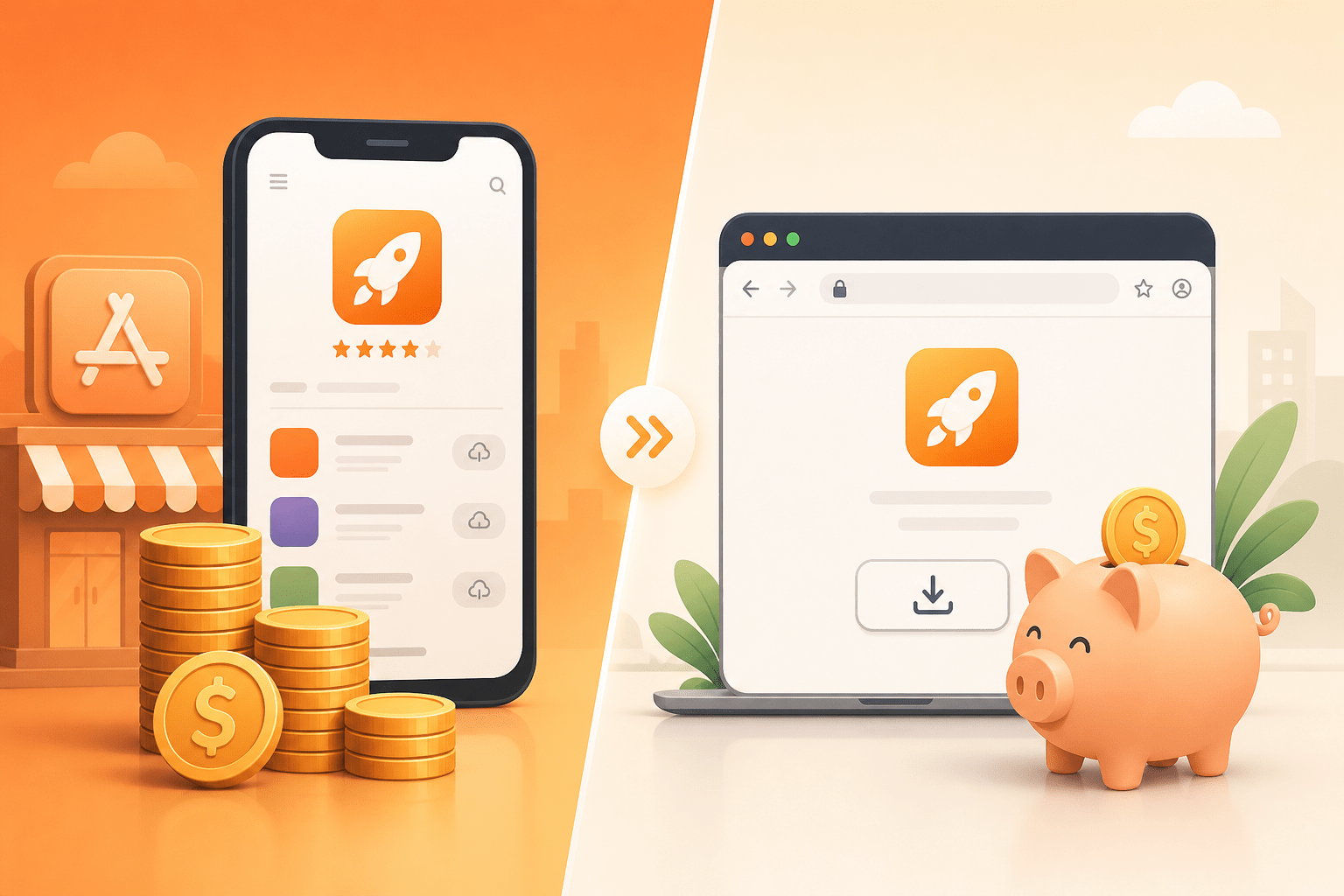
PWA distribution eliminates or dramatically reduces every cost layer in the traditional acquisition stack:
- No app store commission. PWA installs happen through the web browser. Users add your app to their homescreen directly from your landing page. There is no app store intermediary and no revenue share on in-app purchases. That 15-30% Google Play cut goes back to you.
- No MMP fees. PWA install attribution happens through standard web analytics — UTM parameters, first-party cookies, server-side events. No need for a separate mobile measurement partner. Attribution cost drops to near zero.
- Digital service tax applies to ad spend regardless of distribution. You can’t avoid the tax surcharge on Meta ads. But by eliminating the Google Play commission, you free up 15-30% of revenue that can offset the higher acquisition costs.
- Higher install conversion rates. PWA installs happen instantly — the user taps “Add to Home Screen” and the app appears in seconds, no download queue. This typically produces 1.2x higher install conversion rates compared to Google Play, meaning your effective CPI drops even as ad costs rise.
Step 1: Calculate Your True Cost Per Paying User
Before switching distribution channels, you need to know your actual all-in cost. Here’s how to calculate it:
- Sum your total acquisition costs. Include ad spend, digital service tax surcharges, MMP fees, and any agency fees. This is your true acquisition investment.
- Subtract Google Play commission from revenue. Take your gross in-app revenue and subtract the 15-30% Google Play takes. The result is your net revenue.
- Calculate true CPA-to-LTV ratio. Divide total acquisition costs by number of paying users to get true CPA. Divide net revenue by paying users to get net LTV. If your CPA/LTV ratio is above 0.5, you’re in the danger zone — and removing the Google Play commission can bring it back to healthy territory.
- Model the PWA scenario. Recalculate with zero Google Play commission and zero MMP fees. Factor in a 1.2x install conversion rate improvement. The difference is your annual savings opportunity.
For BC gaming teams with strong monetization, this analysis often reveals $100K-500K in annual savings from switching to PWA distribution — savings that come entirely from eliminating intermediary costs, not from reducing quality or reach.
Step 2: Set Up PWA Distribution Without Disrupting Current Campaigns
You don’t need to abandon Google Play overnight. The smart approach is to run PWA distribution in parallel and let the data guide your transition:
- Launch a PWA version of your app. ROiBest handles the technical implementation — wrapping your existing app experience into a PWA that installs from the browser. No code rewrite required.
- Create dedicated PWA landing pages. Design landing pages optimized for PWA install conversion. Key elements: clear value proposition, one-tap install button, social proof, and a 2-second load time target.
- Split your Meta campaigns. Allocate 20-30% of ad spend to campaigns pointing to PWA landing pages. Keep the remaining budget on Google Play campaigns for comparison.
- Measure side-by-side for 4 weeks. Compare CPI, install-to-purchase conversion rate, Day 7 retention, and ROAS between the two channels. Include platform costs in the ROAS calculation.
PWA also gives you capabilities that Google Play cannot match — including push notifications that continue working even after the user removes the app icon. Learn more about this retention advantage in our PWA push notification guide.
Step 3: Optimize Your PWA Funnel for Maximum ROI
Once your PWA distribution channel is live, optimize it with these high-impact tactics:
- A/B test install prompts. Test different install button designs, placements, and trigger timings. The default browser install prompt converts well, but a custom in-page prompt with contextual messaging (e.g., “Install to save your progress”) typically improves conversion by 15-25%.
- Implement progressive engagement. Don’t ask for the install immediately. Let users experience one key feature first (one game level, one AI chat response), then prompt the install. Users who experience value before installing have 40% higher Day 7 retention.
- Set up post-install push sequences. PWA push notifications are your most cost-efficient re-engagement channel. Send a welcome push within 1 hour of install, a value-reinforcement push on Day 1, and a re-engagement prompt on Day 3. This sequence alone can lift Day 7 retention by 20-30%.
- Feed conversion data back to Meta. Use Meta’s Conversions API to send PWA install and purchase events server-side. This gives Meta’s algorithm accurate conversion signals for bid optimization — the same signal quality that Google Play provides through the install referrer, but with zero commission attached.
For teams tracking attribution across both Meta and Google properties, accurate install measurement is essential. Our Meta attribution change analysis covers how PWA tracking maintains accuracy as platform attribution evolves.
The Math Is Clear: PWA Saves Money at Every Step
Digital service taxes are just the latest cost pressure on mobile advertisers. They won’t be the last. As platforms add fees and commissions stack up, the most effective defense is to control your distribution infrastructure. PWA distribution puts you in control of the install experience, the attribution data, and the revenue — no intermediaries, no commissions, no hidden costs.
The teams that make this shift now will have a structural cost advantage that compounds over time. Every dollar saved on Google Play commissions can be reinvested in acquisition. Every improvement in install conversion rate makes your ad spend work harder. And every push notification you send after install costs you nothing — unlike retargeting ads that cost you per impression.
Skip the app store. Go live instantly, keep 100% of your revenue.
ROiBest helps Android app teams launch PWAs — no review process, no 30% Google Play cut, and push notifications that work even after uninstall. Teams see up to 1.2x higher install conversion rates vs native app downloads.



发表评论