

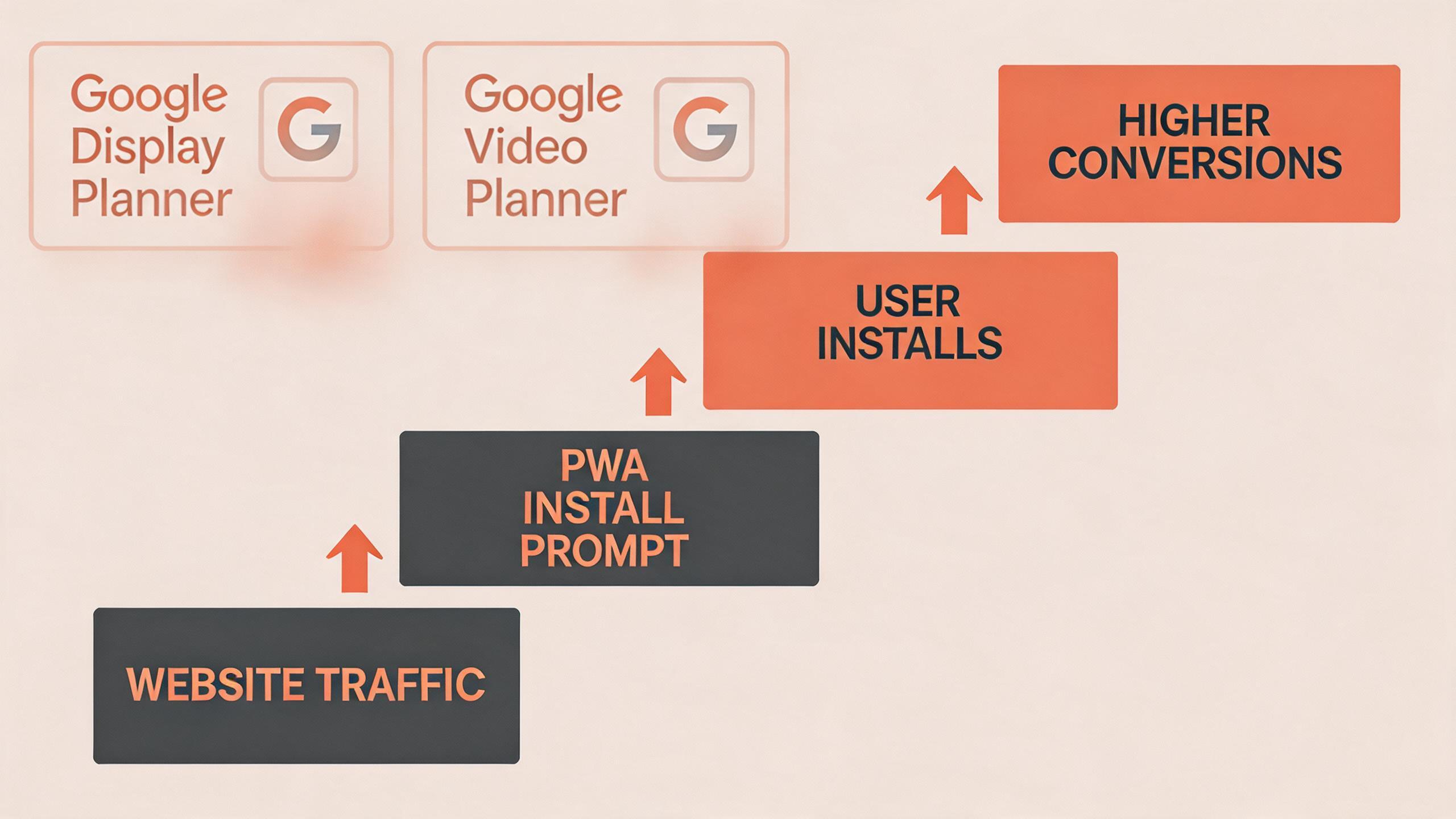
In April 2026, Google quietly retired its Display & Video 360 planning tools — Reach Planner and other awareness-focused forecasting features that advertisers had relied on for years. The move barely made headlines, but for anyone paying attention to how digital distribution is evolving, the signal was unmistakable: Google is abandoning awareness metrics in favor of conversion outcomes. For Android app teams distributing through Google Play, this shift exposes a fundamental problem. The entire app store model — built on impressions, rankings, and discovery — is misaligned with a world that now measures success by install completions and revenue per user. Progressive Web Apps (PWAs) distributed directly to users represent the distribution model purpose-built for this conversion-first reality.
→ Want to bypass Google Play entirely? See how ROiBest PWA works — no submission, no cut, 1.2x installs.
What Google Just Removed — and Why It Matters
Google’s Display & Video 360 (DV360) platform has long been the go-to for brand advertisers running awareness campaigns. Reach Planner helped teams forecast how many users they could reach across YouTube, Display Network, and connected TV inventory. The tool modeled impressions, frequency, and estimated reach — all top-of-funnel metrics designed to answer the question: “How many eyeballs can I get?”
In early 2026, Google began phasing out these planning tools. Reach Planner lost support for several campaign types. The Display & Video forecasting workflows were consolidated into Performance Planner, which focuses exclusively on conversion-based objectives: target CPA, target ROAS, and maximize conversions bidding strategies. Google’s own documentation now steers advertisers toward “outcomes-based planning” rather than reach estimation.
This isn’t an isolated product decision. It’s the culmination of a multi-year strategic pivot. Google introduced Performance Max campaigns in 2021, which replaced manual channel selection with AI-driven optimization across all Google surfaces — but only for conversion objectives. By 2024, Smart Shopping and Smart Display campaigns were fully sunset into Performance Max. Now, with the removal of display planning tools, Google has effectively told the market: we no longer want to help you plan for awareness. Plan for conversions instead.
The implications for app distribution teams are significant. If the largest advertising platform in the world is deprioritizing awareness and reach metrics, then distribution strategies built around visibility — app store rankings, featured placements, category browsing — are swimming against the current. The ecosystem is moving toward measurable, attributable conversion events. And app stores, by design, introduce friction that undermines conversion.
The Conversion-First Shift in Digital Advertising

Google’s tool removal reflects a broader industry transformation. According to eMarketer’s 2026 Digital Advertising Forecast, performance-based ad spending now accounts for 68% of total digital ad budgets, up from 54% in 2022. Advertisers are reallocating budget from awareness channels to conversion-optimized campaigns because the measurement infrastructure has matured enough to demand it.
Three forces are driving this conversion-first shift:
1. Attribution technology has improved dramatically. Multi-touch attribution models, server-side tracking, and first-party data strategies mean advertisers can now trace a user’s journey from ad impression to install to first purchase with far greater accuracy than even two years ago. When you can measure conversions precisely, you stop paying for impressions you can’t connect to outcomes.
2. Privacy regulations have made awareness metrics less reliable. With Apple’s App Tracking Transparency, Google’s Privacy Sandbox for Android, and GDPR enforcement actions increasing, the data that powered reach and frequency planning is degrading. Modeled reach estimates carry wider confidence intervals. Advertisers can’t trust awareness metrics the way they once could, so they’re shifting budget to bottom-funnel actions they can directly observe.
3. CFOs are demanding ROI accountability. The era of “brand building” budgets with vague measurement is ending. A 2025 Gartner CMO survey found that 73% of marketing leaders now face quarterly ROI reviews from finance, up from 41% in 2020. Every dollar needs to connect to a measurable business outcome — and “estimated reach” doesn’t satisfy that requirement.
For app distribution, this conversion-first reality exposes the inherent inefficiency of the app store model. When a user clicks an ad for your app and lands on a Google Play listing, they encounter multiple friction points before completing an install: store loading time, permission screens, download progress bars, storage checks, and installation delays. Each step is a conversion leak. Industry benchmarks from AppsFlyer’s 2025 Performance Index show that Google Play store listing-to-install conversion rates average 26.4% for non-branded traffic — meaning nearly three out of four users who reach your listing never complete the install.
In a conversion-first world, that 73.6% drop-off isn’t just an inconvenience. It’s an existential problem for your unit economics. If you’re paying $2.50 per click to drive users to a store listing that converts at 26%, your effective cost per install is $9.62. The math doesn’t work for most app categories.
Why PWA Distribution Wins in a Conversion-First World
Progressive Web Apps distributed directly — bypassing the app store entirely — solve the conversion problem that Google’s own strategic shift has highlighted. Here’s why PWA distribution aligns with the conversion-first era, and how teams are using it to improve their install economics.
Step 1: Eliminate the Store Listing Conversion Leak
When you distribute a PWA, the user clicks your ad or link and lands directly on your app experience. There is no intermediate store listing. No “Install” button that triggers a multi-step download process. The app loads in the browser, and the user can add it to their home screen with a single tap on the install prompt. The entire journey from click to functional app on the user’s device can happen in under 3 seconds on a 4G connection.
ROiBest customers report install conversion rates averaging 31.8% from paid traffic — a 1.2x improvement over equivalent Google Play campaigns. That improvement compounds directly into your cost-per-install: if the same $2.50 click converts at 31.8% instead of 26.4%, your CPI drops from $9.62 to $7.86. At scale, across thousands of daily installs, that difference represents tens of thousands of dollars in monthly savings.
This conversion advantage exists because PWA distribution removes every friction point that app stores introduce. No download size warnings. No storage permission dialogs. No progress bars. No “Open” button after install. The user is already in the app the moment they arrive. As Google’s own advertising platform shifts to reward conversion efficiency, PWA distribution versus Google Play becomes less of a philosophical debate and more of a mathematical certainty.
Step 2: Retain Users Without Platform Dependencies
The conversion-first shift isn’t just about the initial install — it extends to retention and re-engagement. Google Play’s notification infrastructure requires the user to keep your app installed. Once they uninstall, you lose the ability to reach them entirely. Your re-engagement campaigns must start from scratch, paying acquisition costs a second time.
PWA distribution through ROiBest includes push notification capabilities that persist even after a user removes the app from their home screen. The push subscription remains active as long as the user hasn’t explicitly revoked notification permission in their browser settings. This means your re-engagement campaigns can target churned users at zero incremental acquisition cost — a conversion advantage that compounds over the lifetime of your user base.
Industry data from Localytics shows that the average Android app loses 77% of its daily active users within the first 3 days after install. For apps distributed through Google Play, each of those churned users represents a sunk acquisition cost with no recovery path. With PWA push-after-uninstall, teams can run re-engagement sequences that bring back 8–12% of churned users within 7 days — users who would otherwise require full re-acquisition spend.
Step 3: Keep 100% of Revenue in a Margin-Compressed World
Google’s conversion-first shift has a financial dimension that app teams can’t ignore. As advertisers concentrate spending on conversion-optimized campaigns, auction competition for bottom-funnel inventory intensifies. CPCs and CPIs are rising across performance channels — Google’s own Q1 2026 earnings reported a 14% year-over-year increase in average cost-per-click across Search and Performance Max campaigns.
In this environment, the 15–30% commission that Google Play extracts from in-app purchases and subscriptions becomes increasingly punitive. If your acquisition costs are rising and your platform takes are fixed, your margins compress from both directions. The digital tax on app distribution through Google Play turns a challenging unit economics problem into an unsustainable one.
PWA distribution eliminates the platform commission entirely. You process payments through your own payment infrastructure — Stripe, PayPal, local payment methods — and retain 100% of revenue after payment processing fees (typically 2.9% + $0.30 per transaction versus Google Play’s 15–30%). For a subscription app generating $500,000 in monthly recurring revenue, the difference between a 30% platform cut and a 2.9% processing fee is $135,500 per month retained. Over a year, that’s $1.63 million back in your business.
Step 4: Adapt Faster Than App Store Review Cycles Allow
Conversion optimization requires rapid iteration. You need to test landing page variants, onboarding flows, pricing presentations, and feature positioning in real time. Google Play’s review process introduces a 1–3 day delay on every update. For teams running aggressive conversion optimization programs, that latency is fatal to testing velocity.
PWA updates deploy instantly. Change your onboarding flow at 10 AM, and every new user sees the updated experience by 10:01 AM. Run an A/B test on pricing page layout, measure results by end of day, and deploy the winner before your competitor’s app update has even entered Google’s review queue. In a world where AI-driven app experiences face increasing scrutiny from platform review teams, the ability to update without gatekeepers isn’t just convenient — it’s a competitive moat.
Teams using ROiBest’s PWA distribution typically run 3–5x more A/B tests per month than their Google Play counterparts, because every test cycle that would take 3–5 days through app store review takes less than 1 hour through PWA deployment. More tests mean faster learning, faster optimization, and faster improvement in the conversion metrics that now define success.
Action Plan: Moving to PWA Distribution
If Google’s removal of display planning tools is the signal, here’s how to respond with a concrete migration toward conversion-first PWA distribution:
Week 1–2: Audit your current conversion funnel. Map every step from ad click to app install to first meaningful action (registration, purchase, session completion). Identify where your Google Play conversion rate falls versus the 26.4% industry average. Calculate your true cost-per-install including the store listing drop-off. This baseline will quantify the conversion opportunity that PWA distribution represents.
Week 3–4: Run a parallel PWA distribution test. Launch your existing app as a PWA through ROiBest alongside your Google Play distribution. Direct 20–30% of your paid traffic to the PWA variant. Measure install conversion rate, day-1 retention, and 7-day revenue per install. Most teams see statistically significant conversion improvements within 10–14 days of testing.
Week 5–8: Shift budget based on conversion data. With conversion data from both channels, calculate the CPI and LTV differential. If PWA distribution delivers the 1.2x install conversion improvement that ROiBest customers typically see, begin shifting budget allocation: 50% to PWA, 50% to Google Play. Monitor downstream metrics (retention, revenue, LTV) to ensure the conversion advantage persists beyond initial install.
Week 9–12: Optimize the PWA-native experience. With PWA distribution carrying a significant share of your installs, invest in optimizing the PWA-specific conversion flow. Implement push notification sequences for re-engagement. Set up direct payment processing to eliminate platform commissions. Build your A/B testing cadence around the instant-deployment advantage. By this point, most teams have enough data to make a permanent budget allocation decision.
Summary
Google’s removal of Display & Video planning tools is not a minor product update — it’s a strategic declaration that the advertising industry has moved past awareness metrics toward conversion outcomes. For Android app distribution teams, this shift exposes the fundamental inefficiency of the app store model: high friction installs, platform commissions that compress margins, review delays that slow optimization, and re-engagement limitations that inflate lifetime acquisition costs.
PWA distribution addresses every one of these conversion barriers. Lower-friction installs deliver 1.2x higher conversion rates. Direct payment processing retains 100% of revenue. Instant deployment enables 3–5x faster testing cycles. Push-after-uninstall reduces re-acquisition costs by recovering churned users. In a conversion-first world — the world that Google itself is now building — PWA isn’t an alternative distribution channel. It’s the distribution model that matches how success is measured.
The teams that recognize this signal and act on it in 2026 will build a structural cost advantage that compounds with every install. The teams that wait will find their unit economics increasingly underwater as conversion expectations rise and app store friction remains unchanged.
Skip the app store. Go live instantly, keep 100% of your revenue.
ROiBest helps Android app teams launch PWAs — no review process, no 30% Google Play cut, and push notifications that work even after uninstall. Teams see up to 1.2x higher install conversion rates vs native app downloads.


发表评论