

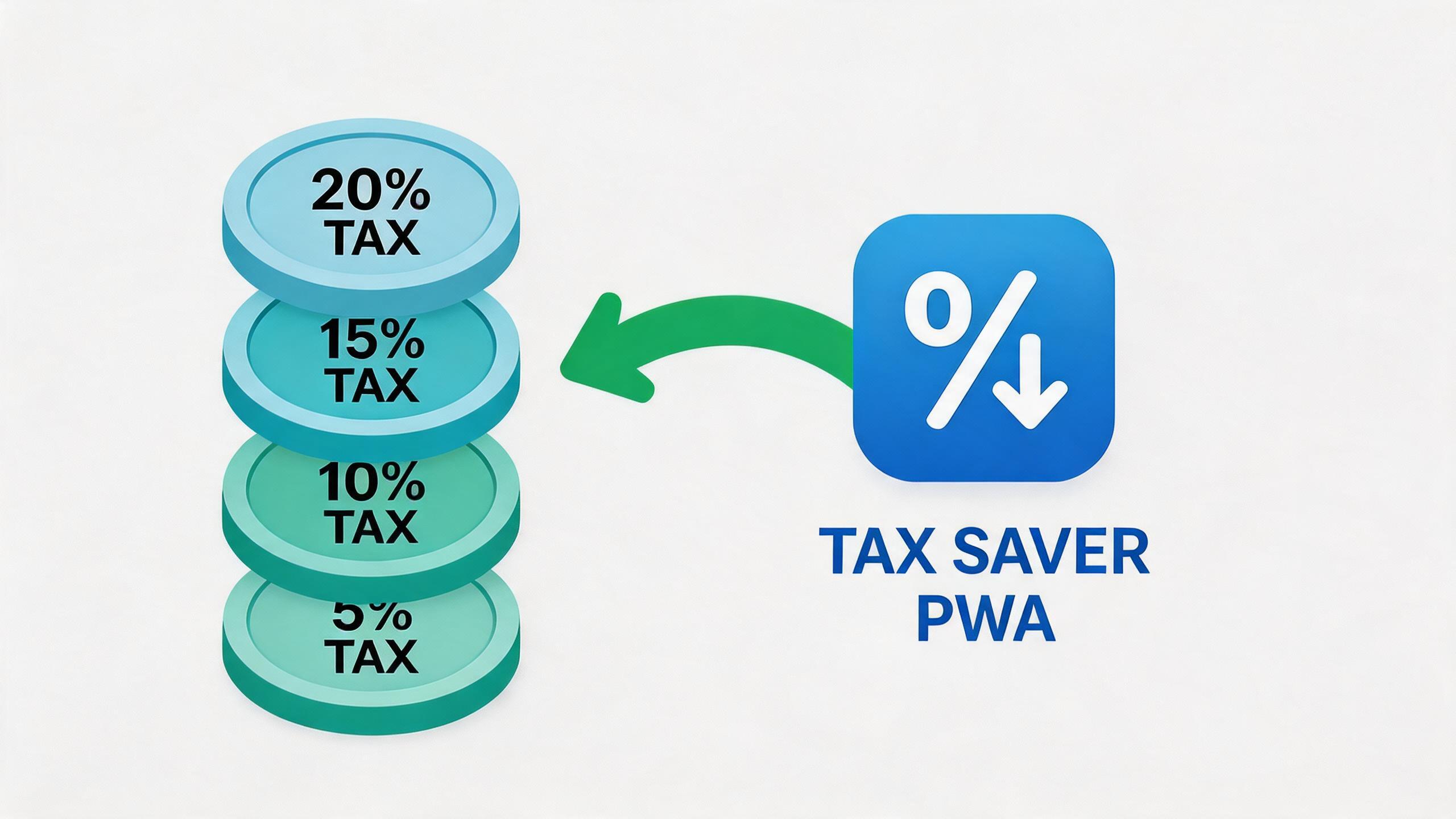
Meta just added digital services tax surcharges in multiple countries, including France, Italy, Spain, Turkey, and the UK. For app teams running Meta ads, this means higher advertising costs on top of what you already pay. And if you are distributing through Google Play, that 30% revenue commission is still eating into every dollar you make.
The math has changed. In 2026, the total cost of acquiring and monetizing a user through traditional channels — Meta ads plus Google Play distribution — hits a tipping point for many app verticals, especially gaming and AI social apps. PWA distribution eliminates the app store commission entirely, and combined with the right ad strategy, can absorb the new tax increases while maintaining healthy unit economics.
→ Want to bypass Google Play entirely? See how ROiBest PWA works — no submission, no cut, 1.2x installs.
The New Cost Reality: Digital Services Tax + App Store Commission
Here is what app teams are now facing on the cost side:
Digital services tax surcharges (new in 2026):
- France: 3% DST applied to Meta ad spend
- Italy: 3% DST on digital advertising services
- Spain: 3% surcharge on Meta and Google ad revenue
- Turkey: 7.5% digital services tax
- UK: 2% DST on search and social ad revenues
Meta is passing these taxes through to advertisers as surcharges on invoices. For a team spending $100,000/month on Meta ads targeting European and Turkish users, this adds $3,000-$7,500 in pure cost with zero additional reach.
Google Play commission (unchanged but compounding):
- 30% on in-app purchases for the first $1M, 15% after (Google Play reduced rate for small developers)
- For games with in-app purchases — the most common monetization model — the effective rate is usually 30% because game revenue quickly exceeds the $1M threshold
- Subscription apps pay 15% after the first year of each subscriber, but churn often resets this
Stack these together: you pay 3-7.5% more for ads, then lose 30% of the revenue those ads generate. For a gaming app with a $5 CPI and $15 LTV, the margin erosion is severe. At $15 LTV with 30% Play commission, you keep $10.50. Subtract a $5 CPI plus 3% DST ($5.15 effective), and your profit per user drops to $5.35 — down from $5.50 pre-tax. Marginal? Yes. But across millions of installs, that is real money.
How PWA Distribution Changes the Equation

PWA (Progressive Web App) distribution eliminates the app store entirely. Users install your app directly from a web page to their home screen — no Google Play, no Apple App Store, no commission.
Here is what changes when you switch to PWA:
Zero app store commission. The 30% Google Play cut disappears completely. Every dollar a user spends in your app stays with you (minus payment processor fees, typically 2.9% + $0.30). For the $15 LTV example above, you keep $14.57 instead of $10.50 — a 39% increase in revenue per user.
Higher install conversion rates. PWA installs are faster than native app downloads because there is no Play Store intermediary. The user taps “Install” on your landing page and the app appears on their home screen in seconds, without downloading a large APK file. Teams using PWA distribution see up to 1.2x higher install conversion rates compared to Play Store links.
No review process, no takedown risk. Google Play has increasingly strict content policies, especially for gaming (real-money gaming, social casino) and AI social apps (AI companions, dating). PWA apps live on your own domain — no review queue, no policy violations, no sudden takedowns. You control the distribution.
Push notifications even after uninstall. Android PWAs support push notifications through Chrome, which persist even if the user removes the PWA from their home screen. This gives you a re-engagement channel that native apps lose after uninstall.
Real Numbers: Cost Comparison for a Gaming App
Let’s model a mid-size gaming app spending $200,000/month on Meta ads, targeting users in Europe and Southeast Asia.
Scenario A: Google Play distribution
- Ad spend: $200,000
- DST surcharge (avg 3%): $6,000
- Total acquisition cost: $206,000
- Installs (at $4 CPI): 51,500
- Revenue per user (LTV): $12
- Gross revenue: $618,000
- Google Play commission (30%): -$185,400
- Net revenue: $432,600
- Profit: $226,600
Scenario B: PWA distribution via ROiBest
- Ad spend: $200,000
- DST surcharge (avg 3%): $6,000
- Total acquisition cost: $206,000
- Installs (at $3.33 CPI with 1.2x conversion): 61,800
- Revenue per user (LTV): $12
- Gross revenue: $741,600
- Payment processor fees (2.9%): -$21,507
- Net revenue: $720,093
- Profit: $514,093
The difference is $287,493 per month — or $3.4 million per year. The digital services tax makes Google Play distribution even more expensive relative to PWA, because you are paying tax on ads that generate less net revenue.
For a complete breakdown of PWA vs Google Play across different app types, see our Android PWA vs Google Play complete guide.
Which App Types Benefit Most From the Switch
Not every app should move to PWA immediately. Here is where the economics make the strongest case:
1. BC / real-money gaming apps. These face the highest Google Play takedown risk AND the highest commission impact. PWA eliminates both. If your game involves real-money elements, PWA is not optional — it is the only sustainable distribution path.
2. AI social and companion apps. Google Play has been rejecting AI dating and companion apps at increasing rates due to content policy concerns. PWA lets you distribute freely without worrying about policy changes you cannot control.
3. Apps with high in-app purchase revenue. The more money users spend inside your app, the more the 30% commission hurts. Apps with LTV above $10 see the biggest absolute savings from PWA.
4. Apps targeting markets with high DST rates. If your user base is concentrated in France, Italy, Turkey, or Spain, the DST surcharge makes acquisition more expensive, which amplifies the need to protect revenue on the monetization side.
Common Concerns Addressed
“Will users accept installing a PWA instead of a native app?”
In markets outside the US, PWA acceptance is already high. In Southeast Asia, India, and parts of Europe, users regularly install web apps. The install prompt on Android Chrome is native-looking and feels like a normal app install. Most users do not distinguish between a PWA and a native app once it is on their home screen.
“What about iOS?”
This strategy is Android-focused. iOS PWA support is limited (no push notifications, no background sync). For iOS users, you would still distribute through the App Store or use alternative distribution methods available in the EU under the DMA.
“Can I still run Google Ads for PWA installs?”
Yes. Google PMax campaigns can drive traffic to PWA landing pages. You set up conversion tracking for PWA installs (Add to Home Screen events) and optimize campaigns against those events. The tracking setup is different from app install campaigns but fully supported.
Action Plan: How to Start
- Calculate your current cost stack. Add up Meta ad spend + DST surcharges + Google Play commissions. This is your true cost of user acquisition plus distribution.
- Model the PWA scenario. Remove the 30% commission, factor in 1.2x install conversion improvement, and calculate the new profit per user.
- Run a 30-day parallel test. Send 20% of your Meta ad traffic to a PWA landing page instead of the Play Store link. Compare install rates, retention, and revenue per user.
- Scale based on data. If PWA outperforms on unit economics (which it typically does for the app types listed above), gradually shift more traffic to PWA distribution.
The digital services tax is not going away — more countries will adopt it. Google Play’s 30% commission is not going away either. The teams that build alternative distribution now will have a permanent cost advantage over competitors who remain locked into the app store model.
Skip the app store. Go live instantly, keep 100% of your revenue.
ROiBest helps Android app teams launch PWAs — no review process, no 30% Google Play cut, and push notifications that work even after uninstall. Teams see up to 1.2x higher install conversion rates vs native app downloads.


发表评论