


Google Just Killed Its Display Planner — And It’s a Signal Every App Team Needs to Hear
In early 2026, Google quietly removed two tools that digital marketers had relied on for years: the Display Planner and the Video planning tool inside Google Ads. No fanfare, no replacement announcement — just gone.
For most advertisers, this looked like a routine spring cleaning. But for Android app teams running user acquisition campaigns, this removal is one of the clearest signals yet about where Google’s entire advertising machine is heading — and what that means for how you distribute your app.
The short version: Google is done helping you plan for reach and impressions. It only cares about conversions now. If your app distribution strategy isn’t built around measurable conversion events, you’re about to fall behind.
Android PWA distribution is built for exactly this world.
→ Want to bypass Google Play entirely? See how ROiBest PWA works — no submission, no cut, 1.2x installs.
What Actually Happened: Google’s Display & Video Planning Tools Are Gone

The Display Planner was a tool inside Google Ads that helped advertisers forecast reach, estimate impressions, and plan budgets for Display Network campaigns. The Video planning counterpart did the same for YouTube and video inventory. Both were beloved by media planners who wanted to model audience scale before committing spend.
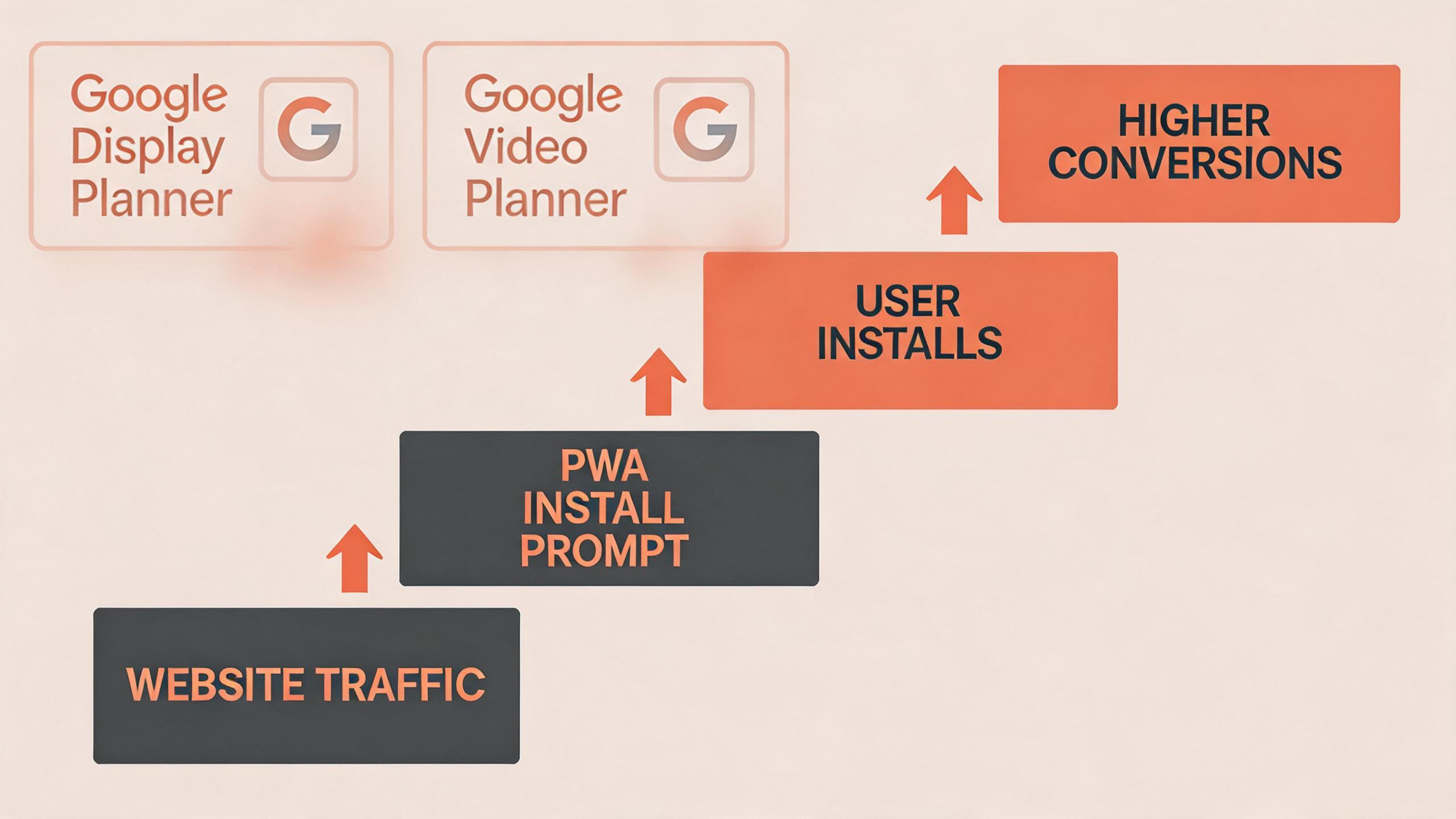
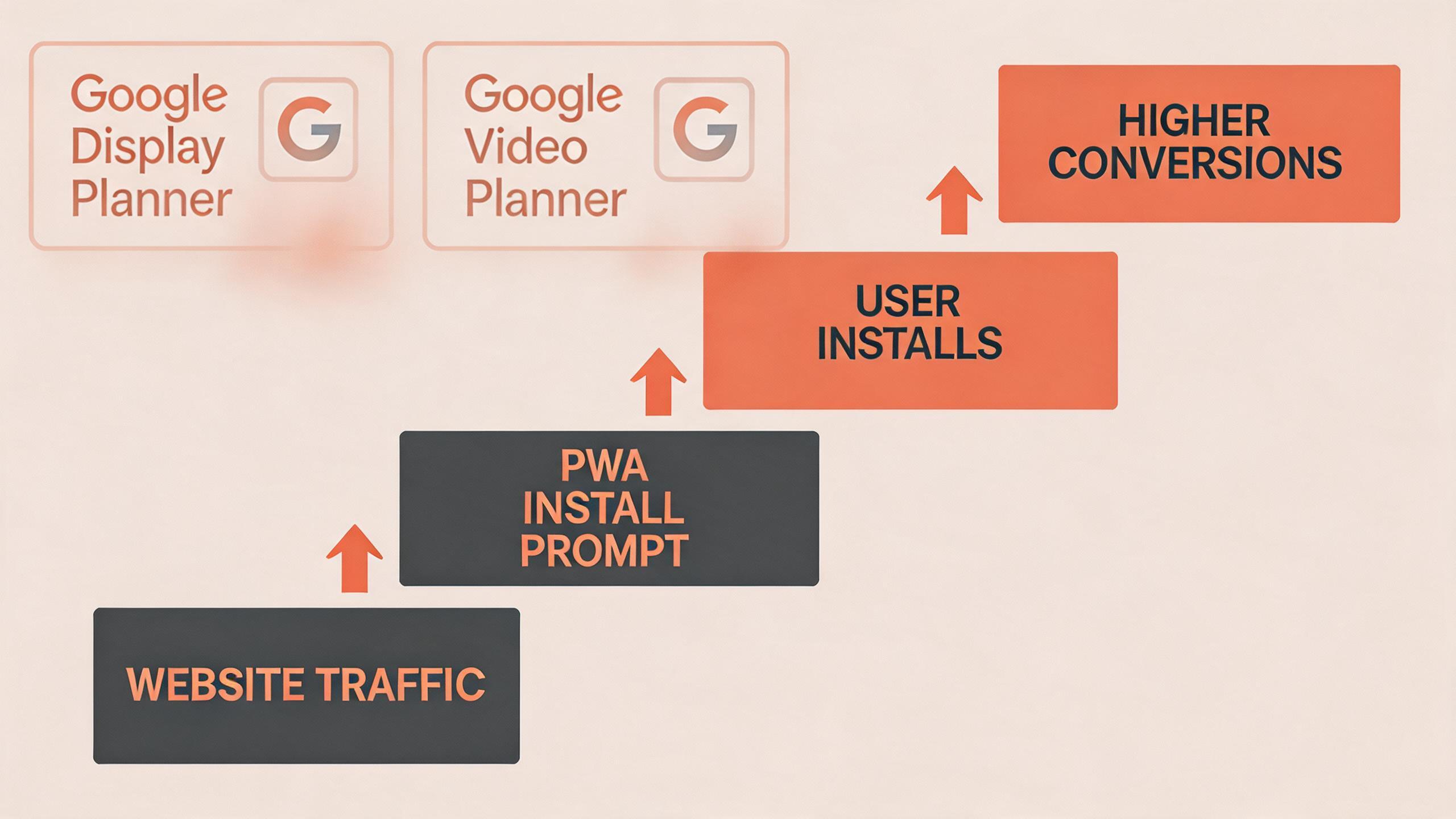
As of 2026, both have been deprecated. Google’s official guidance points users toward Performance Planner instead — a tool that optimizes toward conversion goals, not reach metrics.
This is not an accident. Consider what else has shifted at Google in recent years:
- Smart Bidding defaults to conversion goals. Target CPA and Target ROAS have become the standard campaign settings, not optional add-ons.
- Performance Max replaced dedicated Display and Discovery campaigns as the go-to format for cross-network reach — but PMax is entirely conversion-optimized under the hood.
- Google’s own earnings guidance increasingly emphasizes direct-response advertising revenue over brand awareness spending, reflecting where advertiser budgets are actually performing.
- The deprecation of third-party cookies made impression-based planning far less reliable, accelerating Google’s shift toward first-party, conversion-focused measurement.
The pattern is consistent: Google is systematically removing tools that help you plan for awareness and replacing them with tools that plan for outcomes. If you can’t measure a conversion event, Google’s ecosystem increasingly doesn’t know what to do with you.
For app teams, this has a direct implication: every step in your distribution funnel that creates friction, delays measurement, or loses a user between ad click and app action is now a structural liability.
How Android PWA Distribution Aligns Perfectly With Google’s Conversion-First Direction
The traditional app distribution model — run an ad, send users to Google Play, hope they download, wait for them to open the app, track a first-open event — has always had a measurement gap problem. Users drop off at the Play Store. Downloads don’t equal engagement. First-open attribution is lossy. Google Play’s review process can delay your response to campaign performance by days.
Android PWA distribution closes all of those gaps.
When a user clicks your ad and lands on a PWA install flow, the entire journey happens in the browser. There is no app store intermediary. The install event, the first session, the first conversion action — all of these fire as measurable web events, directly attributable, directly reportable into Google Ads and Google Analytics. Smart Bidding can optimize on them in real time.
Here is what this looks like in practice, compared to the native app path:
| Distribution Factor | Google Play (Native App) | Android PWA |
|---|---|---|
| Time from ad click to install | 3–7 steps (Play Store page, permissions, download, install) | 1–2 steps (land, tap install prompt) |
| Conversion event measurability | Lossy (SDK required, attribution window issues) | Native web events, direct Google Ads integration |
| Launch speed after campaign decision | Days to weeks (review process) | Hours (no review required) |
| Post-uninstall re-engagement | Not possible | Push notifications remain active |
| Revenue cut | 30% to Google | 0% — you keep everything |
In the conversion-first era Google is building, fewer funnel steps means more attributable conversions. More attributable conversions means better Smart Bidding signals. Better Smart Bidding signals means lower CPA over time. PWA distribution feeds that flywheel directly.
You can read more about how this compares at the structural level in this Android PWA vs Google Play complete guide.
Real Performance Data: What App Teams Are Seeing in 2026
The business case for Android PWA distribution isn’t theoretical. Teams using ROiBest PWA infrastructure are reporting measurable outcomes across three areas that directly respond to Google’s conversion-first shift.
1. Install Conversion Rate: 1.2x Over Native App Downloads
When users land on a PWA install experience instead of being redirected to the Play Store, install conversion rates increase by an average of 1.2x. The reason is mechanical: the Play Store adds friction. Every additional tap, every permission screen, every “download in progress” animation is a dropout opportunity. PWA installs happen in the same browser session where the user clicked the ad. The intent signal is fresh. The conversion happens immediately.
For teams running Performance Max campaigns — Google’s current recommended format following the retirement of dedicated Display and Discovery ads — this install conversion rate lift translates directly into better campaign performance signals, lower automated CPA targets, and more efficient spend over time.
2. Revenue Per Install: Full Margin, No 30% Platform Tax
Google Play charges a 30% commission on in-app purchases. For any app team running subscription models, one-time purchases, or in-app consumables, this is a structural cost that compounds as volume grows. A team generating $100,000/month in in-app revenue is handing $30,000 to Google before touching any ad spend.
PWA distribution routes all payment processing outside the Play Store ecosystem. Teams retain 100% of in-app revenue. For many teams, the revenue recaptured from the commission alone funds their entire PWA migration and ongoing ad spend — with margin left over.
3. Post-Uninstall Re-Engagement: Push Notifications That Survive Removal
One of the most underappreciated advantages of PWA distribution is push notification persistence. When a user uninstalls a native Android app, all push notification permissions are revoked. The communication channel is severed permanently.
PWA push notifications are managed at the browser level, not the app level. Even after a user removes the PWA from their home screen, the push subscription remains active. This means lapsed users can be re-engaged with offers, reminders, or new content — a re-engagement capability that simply doesn’t exist in the native app model.
For app teams investing in Performance Max or Google UAC campaigns, re-engagement push notifications function as a zero-cost retention layer that improves LTV calculations and makes every acquired user more valuable over time.
See how PMax Android PWA install conversion workflows operate in practice, including how to structure conversion events for maximum Smart Bidding signal quality.
What This Means for Your User Acquisition Strategy Right Now
Mid-article check: If your current UA strategy still routes users through Google Play and measures success by download volume, you’re optimizing for a metric Google is deprioritizing. The shift to conversion-first measurement is not coming — it’s already here.
Here are three concrete adjustments app teams should make in response to Google’s Display Planner removal and the broader conversion-first transition:
Step 1: Audit Your Conversion Event Chain
Map every step from ad click to first meaningful in-app action. Count the number of handoffs where your user leaves one system and enters another (browser → Play Store → download queue → app → registration). Each handoff is a potential attribution break and a dropout point. For any step that routes through Google Play, quantify your real dropout rate using Play Console funnel data. Most teams are surprised how much they lose between the ad click and the app open.
Step 2: Model the Revenue Impact of Removing the Play Store Cut
Run a simple calculation: take your current monthly in-app revenue, multiply by 0.30, and that’s what you’re paying Google Play per month just for the privilege of being listed. For teams with meaningful in-app revenue, the PWA migration cost is often recovered within the first billing cycle. This isn’t a technology decision — it’s a margin decision.
Step 3: Evaluate PWA as Your Primary Conversion Landing Surface
For teams running Google Ads toward app installs, consider testing PWA as the post-click landing destination instead of the Play Store listing. Structure a PWA install event as a Google Ads conversion goal. Run a split test between the Play Store path and the PWA path for a single campaign. Measure CPA, install rate, and day-7 retention. The data will tell you what the trend lines already suggest.
For mobile gaming teams specifically, the install rate dynamics are particularly significant — you can dig into the data in this piece on mobile game PWA install rate optimization.
Common Concerns App Teams Raise — Addressed Directly
“Will our users actually install a PWA instead of a native app?”
The install rate data says yes — and by a meaningful margin. The PWA install prompt in modern Android Chrome is native-looking and familiar. Users who tap an install button in a browser don’t perceive a significant difference from installing from the Play Store. What they do experience is a faster path: no redirect, no Play Store page load, no download queue. The user who was ready to convert stays in the conversion flow.
“Do we lose app features by going PWA?”
For the vast majority of Android app categories — casual games, utilities, finance, subscription apps, lifestyle apps — PWA capabilities on modern Android cover everything required for a complete user experience. Camera, notifications, offline functionality, home screen presence, payment processing: all available. ROiBest handles the technical configuration. Your team ships the experience.
“What about discoverability? We depend on Play Store search.”
This is the most legitimate concern, and it deserves a direct answer: Play Store organic discovery is real and valuable. PWA distribution is not a replacement for your Play Store presence if you have strong organic ranking there. It is, however, an additional and often superior channel for paid traffic. For teams running Google Ads, the conversion math on PWA-routed traffic is consistently better than Play Store-routed traffic, which means you can scale paid acquisition more profitably while keeping your Play Store listing for organic.
“What if Google penalizes PWA installs in its ad systems?”
PWA installs are standard web conversion events. They are measured, attributed, and optimized by Google Ads the same way any landing page conversion is. There is no policy tension between PWA distribution and Google Ads. In fact, because PWA install events are web events with clean attribution, they tend to produce better Smart Bidding signals than mobile app install events, which rely on SDKs and can have attribution delays.
Summary: The Conversion-First Era Is Here — ROiBest Helps You Win It
Google removing its Display Planner and Video planning tools isn’t a story about two deprecated features. It’s a story about an advertising platform systematically reorganizing itself around conversion outcomes. The tools that helped you plan for reach are going away. The tools that help you optimize for results are getting stronger.
For Android app teams, the response isn’t complicated:
- Reduce friction in the install funnel — every step between ad click and conversion is a liability in a conversion-first measurement environment
- Maximize the revenue from every install — losing 30% to Google Play doesn’t make sense when there’s a direct alternative
- Keep communication channels open past the install — push notifications that survive uninstall are a structural re-engagement advantage
- Feed clean conversion events into Smart Bidding — PWA install events are web events, directly attributable, immediately usable for bid optimization
ROiBest helps Android app teams launch PWA distribution without handling any of the technical configuration. No manifest files, no service worker setup, no infrastructure management. You bring your app experience. ROiBest handles the distribution layer. Your users get a faster path to install. Your campaigns get cleaner conversion data. Your revenue stays whole.
In the era Google is building, that’s not a nice-to-have. It’s a competitive necessity.
Skip the app store. Go live instantly, keep 100% of your revenue.
ROiBest helps Android app teams launch PWAs — no review process, no 30% Google Play cut, and push notifications that work even after uninstall. Teams see up to 1.2x higher install conversion rates vs native app downloads.

发表评论