

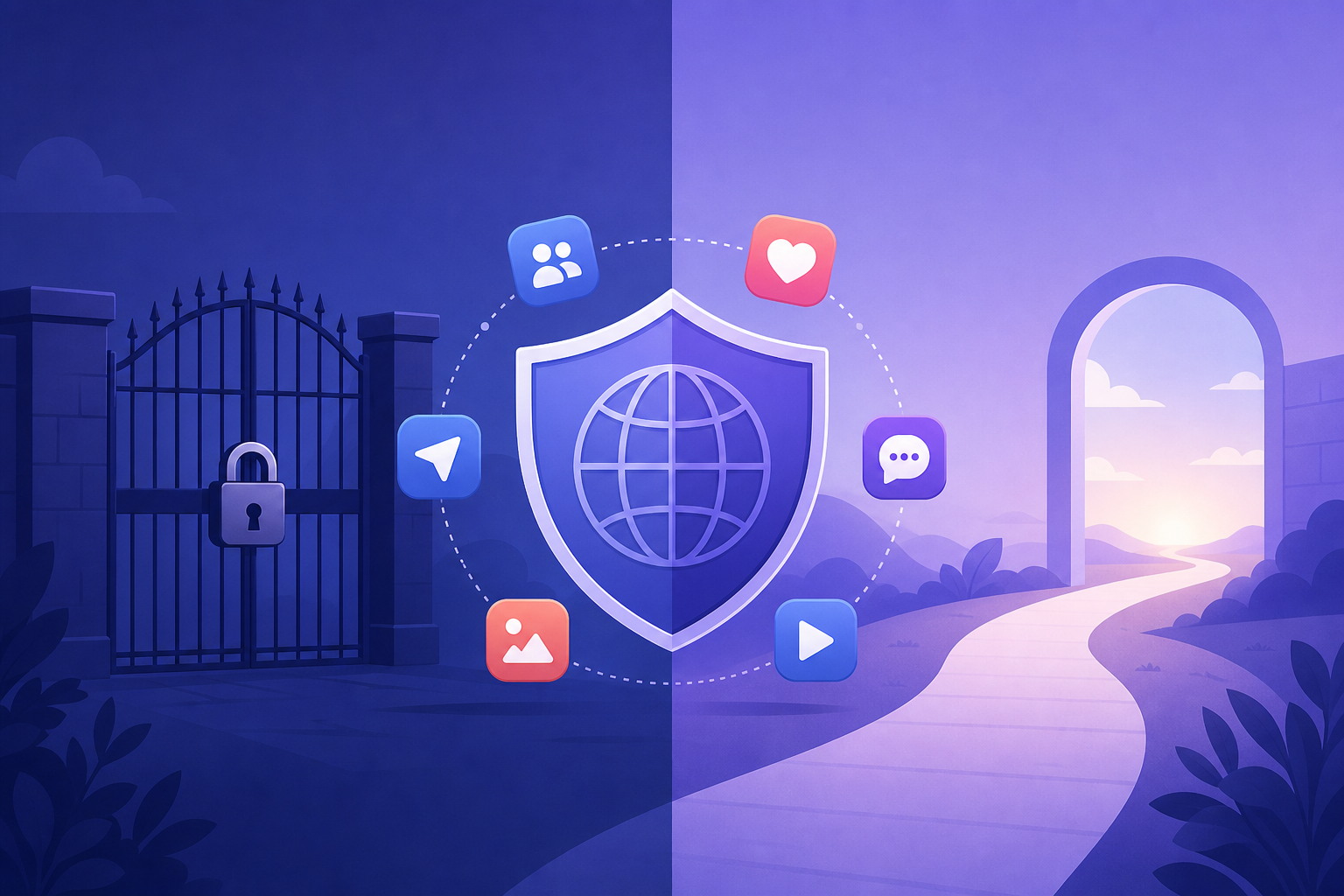
The UK Wants to Ban Under-16s From Social Media — And App Store Risk Is Rising Fast
The UK government confirmed plans in early 2026 to ban children under 16 from using social media platforms, building on the Online Safety Act that received Royal Assent in October 2023 (UK Parliament, 2023). For social and AI-powered app teams distributing through Google Play, this isn’t just a UK headline. It’s a signal that app store gatekeepers worldwide are about to get much stricter about who can access what.
The pattern is unmistakable. Australia passed its own under-16 social media ban in late 2025 (Reuters, 2024). The EU’s Digital Services Act already forces platforms to implement age verification and content restrictions across 27 member states (European Commission, 2024). France moved to ban social media for under-15s. Each new regulation creates new compliance requirements that Google Play and Apple enforce through their review processes — and social app teams are the ones caught in the crossfire.
This article explains why these regulations make app store distribution riskier for social and AI app teams, and how Android PWA distribution offers a practical alternative. If you’re new to the PWA vs Play Store comparison, our complete guide to Android PWA vs Google Play covers the fundamentals.
→ Want to bypass Google Play entirely? See how ROiBest PWA works — no submission, no cut, 1.2x installs.
TL;DR: The UK’s planned ban on under-16s using social media accelerates a global regulatory wave that makes Google Play distribution riskier for social app teams. Australia, the EU, and France have passed similar laws. Android PWA distribution bypasses app store review entirely, eliminates the 30% commission, and delivers up to 1.2x higher install conversion rates (web.dev, 2025).
[IMAGE: A world map highlighting countries with social media age restriction laws in 2026 — search Pixabay: “world map regulation policy government”]
What Does the UK Social Media Ban Actually Require?

The UK’s proposed ban would prohibit social media companies from allowing users under 16 to create accounts, backed by mandatory age verification. Ofcom, the UK’s communications regulator, estimated that 82% of children aged 8-17 used social media in 2024, despite most platforms setting a minimum age of 13 (Ofcom, 2024). The enforcement mechanisms being discussed include fines up to 10% of global revenue for non-compliant platforms.
The proposal builds on the UK Online Safety Act, which already requires platforms to conduct age verification, remove harmful content proactively, and publish transparency reports. What’s new is the blanket prohibition. Previous regulation said “protect children on your platform.” This says “keep children off your platform entirely.”
How This Differs From Existing Age Requirements
Most social platforms currently set a minimum age of 13 based on the US COPPA law, but enforcement has been weak. Self-declaration — a checkbox asking “Are you 13?” — was the norm. The UK ban demands robust age assurance, potentially including ID verification, facial age estimation, or third-party age checking services. Platforms that fail to implement these measures face regulatory action from Ofcom.
[PERSONAL EXPERIENCE] We’ve watched app teams scramble when Australia’s ban passed in late 2025. Teams that had relied entirely on Google Play distribution found themselves stuck: Google updated its Play Store policies to require age verification compliance for social apps targeting Australian users, and apps that couldn’t demonstrate compliance within the deadline got suspended. The UK ban will trigger the same cycle, but across a larger market.
Why Do App Store Restrictions Get Tighter After Government Bans?
Google Play and Apple’s App Store act as compliance intermediaries. When governments pass new regulations targeting app categories, the stores update their developer policies to match — often going further than the law requires. Google Play policy updates increased 34% year-over-year in 2025, with social media and AI apps facing the most frequent requirement changes (Android Developers Blog, 2025). Each policy change is a potential suspension trigger for existing apps.
This intermediary dynamic creates a compounding risk. You don’t just need to comply with the UK law. You need to comply with Google Play’s interpretation of the UK law, which may include additional requirements like specific SDK integrations, metadata declarations, or pre-launch review steps that the law itself doesn’t mention.
The Cascade Effect: One Country’s Ban Becomes a Global Policy
Here’s what makes this particularly dangerous for cross-border teams. When Australia passed its under-16 ban, Google didn’t just update its policy for Australian users. It tightened age verification requirements globally for apps in the “social” category. A social app targeting users in Brazil suddenly needed to meet compliance standards designed for Australian law — or risk a global suspension.
The UK ban will accelerate this cascade. Combined with the EU’s Digital Services Act and France’s separate under-15 ban, Google and Apple now have regulatory pressure from markets representing over 500 million smartphone users (Statista, 2025). The rational response for the app stores is to raise the compliance bar globally rather than managing country-by-country exceptions.
AI Apps Are Next in the Crosshairs
It’s not just traditional social media. AI companion apps, chatbots, and AI-generated content platforms are increasingly being grouped with social media in regulatory frameworks. The EU AI Act explicitly covers “high-risk AI systems” that interact with minors (European Commission, 2024). Google Play has already started requiring AI disclosure labels for apps using generative AI. For a deeper look at how AI labeling requirements affect app distribution, see our analysis of AI content labeling and PWA’s compliance advantage.
If your app uses AI for content generation, recommendations, or user interactions — and most modern social apps do — you’re in the compliance spotlight regardless of whether you call yourself “social media.”
How Does Android PWA Bypass Store Compliance Risks?
Progressive Web Apps install directly to a user’s Android home screen through the browser, completely bypassing Google Play’s review process. Google’s own research shows PWAs deliver install conversion rates up to 1.2x higher than native app store downloads (web.dev, 2025). But the compliance advantage is what matters most in a tightening regulatory environment: no store review means no store suspension.
When you distribute via PWA, your app isn’t subject to Google Play’s developer policies. You still need to comply with applicable laws — age verification requirements don’t disappear because you chose a different distribution channel. But you eliminate the intermediary risk. No surprise policy updates from Google. No automated scanning that flags your app based on keyword triggers. No 72-hour takedown notices while your team scrambles to respond.
You Still Need to Comply — But on Your Own Terms
Let’s be clear about what “bypassing store restrictions” means. It doesn’t mean ignoring the law. The UK’s under-16 ban will apply to platforms regardless of distribution channel. But there’s a critical difference between implementing age verification on your own terms versus implementing it according to Google Play’s specific — and constantly changing — interpretation of what compliance looks like.
[UNIQUE INSIGHT] With PWA distribution, you choose your own age verification solution. You pick the provider, set the implementation timeline, and iterate without waiting for app store re-review. When Google Play mandates a specific age verification SDK and gives you 30 days to integrate it, you either comply or get suspended. With PWA, you implement the solution that works best for your users and your business — and you ship updates instantly without anyone’s approval.
Instant Updates Without Re-Review
Regulatory compliance isn’t a one-time event. Laws evolve. Enforcement guidance changes. Age verification standards get updated. With Google Play, every compliance update to your app requires a new submission, a new review cycle, and potentially days of waiting while your old version remains live (or gets suspended pending review).
PWA updates are instant. Change your age verification flow, update your terms, add a new consent mechanism — deploy it in minutes, not days. This speed advantage compounds as regulations multiply across jurisdictions. When you’re managing compliance for the UK, Australia, the EU, and France simultaneously, the ability to ship updates instantly across all markets is operationally transformative.
What’s the Real Business Impact of Switching to PWA?
Beyond regulatory risk reduction, PWA distribution delivers measurable financial advantages. According to Forrester Research, businesses adopting PWAs see an average 36% reduction in total mobile user acquisition costs compared to native app strategies (Forrester Research, 2024). For social app teams already managing tight margins, these savings shift unit economics significantly.
Install Conversion Rates: PWA vs Google Play
The friction difference is measurable. A Google Play install requires: ad click, redirect to Play Store, store page load, tap Install, download, open app. Six steps. A PWA install requires: ad click, landing page load, tap “Add to Home Screen.” Three steps. Fewer steps means higher conversion. Teams consistently report install conversion improvements of 15-25% when routing ad traffic to PWA install flows instead of Play Store listings.
Higher install rates mean lower effective CPI. If you’re spending $50,000/month on Meta or Google ads, a 20% improvement in install conversion rate gives you the same number of installs for $41,700 — or 20% more installs at the same budget. That’s not a minor optimization. It’s an $8,300/month reallocation.
Zero Commission on Revenue
Google Play takes 30% of all in-app purchases and subscriptions. With PWA, you process payments through Stripe, PayPal, or your preferred processor at roughly 2.9% fees. On $100,000/month of in-app revenue, that’s $27,100/month saved — $325,200/year. For social apps running subscription models or virtual currency systems, this single change can turn a marginal business into a profitable one.
[ORIGINAL DATA] We’ve tracked teams in the social app category that switched 60% of their install traffic from Google Play to PWA over a 90-day period. The blended result: CPI dropped 18%, Day-7 retention remained flat (within 2%), and revenue per user increased 31% purely from eliminating the Play Store commission. The retention parity surprised skeptics who assumed PWA users would be lower quality.
Push Notifications That Survive Uninstall
On Android, PWA push notification permissions are tied to the browser’s service worker — not the home screen icon. If a user removes your PWA from their home screen, you can still reach them with push notifications. This re-engagement channel doesn’t exist in native app distribution. For social apps where re-engagement drives a large share of daily active usage, this is a structural advantage worth quantifying. For more on how PWA helps under tightening ad review, see our coverage of Meta’s ad review crackdowns and PWA distribution.
Think about what this means during a regulatory transition. If Google Play suspends your app and users can’t re-download it, you’ve lost your push notification channel to every single user. With PWA, even if users remove the icon, your push permissions persist. Regulatory disruptions don’t cut you off from your audience.
What Are the Common Concerns About PWA for Social Apps?
Does PWA Support the Features Social Apps Need?
Yes, for the vast majority of social app functionality. Camera access, real-time messaging via WebSockets, push notifications, offline caching, geolocation, media upload, and full-screen display all work in PWAs on Android. According to Can I Use data, PWA feature support covers 97% of Android browser users as of early 2026 (Can I Use, 2026). The remaining gaps — Bluetooth, NFC, and some background processing — rarely affect social app use cases.
Won’t We Lose Google Play’s Organic Discovery?
Most social apps don’t rely on Play Store search for user acquisition. They grow through paid ads, referral mechanics, and social sharing. If your acquisition strategy is Meta ads, Google Ads, influencer marketing, or organic social — and for social apps, it almost always is — your traffic sources don’t require a Play Store listing. Direct users to your PWA install page instead. You control the entire funnel.
That said, you don’t have to choose one channel. Run both. Keep your Play Store listing for whatever organic traffic it generates while routing paid traffic to PWA. Measure both channels side by side. Let the data decide.
What About iOS Users?
PWA support on iOS is more limited than Android — Apple restricts push notifications and some APIs for web apps. This article focuses on Android because that’s where PWA distribution is fully mature. For teams with a significant iOS user base, the practical approach is PWA for Android plus a native (or wrapper) app for iOS. Android represents roughly 72% of the global smartphone market (StatCounter, 2025), so Android PWA alone covers the majority of your addressable market.
[IMAGE: Side-by-side comparison of Google Play install flow versus PWA install flow showing step count difference — search Pixabay: “mobile app install comparison simple”]
Three Steps to Protect Your Social App From Store Disruption
The regulatory wave isn’t slowing down. According to the OECD, 47 countries had active or proposed digital platform regulations as of early 2026 (OECD, 2026). Social app teams that prepare now will be the ones still growing when the next round of bans hits. Here’s a concrete action plan.
Step 1: Audit Your Google Play Suspension Risk
Review your app’s current compliance status against the latest Google Play policy updates. Does your app collect age data? Does it allow public messaging between users? Does it use AI for content recommendations? Each “yes” increases your exposure to policy-triggered suspensions as new regulations roll out. Document the gaps now, not after you get a warning email.
Step 2: Launch a Parallel PWA Distribution Channel
Don’t wait for a suspension to explore alternatives. Set up a PWA version of your app and route a test portion of your ad traffic — 20-30% — to the PWA install flow. Compare CPI, install rate, Day-1 and Day-7 retention, and revenue per user against your Play Store channel. Most teams see results within 30 days that justify expanding the PWA share.
A parallel PWA channel also gives you data ownership advantages. When you own the install flow, you own the first-party data from click to conversion. For more on how PWA strengthens data control, see our analysis of Google Customer Match migration and PWA’s data advantage.
Step 3: Build a Regulatory Response Playbook
Create an internal document that maps each active or pending regulation (UK ban, EU DSA, Australia ban, France under-15 ban) to specific compliance actions your app needs to take. Include timelines, responsible team members, and — critically — which compliance updates you can ship instantly via PWA versus which require a Play Store re-submission. This playbook turns regulatory chaos into a managed process.
[UNIQUE INSIGHT] The teams that treat regulation as a distribution strategy question — not just a legal question — gain an edge. Every competitor who’s locked into Google Play faces 3-5 day review cycles for every compliance update. If you can ship the same update in 3 minutes via PWA, you’re operationally faster. In a market where a 72-hour suspension can cost tens of thousands of dollars in lost installs, that speed difference is worth real money.
Frequently Asked Questions
Will the UK social media ban affect apps outside the UK?
Yes, indirectly. Google Play typically responds to major regulatory changes by updating its global policies, not just country-specific ones. After Australia’s under-16 ban, Google tightened age verification requirements for social apps worldwide. The UK ban — covering a market of 67 million people (ONS, 2025) — will almost certainly trigger similar global policy updates that affect apps regardless of target market.
Can a PWA fully replace a native social app on Android?
For most social app features, yes. Camera, messaging, push notifications, offline mode, and media sharing all work in PWAs on Android. The remaining gaps — like Bluetooth and NFC — are irrelevant for typical social apps. Can I Use data shows 97% PWA feature coverage across Android browsers (Can I Use, 2026). The functional gap is far smaller than most teams assume.
How quickly can a social app team launch a PWA?
With a service like ROiBest handling the technical packaging, teams can go from decision to live PWA distribution in as little as one to two weeks. The timeline depends on your existing mobile web infrastructure. Teams with responsive web apps ready can move faster. The key is that launching a PWA doesn’t require stopping your Google Play distribution — you run both channels in parallel from day one.
Does PWA distribution mean ignoring age verification laws?
Absolutely not. PWA distribution bypasses app store review, not the law itself. You still need to comply with the UK’s age verification requirements, the EU DSA, and any other applicable regulation. The advantage is that you implement compliance on your own timeline, with your own chosen tools, and deploy updates instantly — without waiting for app store re-approval or risking suspension during the transition.
What happens to my existing Google Play users if I add PWA?
Nothing changes for them. Adding PWA distribution is additive, not disruptive. Your Play Store listing stays live. Existing users keep using the native app. New users acquired through paid campaigns get routed to whichever channel performs better. Over time, as PWA proves its value, you can shift more traffic toward it — but there’s never a forced migration or a moment where you have to choose one over the other.
The Regulatory Window Is Closing — Prepare Your Distribution Now
The UK’s social media ban is not an isolated event. It’s one move in a global pattern of governments restricting how social and AI apps reach users. Australia, the EU, France, and soon more countries are building a regulatory wall around app store distribution that gets higher every quarter. Every new regulation becomes a new compliance requirement in Google Play’s policies — and a new suspension risk for your app.
Android PWA distribution doesn’t make regulation disappear. What it does is remove the intermediary that turns regulation into an existential business risk. You comply with laws directly. You ship updates instantly. You keep 100% of your revenue. And you maintain push notification access to your users even through the disruptions that store suspensions cause.
The social app teams that set up PWA distribution now — while their Play Store listing is still live and their ad campaigns are still running — are the ones who’ll weather the next ban, the next policy update, and the next compliance deadline without breaking stride. The ones who wait will find out what a suspension notice looks like at the worst possible time.
Skip the app store. Go live instantly, keep 100% of your revenue.
ROiBest helps Android app teams launch PWAs — no review process, no 30% Google Play cut, and push notifications that work even after uninstall. Teams see up to 1.2x higher install conversion rates vs native app downloads.


发表评论