


Starting July 1, 2026, Meta will add Digital Services Tax (DST) surcharges of 2% to 5% on every ad impression delivered in six countries — Austria, France, Italy, Spain, Turkey, and the United Kingdom. For cross-border Android app teams running install campaigns through Meta Ads, this is not a policy footnote. It is a direct increase in your cost per install, layered on top of Google Play’s existing 15-30% revenue commission. The good news: teams distributing via Android PWA can sidestep most of this cost pressure entirely, keeping install funnels lean and margins intact.
→ Want to bypass Google Play entirely? See how ROiBest PWA works — no submission, no cut, 1.2x installs.
The Problem: Meta’s New Digital Services Tax Surcharges Explained
Meta announced in March 2026 that it will begin passing Digital Services Tax costs directly to advertisers as “Location Fees.” These are not optional. They are automatically applied to your invoices based on where your ads are shown — not where your business is located.
Here is the full breakdown of the new surcharge rates taking effect July 1, 2026:
- Austria: 5% surcharge
- Turkey: 5% surcharge (dropping to 2.5% in January 2027)
- France: 3% surcharge
- Italy: 3% surcharge
- Spain: 3% surcharge
- United Kingdom: 2% surcharge
These fees are calculated on top of your total ad spend delivered to users in those countries. If you spend $10,000 on Meta ads targeting UK users, your invoice will now include an additional $200 in location fees. Target French users with that same budget, and the extra cost jumps to $300.
Meta has also signaled that this list will likely expand as more countries implement their own DST legislation. Canada, India, Kenya, and several Southeast Asian nations have DST frameworks in various stages of adoption. The direction is clear: digital advertising costs are going up, and platforms are passing the bill to advertisers.
This follows a pattern already set by Google, which began charging similar DST surcharges to advertisers back in 2020 for the UK, Turkey, and Austria. Amazon has applied comparable surcharges as well. Meta is the last of the major platforms to make this move — but for app install advertisers, the timing is particularly painful because it coincides with an already aggressive rise in mobile CPI across every major market.
How DST Surcharges Hit Android App Install Costs Specifically
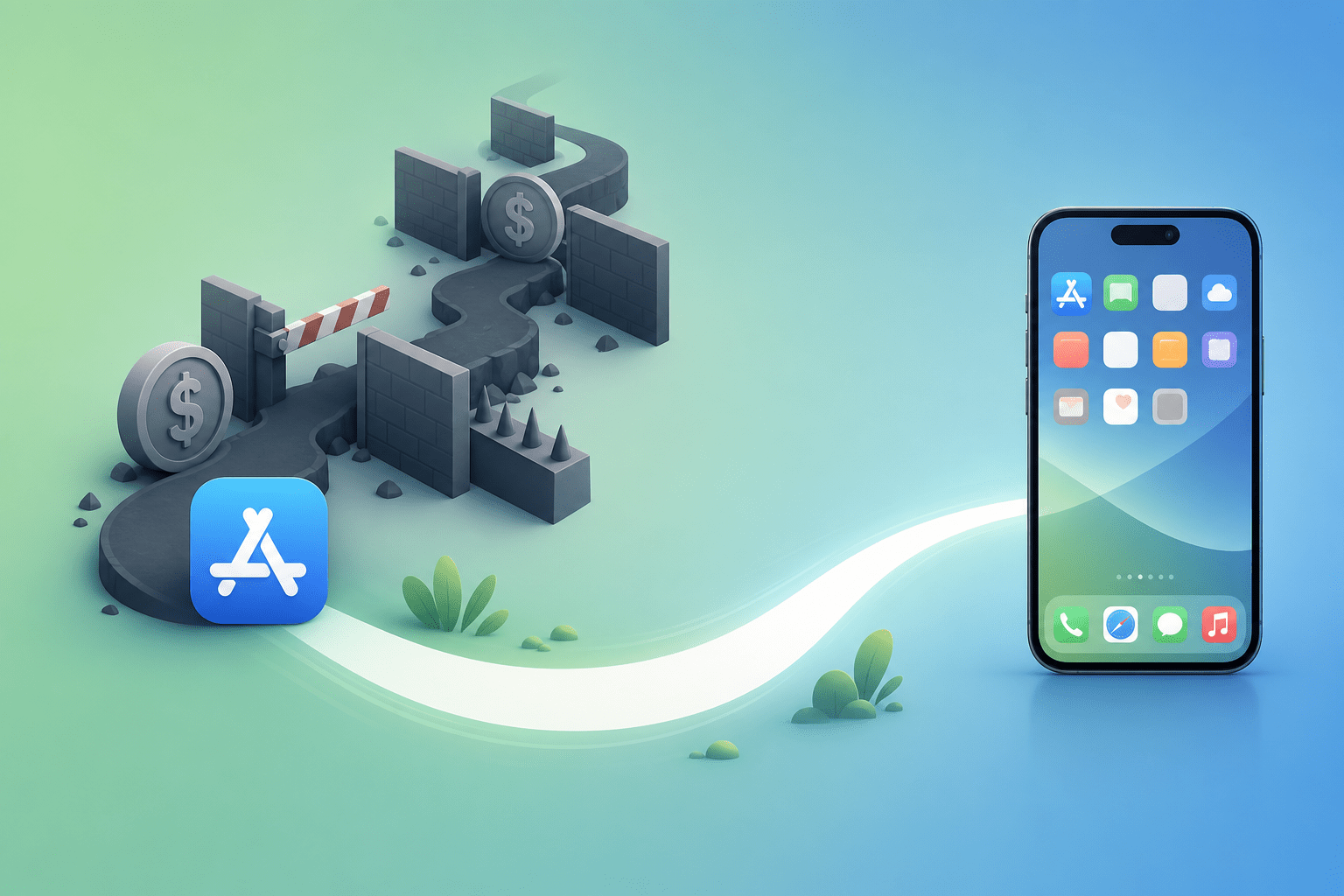
For teams running Android app install campaigns on Meta, the DST surcharge does not exist in isolation. It compounds with costs that are already rising across the board.
The CPI squeeze is real
The average cost per install (CPI) for Android apps via Meta Ads currently sits between $1.00 and $3.00 for most markets, with competitive verticals like gaming and finance pushing well past $5.00. Global median CPI on Meta surged by over 100% during 2025, reflecting intensifying competition for mobile users. Industry benchmarks from Business of Apps and Sensor Tower both confirm the upward trajectory — and that was before DST surcharges entered the picture.
Now layer on the DST surcharge. If your blended CPI across European markets is $2.50, a 3% surcharge means you are paying an extra $0.075 per install in France, Italy, or Spain. At 5% in Austria or Turkey, that is $0.125 more per install. These numbers seem small in isolation — but at scale, they are significant.
The math at scale
Consider a mid-sized cross-border team running 50,000 installs per month across European markets through Meta:
- Base CPI: $2.50
- Monthly ad spend: $125,000
- Average DST surcharge (blended across UK, France, Spain, Italy): ~2.8%
- Additional monthly cost from DST: $3,500
- Annual DST cost increase: $42,000
That $42,000 per year is pure cost with zero additional installs. It does not buy you better targeting, more impressions, or higher conversion rates. It is a tax pass-through — and it comes on top of Google Play’s 15% to 30% commission on any revenue those users generate after installing your app.
The double squeeze: DST plus Google Play commission
Here is where the pain really compounds. A typical cross-border Android app team faces two layers of cost extraction that are entirely outside their control:
- Acquisition side: Meta CPI + DST surcharge (2-5% added on top of ad spend)
- Monetization side: Google Play’s 15-30% revenue commission on every in-app purchase and subscription
Both costs are rising. Both are outside your control. And together, they eat directly into the unit economics that determine whether your app business is profitable or burning cash. The DST surcharge may look like a small percentage, but when it stacks on top of a 30% platform commission, the combined extraction rate from your funnel starts to feel unsustainable.
PWA Distribution Eliminates These Cost Pressures
Android Progressive Web Apps (PWAs) distributed outside Google Play do not eliminate the DST surcharge on Meta ads — that applies regardless of where your app lives. But PWAs fundamentally change the install funnel economics in ways that more than offset the DST hit.
Here is why teams switching to PWA distribution through ROiBest are seeing better unit economics even as DST costs rise:
No Google Play commission — keep 100% of revenue
When you distribute via PWA, there is no app store in the middle. No 15% small business commission. No 30% standard commission. Every dollar of in-app revenue stays with you. For an app generating $500,000 annually through Google Play, switching to PWA saves $75,000 to $150,000 per year in commission costs alone — dwarfing the $42,000 DST surcharge impact from the example above.
Put differently: the DST surcharge adds roughly 3% to your acquisition costs. Google Play takes 15-30% of your revenue. Eliminating the larger cost makes the smaller one a rounding error.
Higher install conversion rates reduce effective CPI
PWA install flows are faster and simpler than Google Play downloads. Users tap a link, the PWA loads instantly in the browser, and they can add it to their home screen in two taps. There is no app store redirect, no Play Store loading screen, no download progress bar, and no storage permission prompts that cause users to bounce.
Teams using ROiBest PWA distribution consistently see up to 1.2x higher install conversion rates compared to native Google Play downloads. When your conversion rate goes up, your effective CPI goes down — even if the top-of-funnel ad cost (including DST) stays the same. This is the lever that matters most for teams trying to maintain growth targets in a rising-cost environment.
No review process means faster iteration and zero downtime
Google Play app review can take days. Rejections can take weeks to resolve. Policy changes can result in sudden takedowns with no warning. Every day your app is stuck in review is a day your Meta ad spend is either paused (wasting momentum) or driving traffic to a broken funnel (wasting money).
PWAs go live instantly. Update whenever you want. No review queue, no compliance ambiguity, no sudden policy-change takedowns. When DST surcharges make every dollar of ad spend more expensive, the last thing you need is funnel downtime caused by app store bureaucracy.
For a deeper look at how platform independence protects your business, read about why PWA independence matters for Meta advertisers.
First-party tracking survives where SDK attribution breaks
With third-party cookies disappearing and mobile attribution becoming increasingly unreliable, PWAs offer a significant advantage: first-party install tracking. You own the data. You can measure exactly which Meta ad drove which install, without relying on Meta’s Conversions API alone or third-party MMPs that lose signal in privacy-restricted environments.
Better attribution means better optimization, which means lower CPI over time. When DST adds 2-5% to every impression, you cannot afford to waste budget on installs you cannot attribute. Learn more about the first-party PWA install tracking advantage.
Real Data: PWA vs Google Play Install Costs With DST Impact
Let us compare two scenarios for a cross-border Android app team spending $125,000 per month on Meta install campaigns targeting European markets (UK, France, Spain, Italy blend).
Scenario A: Google Play distribution
- Monthly Meta ad spend: $125,000
- DST surcharge (~2.8% blended): +$3,500
- Total acquisition cost: $128,500
- Base CPI: $2.50
- Effective CPI (with DST): $2.57
- Installs delivered: ~50,000
- Monthly app revenue (from these users): $80,000
- Google Play commission (15%): -$12,000
- Net revenue after commission: $68,000
- Monthly margin (revenue minus acquisition): -$60,500
Scenario B: PWA distribution via ROiBest
- Monthly Meta ad spend: $125,000
- DST surcharge (~2.8% blended): +$3,500
- Total acquisition cost: $128,500
- Base CPI: $2.50
- Install conversion rate lift: 1.2x
- Effective CPI (with DST + conversion lift): $2.14
- Installs delivered: ~60,000
- Monthly app revenue (from these users): $96,000
- Google Play commission: $0
- Net revenue: $96,000
- Monthly margin (revenue minus acquisition): -$32,500
The difference
- 10,000 more installs per month from the same ad spend
- $28,000 better monthly margin ($12,000 saved on commission + $16,000 from additional install revenue)
- $336,000 annual savings — enough to fund an entire additional market expansion
The DST surcharge adds $3,500 per month in both scenarios. But in the PWA scenario, the savings from eliminating Google Play’s commission and improving install conversion rates far exceed the DST cost. The tax becomes a rounding error inside a more efficient funnel.
As the list of DST countries grows — and Meta has indicated it will — the gap between these two scenarios will only widen. Teams locked into Google Play distribution will feel every new surcharge directly. Teams on PWA distribution will absorb them without changing their growth trajectory.
For a comprehensive comparison of every factor, see our Android PWA vs Google Play complete guide.
Action Steps: How to Switch to PWA Distribution
Moving from Google Play to PWA distribution is a business decision, not a technical project. ROiBest handles the technical implementation. Here is what your team needs to do:
Step 1: Audit your current install funnel economics
Pull your Meta Ads data for the past 90 days. Calculate your blended CPI across all target markets. Identify what percentage of your installs come from the six DST-affected countries (Austria, France, Italy, Spain, Turkey, UK). Multiply your spend in those markets by the applicable surcharge rates. Now you know exactly how much DST will cost you starting July 1, and you have a baseline to measure improvements against.
Step 2: Calculate your Google Play commission exposure
Look at your total Google Play revenue for the past 12 months. Apply your commission rate (15% for the first $1M in annual revenue, 30% above that). This is the money you are leaving on the table every year. Compare it to the DST surcharge — for most teams, the Google Play commission is 3x to 10x larger than the DST impact. That comparison alone usually makes the business case for switching.
Step 3: Contact ROiBest for a PWA migration assessment
ROiBest evaluates your current app, your target markets, and your install funnel to build a PWA distribution plan. This includes setting up your PWA, configuring push notifications (which work even after the PWA is removed from the home screen), and establishing first-party install tracking that feeds back into your Meta campaign optimization. The assessment is free, and most teams get a migration plan within one business day.
Request your free PWA assessment here.
Step 4: Run a parallel test
You do not need to go all-in on day one. Run 20-30% of your Meta install budget through PWA landing pages while keeping the rest on Google Play. Compare CPI, install rates, day-1 retention, and downstream revenue metrics over 30 days. Most teams see the PWA advantage within the first two weeks — higher conversion rates and cleaner attribution data are immediately visible in your dashboards.
Step 5: Shift budget based on results
Once you have data confirming better unit economics with PWA, gradually shift more budget. Many ROiBest clients move to 80-100% PWA distribution within 60 days of their first test, because the numbers make the decision obvious. The combination of zero commission, higher install rates, and better tracking creates a compounding advantage that grows stronger as you scale.
Summary
Meta’s new Digital Services Tax surcharges — ranging from 2% to 5% across six European countries starting July 1, 2026 — will increase acquisition costs for every cross-border Android app team running Meta install campaigns. There is no way to avoid the tax itself, and the list of affected countries will likely grow.
But you can control the rest of your cost stack. By switching from Google Play to Android PWA distribution through ROiBest, you eliminate the 15-30% app store commission, gain up to 1.2x higher install conversion rates, and maintain first-party tracking that keeps your Meta campaigns optimized as attribution signals degrade across the industry.
The DST surcharge adds roughly $42,000 per year for a mid-sized team. PWA distribution saves $336,000 per year for that same team. The math is not close.
Do not let a 3% tax distract you from the 30% commission that has been eating your margins all along. The real savings are in fixing your distribution model — and the DST surcharge just made the case even more urgent.
Skip the app store. Go live instantly, keep 100% of your revenue.
ROiBest helps Android app teams launch PWAs — no review process, no 30% Google Play cut, and push notifications that work even after uninstall. Teams see up to 1.2x higher install conversion rates vs native app downloads.


发表评论