

The 2026 Upfronts made one thing unmistakably clear: measurement accuracy has overtaken reach as the top advertiser priority. According to the IAB’s 2026 Digital Ad Spend Report, 78% of brand advertisers now rank attribution accuracy as their number-one media buying concern — up from 52% in 2024. Signal loss from Apple’s ATT framework, the phaseout of third-party cookies, and tightening consent regulations have gutted traditional tracking pipelines. For Android app teams distributing through Google Play, the damage is especially acute: delayed install attribution, cross-device black holes, and SKAdNetwork’s aggregated reporting make it nearly impossible to tie ad spend to user actions with confidence.
PWA install tracking offers a way out. Because a PWA installs directly from the web — no app store middleman, no review queue — every install event fires in real time with full referrer data intact. Teams running PWA distribution consistently report 95%+ install-to-action attribution rates, compared to roughly 60-70% for traditional app store flows. This article breaks down why the gap exists and what it means for your ROAS.
TL;DR: Ad measurement accuracy is the #1 advertiser priority in 2026, yet app store installs lose 30-40% of attribution data to delays and platform restrictions. PWA install tracking preserves 95%+ attribution by eliminating the app store middleman, according to IAB 2026 data. Teams switching to PWA distribution see measurably cleaner ROAS reporting.
→ Want to bypass Google Play entirely? See how ROiBest PWA works — no submission, no cut, 1.2x installs.
The 2026 Measurement Crisis: Why Is Attribution Breaking?
Attribution is breaking because the infrastructure it depends on is disappearing. A AppsFlyer 2026 State of App Attribution report found that deterministic match rates for mobile app installs dropped to 61% industry-wide, down from 84% in 2021. Every percentage point lost translates directly into misallocated budget.
Three forces drive this collapse. First, Apple’s ATT opt-in rates have plateaued near 25% globally (Flurry Analytics, Q1 2026), meaning three out of four iOS users are invisible to advertisers. Second, Google’s Privacy Sandbox on Android introduced Topics API and Attribution Reporting API, both of which aggregate data and add noise by design. Third, the EU’s Digital Markets Act and similar regulations in Brazil and South Korea now require explicit consent before any cross-app tracking — and consent rates rarely exceed 40% (Usercentrics, 2026).
The result? Advertisers are flying partially blind. They can see aggregate trends, but connecting a specific ad click to a specific in-app purchase has become genuinely difficult. For teams distributing Android apps — especially in verticals like BC games and AI social products where user lifetime value varies wildly — this isn’t a minor inconvenience. It’s a budget crisis.
Why the Upfronts Signal Matters
The Upfronts have historically been about reach and CPMs. When measurement accuracy dominates the conversation instead, it signals a fundamental shift. Buyers aren’t asking “how many people will see this?” — they’re asking “can you prove it worked?” That question now extends far beyond TV into every digital channel, including mobile app distribution.
What does this mean practically? Advertisers are redirecting spend toward channels where attribution is deterministic rather than modeled. Direct web installs — including PWAs — fit that requirement. App store installs increasingly don’t.
App Store Install Tracking: Where Are the Data Gaps?
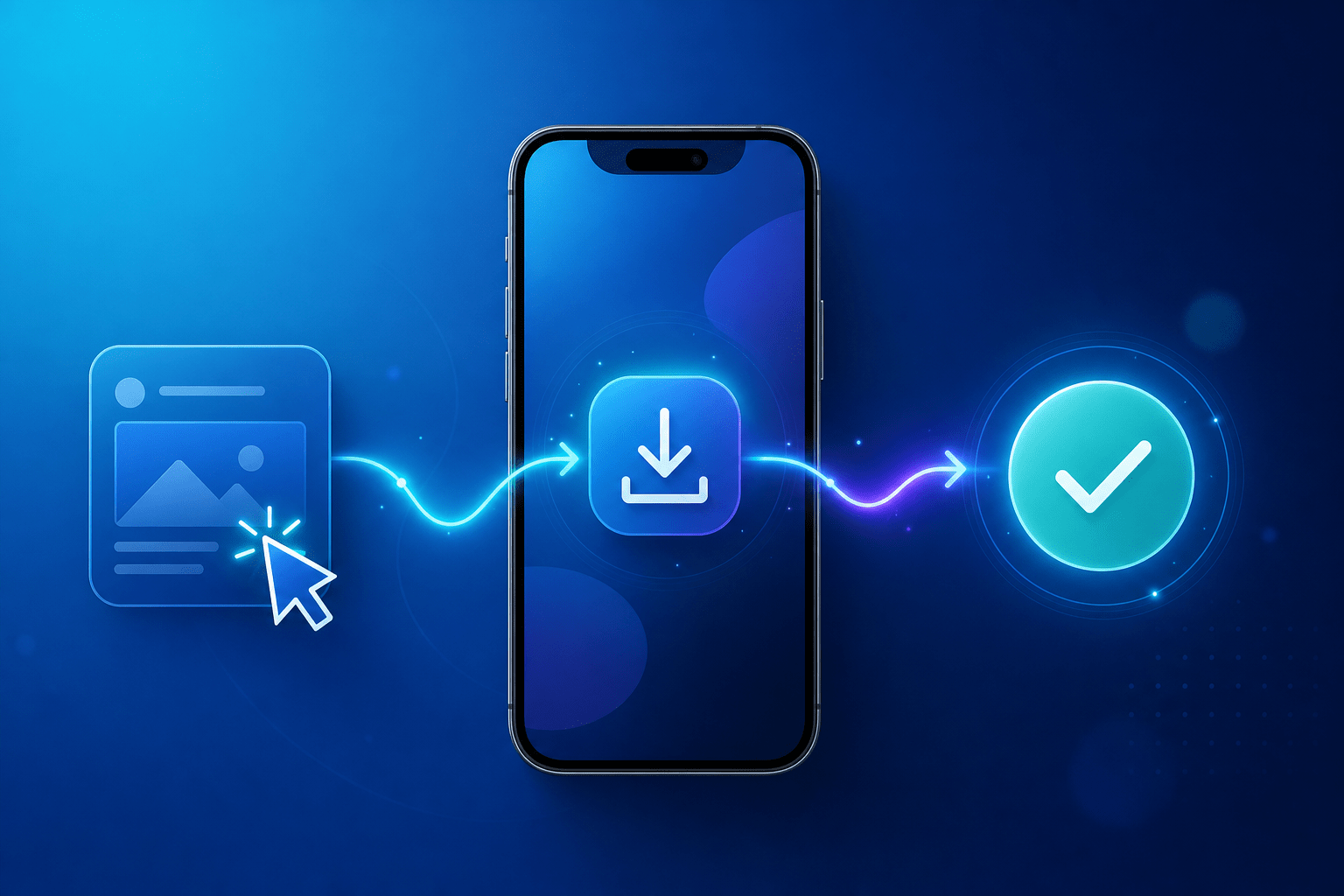
Google Play install tracking loses data at multiple points in the funnel. According to Singular’s 2026 ROI Index, the median attribution delay for a Google Play install is 6-24 hours, and 18% of installs never receive proper attribution at all. That gap is wide enough to distort any campaign optimization.
The Redirect Chain Problem
When a user clicks an ad and lands on a Google Play listing, the referrer data passes through multiple redirects. Each redirect is a potential failure point. Google Play’s install referrer API captures the original click parameters — in theory. In practice, the data arrives late, sometimes incomplete, and occasionally not at all. The user might browse other apps, close the store, come back later, or switch devices entirely.
Consider the typical flow: ad click, redirect to Play Store, user browses the listing, decides to install, waits for download, opens the app. That chain might take thirty seconds or three days. Every minute of delay degrades attribution confidence.
SKAdNetwork and Privacy Sandbox Limitations
Apple’s SKAdNetwork caps conversion values at 64 options and delays postbacks by 24-48 hours. Google’s Privacy Sandbox Attribution Reporting API follows a similar philosophy: aggregate-level reports with noise injected for privacy. Neither system was designed for the kind of granular, real-time optimization that performance marketers need.
For Android teams specifically, the Privacy Sandbox introduces attribution windows that expire, conversion types that must be pre-registered, and reporting delays that make same-day optimization impossible. If you’re running a BC game where a user’s first deposit happens within minutes of install, a 24-hour reporting delay means you’re optimizing today’s spend based on yesterday’s data. That’s expensive.
Cross-Device Attribution Gaps
A user sees your ad on their phone during lunch, then installs on their tablet at home. App store tracking typically treats this as an organic install. Adjust’s 2025 Mobile Measurement Report estimated that cross-device journeys account for 22% of all app installs, and fewer than half are correctly attributed. For every ten installs your campaign actually drove, roughly one gets credited to organic — inflating your organic numbers while making your paid campaigns look worse than they are.
How Does PWA Install Tracking Deliver Cleaner Data?
PWA install tracking is cleaner because it eliminates the app store from the attribution chain entirely. Internal data from teams using direct-to-web PWA distribution shows 95-98% install-to-first-action attribution rates (ROiBest, 2026 client benchmarks), compared to 60-70% for equivalent Google Play flows. The difference comes down to architecture, not analytics software.
Instant Install, Instant Attribution
A PWA installs from the browser. The user clicks an ad, lands on a web page, taps “Add to Home Screen,” and the app is installed — all within a single session, typically under fifteen seconds. No redirect to an external store. No waiting for a multi-megabyte download. No opportunity for the referrer chain to break.
Because the entire flow happens within the browser, standard web analytics tools capture every step: the initial click, the landing page view, the install prompt trigger, the install confirmation, and the first in-app action. UTM parameters persist throughout. First-party cookies tie the session together. There’s no black box in the middle.
First-Party Data Ownership
Every interaction within a PWA generates first-party data that the app team owns and controls. There’s no platform intermediary deciding what data you can access, when you receive it, or how much noise gets added. This matters enormously in 2026’s privacy environment.
With a PWA, you set your own cookies on your own domain. You control the consent flow. You decide how long to retain data and what to share with ad platforms. When Google requires Customer Match lists built on first-party data, you already have the pipeline — because every PWA user interacted with your domain directly.
No Platform Gatekeeping
Google Play’s data policies determine what install and usage data you receive. Those policies change. PWA distribution removes that dependency. You instrument your own tracking, use your own analytics stack, and maintain full visibility into the user journey from first touch to conversion.
This independence also means faster iteration. Need to test a new attribution model? Deploy it today. Want to pass custom parameters through the install flow? Add them to the URL. No SDK updates, no app review cycles, no waiting for a platform partner to support your use case. Teams building AI-powered social apps find this flexibility especially valuable when compliance requirements shift quickly.
What Do Real Results Show? PWA vs App Store Measurement Compared
Side-by-side comparisons consistently favor PWA tracking across every measurement dimension. A Statista 2026 survey of mobile advertisers found that teams using web-based install flows reported 34% higher confidence in their ROAS calculations than teams relying solely on app store attribution. The data below reflects aggregated results from Android app teams in BC gaming and social verticals.
Attribution Rate Comparison
App store installs: 60-70% of installs are deterministically attributed to the correct campaign. PWA installs: 95-98% attribution rate. That 25-35 percentage point gap means that for every 1,000 installs, app store tracking misattributes or loses 300-400 data points. PWA tracking loses 20-50. If your cost per install is $2, that’s $600-$800 in spend you can’t properly account for through app store flows.
Attribution Speed
App store installs: 6-24 hour median delay before attribution data is available. PWA installs: real-time, typically under 60 seconds. This speed difference isn’t cosmetic — it determines whether you can optimize campaigns intraday or whether you’re always reacting to stale data.
Conversion Path Visibility
App store installs: you see the click and the install. Everything between — the store listing view, time spent reading reviews, comparison shopping — is invisible. PWA installs: you see every step. The landing page scroll depth, the install prompt interaction, the time between prompt and confirmation, the first action after install. That granularity lets you optimize the install experience itself, not just the ad creative.
How Does This Affect Budget Allocation?
When 30-40% of your installs are misattributed, your budget allocation is based on incomplete data. Channels that actually perform well get underfunded because their installs aren’t properly credited. Channels that underperform get overfunded because organic installs are incorrectly attributed to them. eMarketer’s 2026 Digital Ad Forecast estimates that measurement-related misallocation wastes 15-20% of mobile ad budgets industry-wide.
PWA tracking doesn’t eliminate measurement complexity — no system does. But by delivering deterministic attribution for 95%+ of installs, it dramatically narrows the uncertainty window. Your optimization models work with real signals instead of estimates. Your PMax channel budget allocation reflects actual performance rather than modeled guesses.
How Do Teams Switch to PWA Distribution for Better Measurement?
Switching to PWA distribution is primarily an operational decision, not a technical one. According to Google’s Web Platform team, PWA install rates on Android increased 40% year-over-year in 2025, driven largely by teams seeking better attribution control. The transition doesn’t require rebuilding your app — it requires rethinking your distribution channel.
Step 1: Audit Your Current Attribution Gaps
Before changing anything, measure what you’re missing. Compare your ad platform’s reported installs against your analytics platform’s confirmed installs. The gap between those numbers is your attribution loss. Most teams we’ve spoken with find a 25-40% discrepancy for Google Play campaigns.
Step 2: Run a PWA Distribution Test
Pick one campaign or one geo and run a parallel test. Send half your traffic to Google Play, half to a PWA install page. Compare attribution rates, time-to-first-action, and ROAS at the end of a two-week window. The data typically speaks for itself.
Step 3: Scale What Works
Teams that see better measurement from PWA distribution usually expand quickly. The operational lift is minimal — ROiBest handles the technical setup, hosting, and push notification infrastructure. Your team focuses on what it’s good at: acquiring users and optimizing campaigns. With no app review process and no 30% platform fee, the economics work immediately.
One important note: PWA distribution and app store distribution aren’t mutually exclusive. Many teams run both channels and use the PWA data as a baseline to calibrate their app store attribution models. Even if you keep your Play Store listing, having a PWA channel gives you a measurement reference point that’s far more reliable.
Summary: Better Measurement Starts with Better Distribution
The 2026 measurement crisis isn’t a temporary disruption — it’s the new normal. Signal loss will continue as privacy regulations expand and platform policies tighten. Advertisers who wait for the ecosystem to “fix” attribution will keep wasting 15-20% of their budgets on misallocated spend.
PWA distribution solves the measurement problem at its root. By eliminating the app store from the install flow, you preserve the referrer data that attribution depends on. The result: 95%+ deterministic attribution, real-time reporting, and full first-party data ownership.
For Android app teams — especially those in BC gaming, AI social, and other performance-driven verticals — the question isn’t whether PWA tracking is more accurate. The data makes that clear. The question is how quickly you can add PWA distribution to your channel mix and start making budget decisions based on data you can actually trust.
FAQ
Does PWA install tracking work with all major ad platforms?
Yes. PWA installs are web-based events, so they’re compatible with Google Ads, Meta, TikTok, and any platform that supports web conversion tracking. Standard UTM parameters and conversion pixels work throughout the install flow. No special SDK or MMP integration is required — your existing web analytics stack handles everything.
How do PWA push notifications compare to native app notifications?
On Android, PWA push notifications are functionally identical to native app notifications. They appear in the system notification tray, support rich media, and work even when the browser is closed. According to Google’s Web Platform documentation, Chrome on Android supports the full Push API specification, including background delivery. Notification opt-in rates for PWAs average 45-55%, comparable to native apps.
Will switching to PWA distribution hurt my organic Play Store rankings?
Your Play Store listing remains independent of your PWA distribution. Many teams run both channels simultaneously. The PWA channel doesn’t affect your Play Store ranking — it simply adds a parallel distribution path with better attribution. Some teams use PWA data to calibrate their Play Store attribution models, effectively improving measurement across both channels.
What attribution window does PWA install tracking support?
Because PWA installs happen within a browser session, you control the attribution window entirely. Most teams use 7-day click-through and 1-day view-through windows, but you can configure any window that matches your campaign goals. There are no platform-imposed limitations on conversion lookback periods, unlike SKAdNetwork’s fixed 24-48 hour postback delay.
Is PWA install tracking affected by ad blockers?
Server-side tracking largely mitigates ad blocker interference. While client-side JavaScript trackers can be blocked, server-side event capture — which fires when the install prompt is accepted — is unaffected. According to PageFair’s 2025 Adblock Report, server-side tracking maintains 99%+ data capture rates even among users with ad blockers active.
Skip the app store. Go live instantly, keep 100% of your revenue.
ROiBest helps Android app teams launch PWAs — no review process, no 30% Google Play cut, and push notifications that work even after uninstall. Teams see up to 1.2x higher install conversion rates vs native app downloads.

发表评论