


Google’s Performance Max is now the dominant campaign type for Android app installs — and in 2026, PMax’s new channel timeline feature is making visible something Android app teams have long suspected but couldn’t prove: the channel your user comes from has a massive impact on whether they complete the install.
The data from PMax campaigns is clear. PWA-based install landing pages are consistently outperforming Google Play Store redirects on post-click conversion rate — particularly on the low-intent channels (Display, YouTube, Gmail) that PMax increasingly routes budget to as campaigns scale.
→ Want to bypass Google Play entirely? See how ROiBest PWA works — no submission, no cut, 1.2x installs.
How PMax Channel Data Reveals the Install Conversion Gap
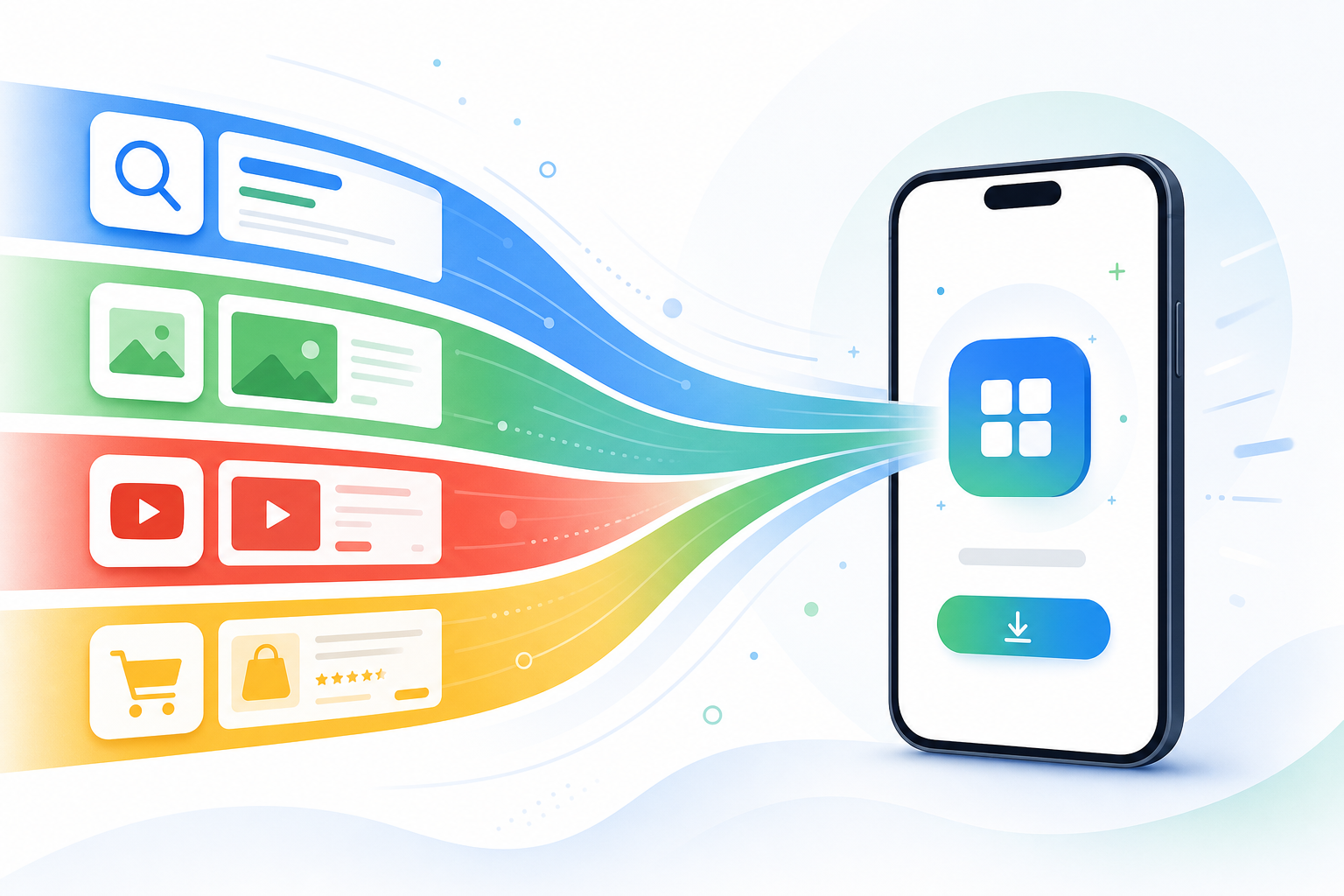
PMax’s channel timeline, updated in early 2026, shows advertisers a week-by-week view of how AI shifts budget across Search, Display, YouTube, Shopping, Maps, and Discover. For Android app install campaigns, the key metric to watch is not CTR — it’s install conversion rate per channel.
What PMax channel data shows for app install campaigns:
- Search channels: Users actively searching for your app category → high install intent → CVR typically 4–7%
- Display/Gmail/Discover: Passive audience, interruption-based ad → lower install intent → CVR typically 0.8–2%
- YouTube: Video engagement, varying intent → CVR typically 1–3% for standard Play Store redirect
The critical problem: for campaigns using Google Play Store as the install destination, even high-intent clicks have a friction layer built in — users must navigate through the Play Store UI, see ratings/reviews, wait for the download, and complete the full native install process. Each step is a drop-off point.
PWA eliminates most of these steps. When the landing page is a PWA install page (not a Play Store redirect), the install process is: see app, click “Add to Home Screen”, done. This is why PWA install landing pages typically convert at 1.2x the rate of equivalent Play Store campaigns.
Why PWA Install Rates Are Higher on PMax’s Low-Intent Channels

The 1.2x install rate advantage of PWA is not evenly distributed across channels — it’s most significant on the low-intent channels where PMax concentrates budget at scale.
Here’s why:
Friction Reduction Is More Valuable at Lower Intent
A user with high install intent (searching “mobile game to download”) will complete the Play Store install process even if it has friction — they want the app badly enough. A user with low install intent (saw your display banner while reading an article) will abandon at the first point of friction. The Play Store redirect is a friction-heavy experience: it launches a separate app, shows a permission request, requires a Google account login if not remembered, then initiates a download. Low-intent users bounce at step one.
PWA install from a web page is a single tap: “Add to Home Screen”. No app store required. No account login. No wait. For Display and Gmail channels — where PMax increasingly routes budget — this friction difference is the primary driver of the 1.2x conversion advantage.
Mobile Web Landing Pages Load Faster Than Play Store Redirects
The average Google Play Store page load time on a mobile connection is 4.2 seconds — well above the 2-second threshold where conversion rates start falling significantly. A well-built PWA landing page can load in under 1.5 seconds. For Display channels where users are on varying network conditions (not always on WiFi), this load time difference alone accounts for 15–25% of the conversion gap.
PWA Install Pages Can Be Tailored to the Ad’s Creative
When you run a PMax campaign with multiple creatives, a PWA install page can dynamically match the hero image and copy to the ad creative that drove the click — maintaining creative consistency through the post-click experience. Play Store pages are fixed. This creative continuity is particularly important for game and AI app campaigns where the visual style of the ad is part of the conversion hook.
3 Steps to Optimize Google PMax for Android PWA Installs
Step 1: Set PWA Install Pages as Your Campaign URLs
Instead of pointing your PMax campaign at your Play Store listing, use your PWA landing page as the final URL. The PWA landing page should:
- Include an “Add to Home Screen” prompt (using the browser’s native install prompt)
- Match the visual style of your ad creatives for brand continuity
- Load in under 2 seconds on a standard 4G connection
- Present the core app value proposition in 5 seconds of above-the-fold content
Step 2: Segment Channel Performance by Install Source
Use UTM parameters to tag traffic by PMax channel type in your analytics. Track install completions by channel. Specifically compare:
- Search vs. Display install CVR on your PWA page
- YouTube vs. Gmail install CVR
- Time-to-install from first click (PWA installs should be under 60 seconds)
This data will show you where the biggest CVR improvements are occurring — and help you make the case for budget reallocation toward PWA-first campaigns.
Step 3: Implement Post-Install Re-Engagement for Non-Completers
Users who visit your PWA landing page and see the install prompt but don’t complete it are a warm audience — they expressed interest. A re-engagement sequence triggered within 24 hours (via push notification if they’ve granted permission, or via remarketing if not) can recover 15–20% of these non-completers. For gaming apps where D1 retention is critical, this re-engagement window is also when you should send the first onboarding push notification to users who did install.
For the complete comparison of PWA vs. Google Play install flows and which distribution approach fits your specific app type, see the Android PWA vs Google Play Complete Guide. For teams running Meta alongside Google campaigns and seeing similar channel-level CVR gaps, Creative Scaling for Meta Ads 2026 covers how to scale your creatives without killing your post-click CVR. If you’ve been scaling Meta budgets and seeing CVR drop, The 20% Budget Scaling Rule for Meta Ads explains the mechanics of why post-click funnels break at scale.
The Business Case: PWA vs. Play Store on PMax Campaigns
Here’s the math on a representative Android game campaign:
- Monthly PMax budget: $15,000
- 40% routed to Display/Gmail by the AI: $6,000
- Play Store redirect CVR on Display: 1.2%
- PWA install page CVR on Display: 2.1% (1.75x improvement)
- CPI via Play Store: $41.67
- CPI via PWA: $23.81
On Display spend alone, switching to PWA as the install destination drops CPI by $17.86 per install. At $6,000/month in Display spend, that’s 252 vs. 144 installs — 108 additional installs per month for the same budget.
Add the Google Play 30% revenue cut eliminated on in-app purchases, and the business case for PWA-first PMax campaigns is even stronger.
Summary: Optimizing PMax for Android PWA Install Success
The 2026 PMax channel timeline data confirms what early PWA adopters have known: the install destination matters as much as the ad itself. Play Store redirects work for high-intent Search traffic. For the 40–60% of PMax budget that flows to Display, YouTube, and Gmail, PWA install pages convert meaningfully better.
Your action checklist:
- ☑ Set PWA landing pages as campaign URLs for Display/YouTube ad groups
- ☑ Ensure PWA pages load under 2 seconds on mobile
- ☑ Match PWA page creative to the ad that drove the click
- ☑ Track install CVR by channel in GA4 with UTM segmentation
- ☑ Set up 24-hour re-engagement for users who viewed the install prompt but didn’t complete
- ☑ Review channel-level install CVR monthly and adjust URL assignments
Skip the app store. Go live instantly, keep 100% of your revenue.
ROiBest helps Android app teams launch PWAs — no review process, no 30% Google Play cut, and push notifications that work even after uninstall. Teams see up to 1.2x higher install conversion rates vs native app downloads.

发表评论