

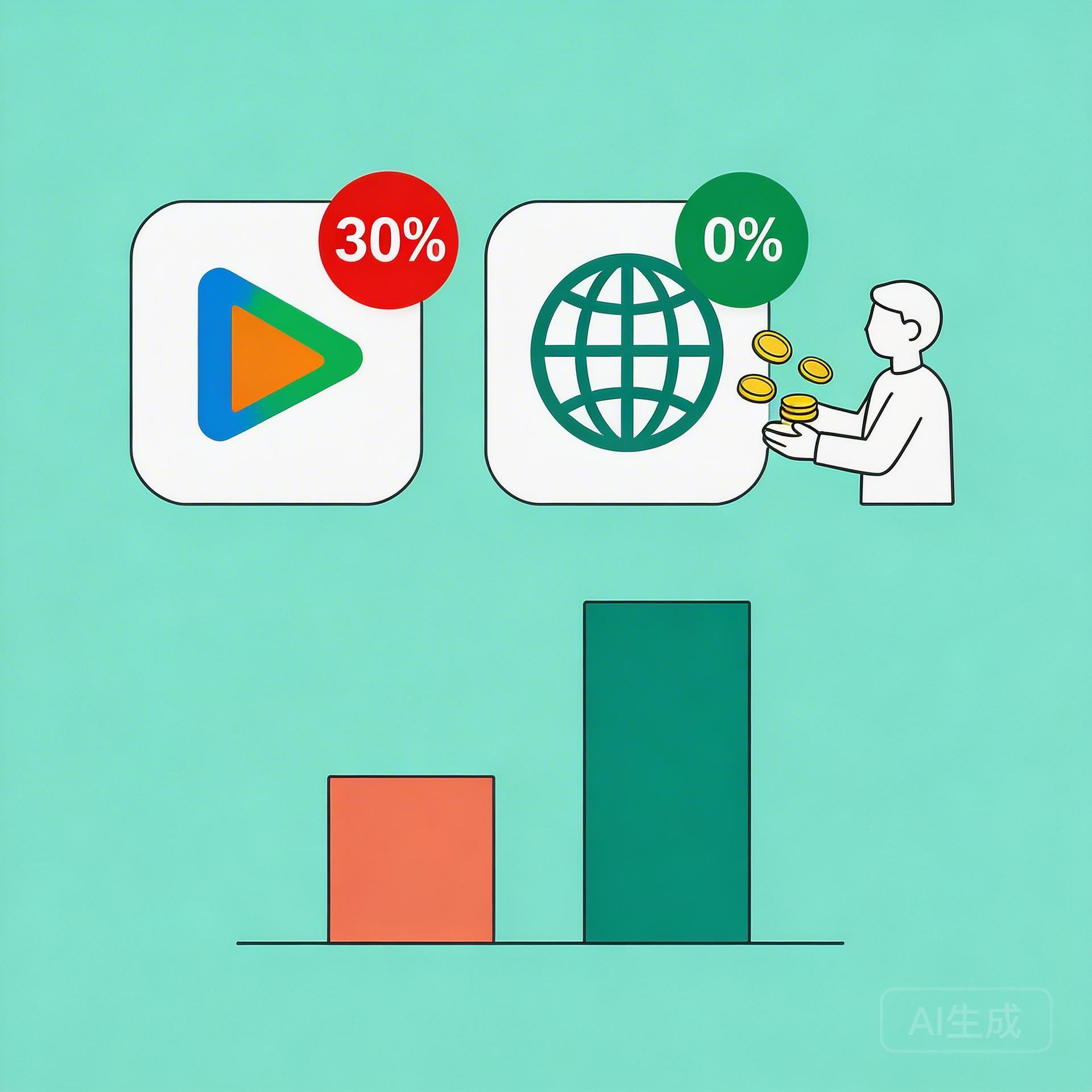
Mobile app monetization has a hidden leak that most teams don’t fully calculate: the 30% Google Play commission on every in-app purchase. For a gaming app generating $100,000 per month in IAP revenue, that’s $30,000 per month — $360,000 per year — going directly to Google before you’ve paid a single marketing dollar.
In 2026, more Android app teams are finding a viable path around this: distributing their app as an Android PWA (Progressive Web App) outside of Google Play, keeping 100% of their in-app revenue. This article explains where that $30,000 per month actually comes from, what the alternatives look like, and how the math works for different app categories.
→ Want to bypass Google Play entirely? See how ROiBest PWA works — no submission, no cut, 1.2x installs.
Breaking Down Android App Revenue Losses Under Google Play
Google’s commission structure looks deceptively simple: 15% for the first $1M in annual revenue per app, 30% for everything above. But the actual impact on your business model goes deeper than the headline rate.
The 30% Cut: What It Actually Costs Per Category
Let’s run the numbers for three common app categories:
Mobile gaming (IAP model):
- Monthly IAP revenue: $200,000
- Google Play commission (30%): $60,000/month
- Annual platform cost: $720,000
- Effective impact: You need to acquire $60,000 more in revenue each month just to break even with what you’d keep through a direct distribution channel
AI social app (subscription model):
- Monthly subscription revenue: $80,000
- Google Play commission (30%): $24,000/month
- Annual platform cost: $288,000
- Reality check: That’s the equivalent of approximately 4-8 months of mid-level growth engineer salaries lost to the platform every year
Casual game (mixed IAP + ads):
- Monthly IAP component: $50,000
- Google Play commission: $15,000/month
- Annual cost: $180,000
- Important note: Ad revenue is NOT subject to Google Play commission — only IAP transactions processed through Google’s billing system
The Review Friction Tax (Less Discussed, Still Real)
Beyond the direct commission, Google Play’s review process creates what you might call an “opportunity cost of speed.” Initial reviews average 3-7 days. Update reviews can take 1-3 days. Features requiring sensitive permission changes can trigger extended reviews of 1-4 weeks.
For gaming BC teams running seasonal promotions or needing to deploy hotfixes quickly, this delay has real revenue impact. A missed promotional window can cost more than months of commission savings.
Android App Revenue Without Google Play: What Are the Options?

There are several ways to distribute Android apps outside of Google Play, each with different tradeoffs:
Option 1: Direct APK Distribution (Sideloading)
How it works: Host your .APK file on a website and direct users to download and install manually. Users must enable “install from unknown sources” in their device settings.
Reality: Conversion rates are very low. The friction of enabling unknown sources, downloading a file, then manually installing creates a multi-step experience that most users abandon. Industry data suggests sideload conversion rates run at 15-25% of equivalent app store install conversion rates. This approach is generally not viable for performance-driven user acquisition.
Option 2: Alternative Android App Stores
Options include: Amazon Appstore (strong in some markets), Samsung Galaxy Store, Huawei AppGallery (strong in non-Google markets).
Reality: These stores have meaningful market coverage in specific geographies (Amazon in US, Samsung globally, Huawei in EU/Southeast Asia) but don’t approach Google Play’s total reach. Commission rates vary: Amazon charges 30% (same as Google), Samsung charges 30%, Huawei varies by region. You escape the Google dependency but not the platform commission.
Option 3: Android PWA Distribution (Recommended for Revenue Optimization)
How it works: Users visit your web URL, are prompted to “Add to Home Screen” via the browser’s native install prompt, and receive an app-like experience installed directly to their Android home screen. No app store involved.
Revenue impact:
- No Google Play commission on any revenue processed through your own payment system
- Use any payment processor (Stripe, Braintree, direct) — 0% platform cut
- Push notifications work even after uninstall (via Chrome/browser push API)
- No review delays for updates — change your web app and users get it immediately
Install conversion data: ROiBest data shows Android PWA install rates running at 1.2x compared to equivalent Google Play campaigns when traffic is properly directed to the install prompt. The “Add to Home Screen” flow, when presented contextually, converts at comparable rates to Play Store installs for audiences already familiar with the brand.
The Revenue Math: PWA vs Google Play
Let’s model the annual economics for a gaming BC app with $150,000/month in IAP revenue:
Google Play scenario:
- Gross IAP: $150,000/month
- Google commission (30%): -$45,000/month
- Net IAP to developer: $105,000/month
- Annual net: $1,260,000
Android PWA scenario:
- Gross IAP: $150,000/month (same revenue, different channel)
- Payment processor fee (e.g., Stripe: ~2.9% + $0.30): ~-$4,500/month
- PWA distribution platform cost: varies (typically $2,000-8,000/month for ROiBest-tier solutions)
- Net to developer: ~$137,500-141,500/month
- Annual net: ~$1,650,000-1,698,000
Annual advantage: $390,000-438,000 in retained revenue
Reality check: PWA distribution doesn’t automatically give you the same traffic as Google Play’s organic discovery. Your user acquisition costs may increase if you’re currently benefiting from Play Store organic. Factor in UA cost delta when modeling. For teams doing performance marketing (Google Ads, Meta Ads) to drive installs, the UA cost change is typically minimal — you’re already paying for traffic.
Curious whether PWA distribution makes economic sense for your app? Get Started Free with ROiBest to model the numbers for your specific case.
Which App Categories Benefit Most from PWA Distribution
PWA distribution isn’t the right answer for every app. Here’s a practical breakdown:
Strong fit (prioritize moving to PWA):
- BC games with high IAP ARPU: The commission savings are largest, and performance marketing already drives most installs
- AI companion/dating apps: High subscription revenue + Google Play review risk (many AI social apps face policy enforcement) = double incentive
- Apps in regulated categories (gambling adjacent, adult content): Google Play review risk is high, PWA removes that exposure
Moderate fit (evaluate carefully):
- Casual games where significant revenue comes from Play Store organic discovery (don’t abandon that channel without a plan to replace the traffic)
- Apps with complex hardware integration (camera, Bluetooth, sensors) — PWA has more limited access to device APIs vs native
Poor fit:
- Apps that rely heavily on Google Play’s recommendation algorithm for organic growth as the primary UA channel
- Apps with extensive use of Google Play-specific features (Play Integrity, Google Play Games)
Also: The Push Notification Advantage
One underappreciated PWA advantage for retention and revenue: push notifications that survive uninstall. Via Chrome’s Web Push API, Android PWAs can send push notifications even after a user removes the app icon from their home screen — as long as they haven’t blocked notifications.
For gaming apps, this means you maintain a re-engagement channel for users who would otherwise be completely lost after uninstall. Industry data suggests PWA push re-engagement campaigns run at 3-7% click-through rates — comparable to native app push notifications, at no additional platform cost.
Check out our guide on Android app push notifications after uninstall with PWA for implementation details and performance benchmarks.
Summary: Android App Revenue Without Google Play in 2026
- Google’s 30% commission is the single largest controllable cost for most IAP-driven Android apps
- Direct APK sideloading is not viable at scale due to install friction
- Alternative app stores don’t eliminate commission — just change which platform collects it
- Android PWA distribution eliminates the platform commission while delivering comparable install conversion rates (1.2x benchmark) for performance-driven traffic
- Best fit: gaming BC apps, AI social apps, high-subscription revenue apps, and apps facing Google Play policy risk
- Push notifications after uninstall are a significant retention advantage unique to PWA
Skip the app store. Go live instantly, keep 100% of your revenue.
ROiBest helps Android app teams launch PWAs — no review process, no 30% Google Play cut, and push notifications that work even after uninstall. Teams see up to 1.2x higher install conversion rates vs native app downloads.

发表评论